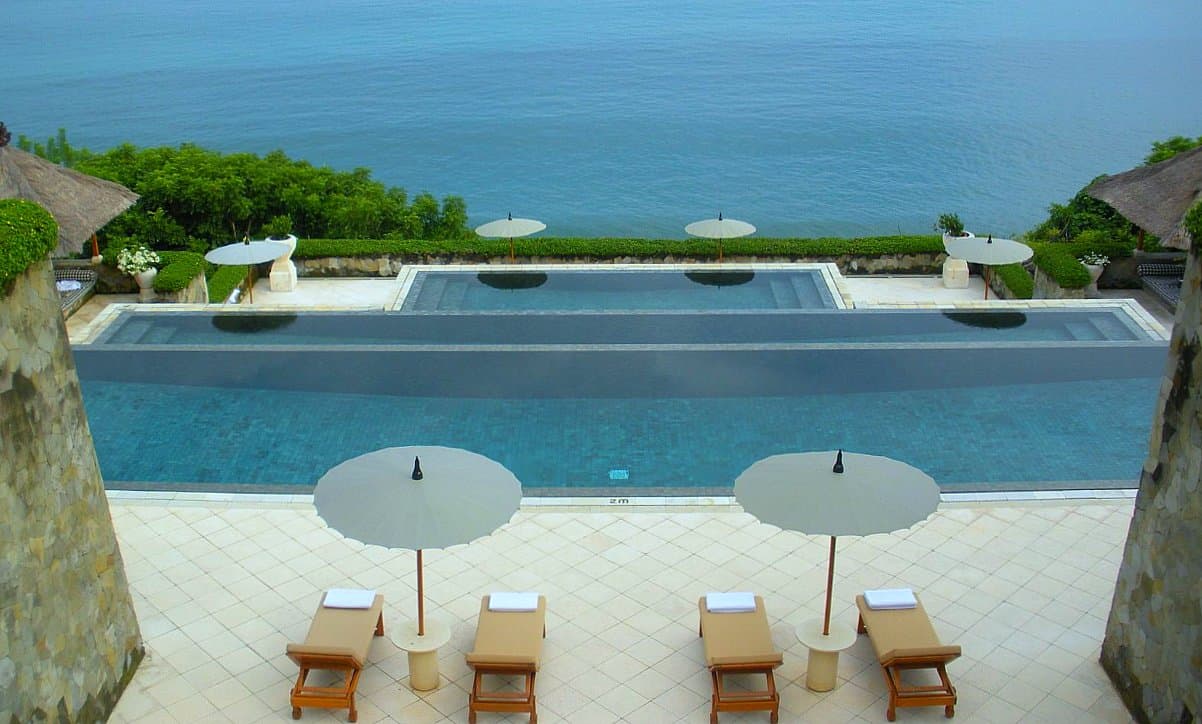
From the rotunda at the centre of Amanjiwo, a straight line runs down the steps, across the pool and over the rice fields to the stupa of Borobudur, three kilometres away. The resort was built on that axis. It opened in 1997 in the Menoreh hills outside Magelang, in central Java, as Aman's second hotel in Indonesia after Amandari and Amankila on Bali.
History
Borobudur, the largest Buddhist monument in the world, was built in the ninth century and lost under volcanic ash and jungle until British and Dutch excavations in the nineteenth century. UNESCO listed it in 1991 after a decade of restoration. Aman and Ed Tuttle chose a site on the slope of the hills to the south, facing the temple across the Kedu plain, and the name, Sanskrit for "peaceful soul", was given at the opening in 1997. The resort has since become the base for most visitors who want to climb Borobudur at dawn before the gates open to the public.
Architecture and design
Tuttle built in pale Javanese limestone and designed the resort as a series of concentric crescents. The rotunda at the top, a domed hall of bell-shaped profile that echoes the stupas of Borobudur, holds the bar and the dining room. Below it the suites are set in two curved tiers like the seats of an amphitheatre, so that every one faces the temple. Columns, pergolas and terraces are in the same stone, the floors are terrazzo and the furniture is made from Javanese teak and coconut wood. Batik and the glass paintings of the region decorate the rooms. The gardens are planted with frangipani, and beyond the walls the rice fields are farmed as they have always been.
Rooms and suites
There are 36 suites. Each is a freestanding stone house with a domed roof, a four-poster bed under a canopy, a sunken bathtub, a dressing area and a terrace with a bale, the Javanese pavilion for sitting outside. Fifteen suites have private pools. The Dalem Jiwo Suite, at the top of the resort, has two bedrooms, its own pool of fifteen metres and the clearest line to the temple.
Dining
The restaurant in the rotunda serves Javanese and Indonesian cooking with dishes drawn from the villages of the plain, as well as Western food, and the terrace outside has the view. Lunch is served at the pool club, and dinners can be set up in the rice fields or at the temple of Pawon, one of the small shrines on the pilgrim's road to Borobudur.
Wellness
The main pool, 40 metres long, lies at the bottom of the axis and faces the temple. The spa is built around a Javanese garden, with treatments based on jamu, the island's herbal tradition, and the resort runs yoga sessions and guided walks in the hills. A tennis court and a small gym complete the facilities.
Weddings and events
Amanjiwo hosts weddings on the terrace of the rotunda and in the rice fields below the resort, with Javanese gamelan and dancers from the villages. The hotel is taken in full for larger celebrations, given the 36 suites, and it does not publish room capacities. Company retreats use the rotunda and the private dining spaces.
Location
The resort stands at the foot of the Menoreh hills, with Borobudur three kilometres north and the volcanoes of Merapi, Merbabu, Sumbing and Sindoro on the horizon. Magelang, the district town, is about half an hour away. Yogyakarta international airport at Kulon Progo is about an hour and a half by road, and the old airport of Adisucipto, near the city, about an hour and a quarter. Yogyakarta itself, with the sultan's kraton and the Prambanan temples, makes a day trip. Among the luxury resorts of central Java, Amanjiwo is the one within walking distance of the temple, and the dawn excursion to Borobudur, by car and then on foot, takes guests up the monument before sunrise.
At a glance
What sets it apart
- 01Central rotunda aligned on Borobudur, three kilometres across the plain
- 0236 freestanding limestone suites in two amphitheatre tiers
- 03Fifteen suites with private pools; 40-metre main pool facing the temple
- 04Dawn access to Borobudur arranged before the public opening
- 05Designed by Ed Tuttle, opened 1997
Chronology
Dates that matter
1991
Borobudur is inscribed as a UNESCO World Heritage Site after a decade of restoration.
1997
Amanjiwo opens in the Menoreh hills facing the temple, designed by Ed Tuttle.