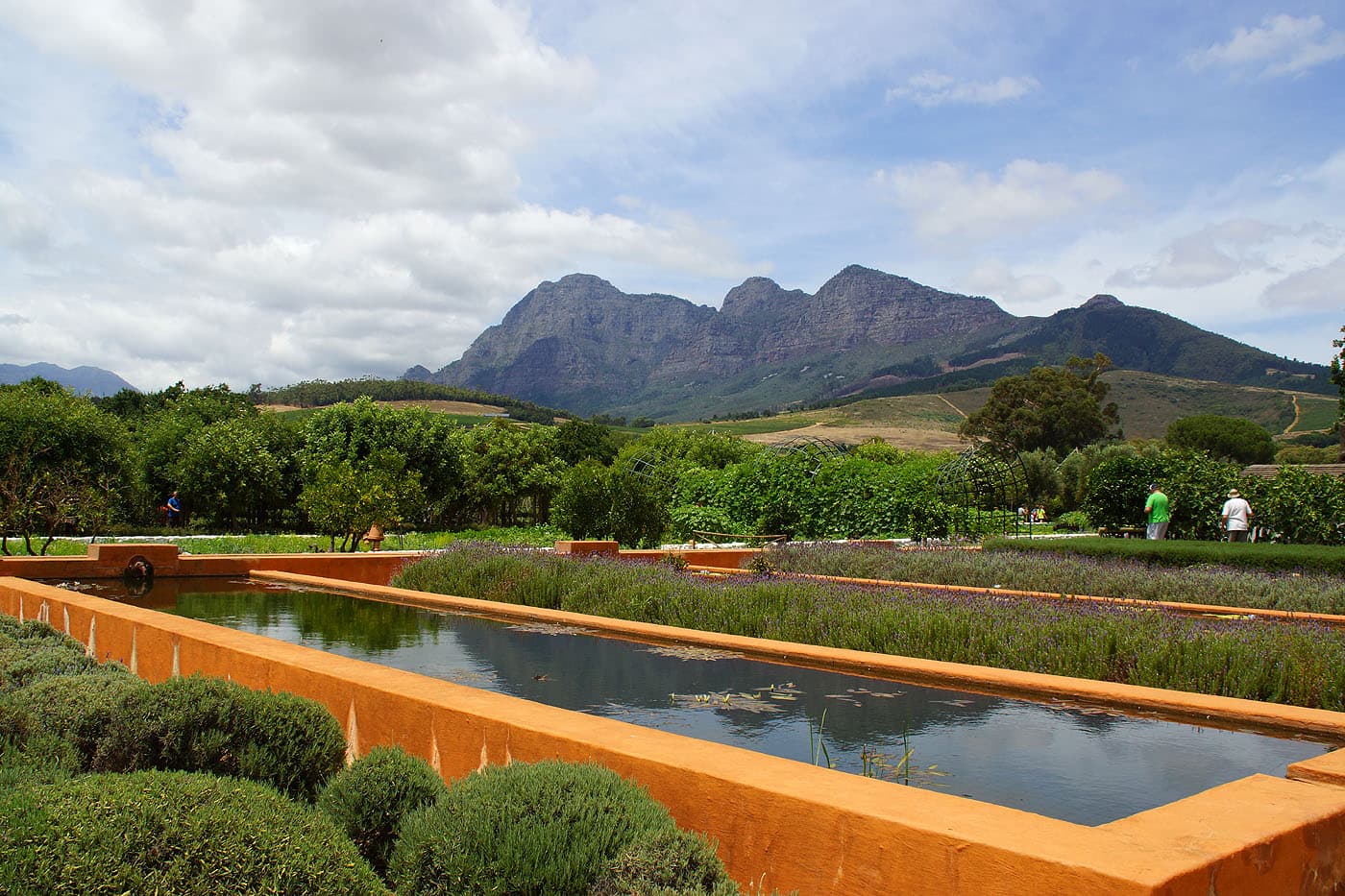
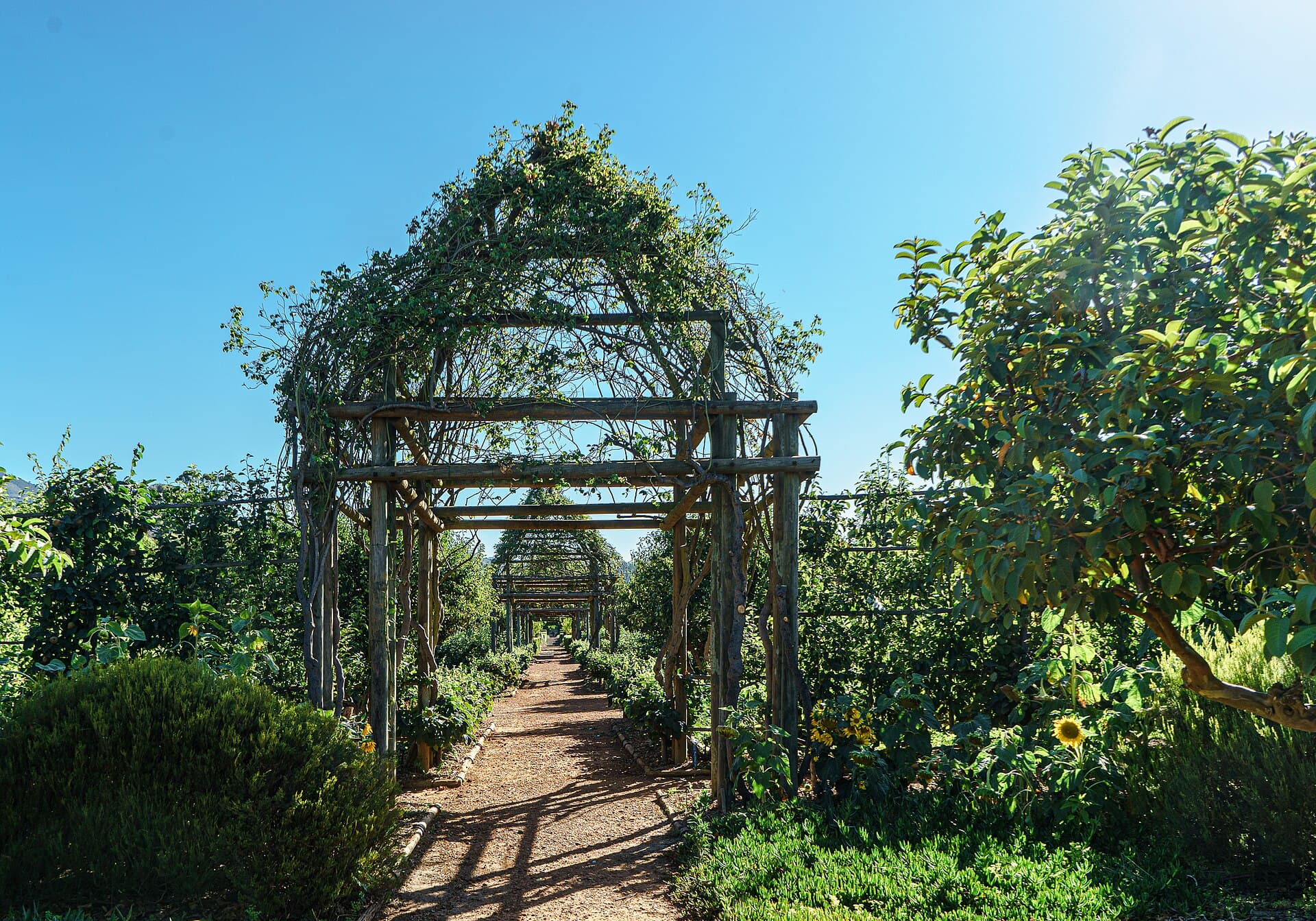
Quinces, guavas, pomegranates and prickly pears grow along the paths of the garden at Babylonstoren, a working farm in the Drakenstein valley near Franschhoek in the Cape Winelands, and the kitchens of the farm hotel cook from whatever is ripe that week. The garden is the heart of the place. The restaurants, the cottages, the cellar and the spa are all arranged around it.
History
The farm was granted in 1692, in the early decades of Dutch settlement at the Cape. It takes its name from a small hill on the property whose shape reminded early farmers of the Tower of Babel. Its Cape Dutch manor house, with a gable dated 1777, and the walls of the old farmyard, or werf, survive from the eighteenth century and still give the place its outline.
In 2007 the farm was bought by the media executive Koos Bekker and his wife, Karen Roos, a former editor of Elle Decoration South Africa. They restored the old buildings, planted the garden and opened the farm to guests in 2010. The couple later applied the same thinking to The Newt in Somerset, England, which opened in 2019.
Architecture and design
The restoration kept the whitewashed walls, gables and thatch of the old buildings and set plain modern work against them: glass, steel and concrete used sparingly, with very little ornament. The effect is closer to a farm than to a country house.
The garden, laid out by the French architect Patrice Taravella, covers about 3.5 hectares. It was inspired by the Company's Garden in Cape Town, which the Dutch East India Company planted in the seventeenth century to supply its ships, and it holds more than 300 varieties of plants, every one of them edible or medicinal. It is divided into sections for vegetables, fruit, berries, herbs, bulbs and medicinal plants, and guided garden walks run every day.
Rooms and suites
Guests stay in the former labourers' cottages along the farmyard, converted into white, spare rooms with stone floors, and in later suites set in the garden and orchards. Many have their own kitchen, designed so that guests can cook with produce picked on the farm.
Dining
Babel, the main restaurant, occupies the old cowshed, with a glass wall added on one side. Its menus are built around picking, and its salads are grouped by colour, red, green or yellow, according to what is in the beds that day. The Greenhouse, in the garden, serves lighter lunches and teas. A bakery, a farm shop, a charcuterie and a cheese room sell what the farm produces, and the cellar makes red, white and rosé wines under the Babylonstoren name, poured in the tasting room.
Wellness
The spa has a hammam, treatment rooms and a pool, and guests can walk, run or cycle on the farm's own tracks between the vineyards and orchards.
Location
Babylonstoren lies on the road to Simondium, between Paarl and Franschhoek, with the Simonsberg to the south and the Drakenstein mountains closing the valley to the east. Franschhoek, Stellenbosch and Paarl are all within easy reach for wine tasting, and the farm itself has vineyards, orchards and olive groves to explore on foot or by bicycle. Cape Town International Airport is under an hour away by car.
It is a luxury hotel in the Cape Winelands built around a working farm rather than a vineyard view, and the produce, more than the buildings, is the reason most guests come.
At a glance
What sets it apart
- 01Farm granted in 1692, with a Cape Dutch manor house
- 023.5-hectare garden laid out by Patrice Taravella
- 03Guest rooms in the former farm labourers' cottages
- 04Babel restaurant in the old cowshed
- 05Spa with hammam; own wine cellar
Chronology
Dates that matter
1692
The farm is granted in the early years of Dutch settlement at the Cape.
1777
The date carried on the gable of the Cape Dutch manor house.
2007
Koos Bekker and Karen Roos buy the farm and begin its restoration.
2010
Babylonstoren opens to guests, with its garden, cottages and Babel restaurant.