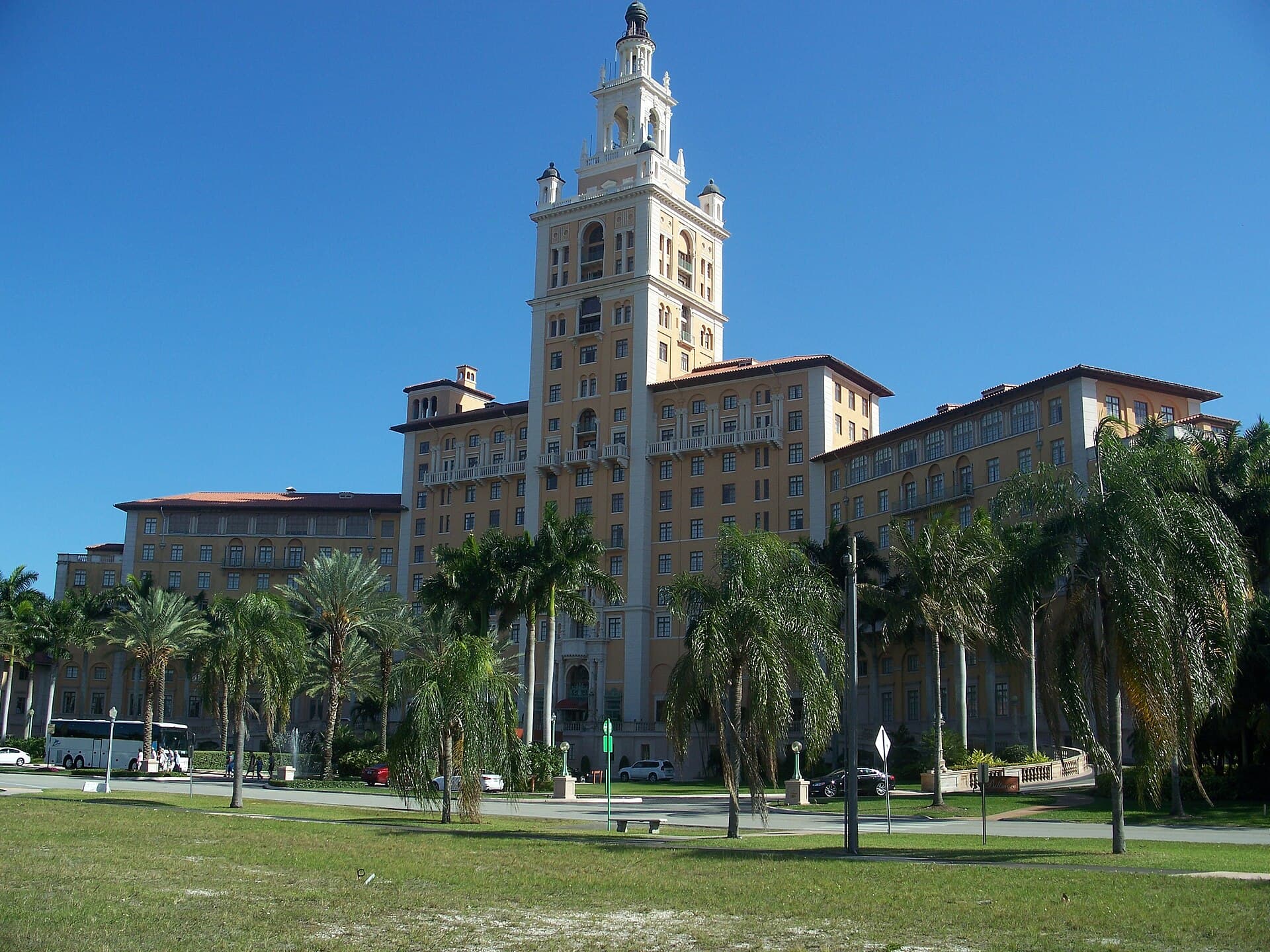
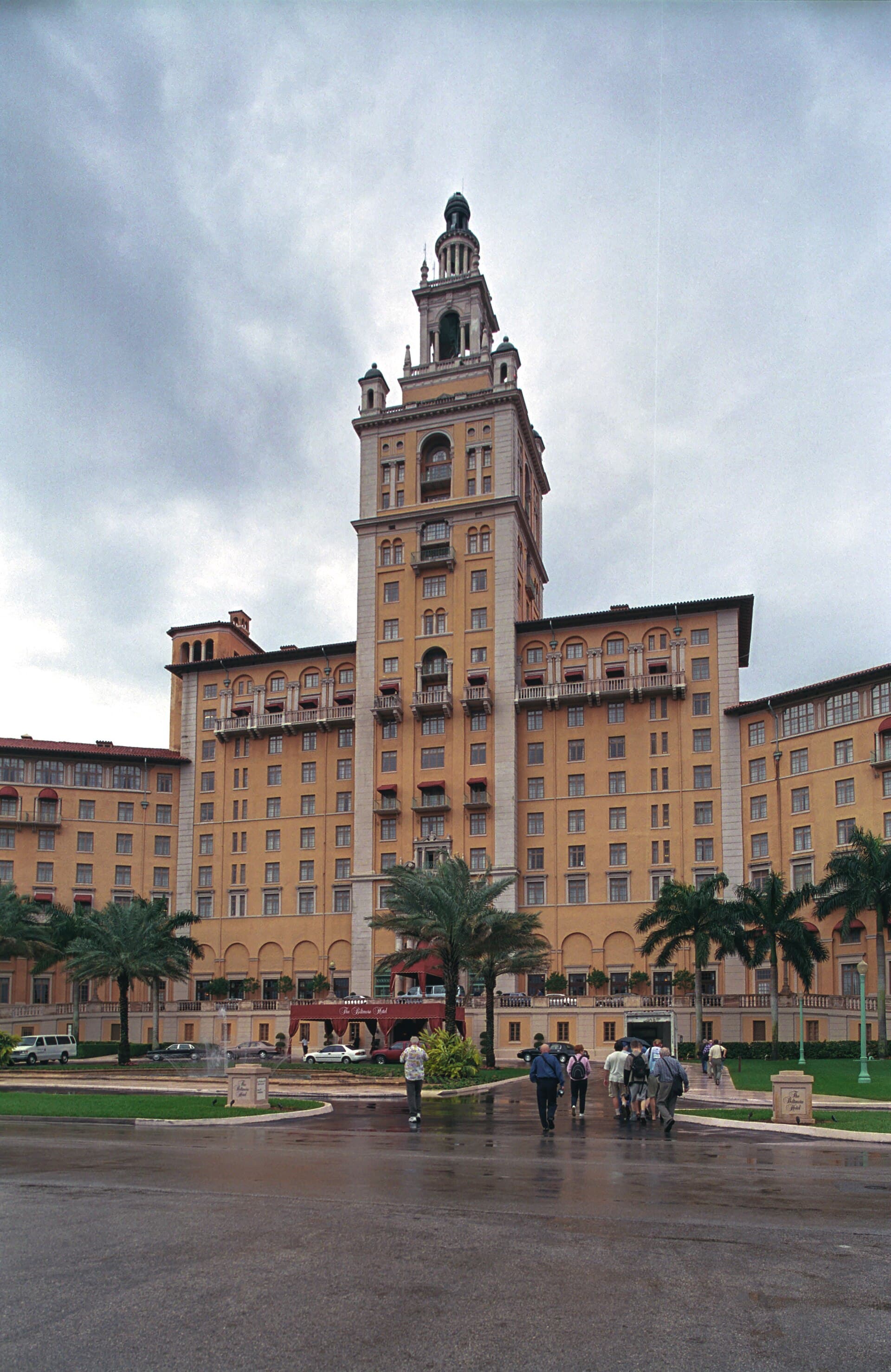
The tower that rises over Coral Gables, on the edge of Miami, is a copy of the Giralda in Seville, and the resort beneath it, The Biltmore Hotel, opened in 1926 with a swimming pool that was for decades the largest of any hotel in the continental United States. Designed by Schultze & Weaver for George Merrick, the founder of Coral Gables, it was a military hospital for a quarter of a century and stood empty for ten years before reopening as a hotel in 1987.
History
George Merrick planned Coral Gables in the early 1920s as a Mediterranean city built from scratch, and the hotel was to be its centrepiece. He partnered with John McEntee Bowman of the Bowman-Biltmore chain, and the hotel opened in January 1926 with a special train of guests from the north. Its early years were the Florida boom: fashion shows, aquatic galas in the pool where Johnny Weissmuller taught swimming, and gangsters among the guests. In 1929 the gambler Thomas 'Fatty' Walsh was shot dead on the thirteenth floor, in a suite later associated with Al Capone.
In 1942 the War Department took the hotel and turned it into the Army Air Forces Regional Hospital, sealing the windows and covering the floors with linoleum. It stayed a veterans' hospital until 1968 and housed part of the University of Miami's medical school afterwards, then stood empty from 1973. The City of Coral Gables took ownership, spent four years on restoration, and reopened it as a hotel in 1987. A second closure during the bankruptcy of 1990 ended with a new operator, Seaway Hotels, in 1992. The hotel hosted the Summit of the Americas in 1994 and was designated a National Historic Landmark in 1996.
Architecture and design
Schultze & Weaver, who had just built the Los Angeles Biltmore, worked in the Mediterranean Revival style that Merrick demanded for the whole city: stucco walls, barrel-tile roofs, loggias and courtyards. The tower is the landmark, a copy of the Giralda bell tower of Seville cathedral that the same firm had used for the Freedom Tower in downtown Miami. The lobby is a vaulted hall with travertine columns, hand-painted ceilings and a double loggia opening on to the courtyard. The pool behind the hotel holds about 700,000 gallons and is surrounded by colonnades and cabanas.
Rooms and suites
The hotel has around 270 rooms and suites in the main building, the tower and a later wing, with the suites on the upper floors of the tower, including the Everglades Suite on the thirteenth floor that guests still ask for as the Al Capone suite. It is the only luxury hotel in Coral Gables of this age and scale.
Dining
Palme d'Or, the French restaurant, is the hotel's formal dining room. Fontana serves Italian cooking in the central courtyard around a fountain, and the Cascade bar sits by the pool. Sunday brunch in the courtyard is a Miami tradition.
Wellness
The spa occupies its own wing with treatment rooms and a fitness centre, and the 18-hole golf course laid out by Donald Ross in 1925 wraps around the hotel, with tennis courts beside it.
Weddings and events
The Alhambra and Granada ballrooms, with their painted ceilings, are the principal wedding and gala rooms, and the courtyard, the pool terrace and the golf course lawns serve ceremonies and outdoor receptions. The hotel is a fixture of Miami's charity calendar and a frequent choice for weddings that want the tower in the photographs. Meeting rooms and the Country Club building handle conferences.
Location
The hotel stands at 1200 Anastasia Avenue in Coral Gables, in a residential district of Merrick's Mediterranean villas, a short walk from the Venetian Pool and ten minutes by car from Miracle Mile and the University of Miami. Downtown Miami and Brickell lie about 15 minutes to the north-east, and Miami International Airport about 10 kilometres to the north.
At a glance
What sets it apart
- 01Opened in January 1926, designed by Schultze & Weaver for George Merrick
- 02315-foot tower modelled on the Giralda of Seville
- 03Pool of about 700,000 gallons, where Johnny Weissmuller taught swimming
- 04Army Air Forces hospital from 1942, veterans' hospital until 1968
- 0518-hole golf course by Donald Ross; National Historic Landmark since 1996
Chronology
Dates that matter
1926
The Miami Biltmore opens in January.
1929
Thomas 'Fatty' Walsh is shot dead in a thirteenth-floor suite.
1942
The War Department converts the hotel into a military hospital.
1968
The Veterans Administration hospital closes.
1987
The Biltmore reopens as a hotel after a four-year restoration.
1992
Seaway Hotels reopens the hotel after the 1990 closure.
1994
The hotel hosts the Summit of the Americas.
1996
The Biltmore is designated a National Historic Landmark.