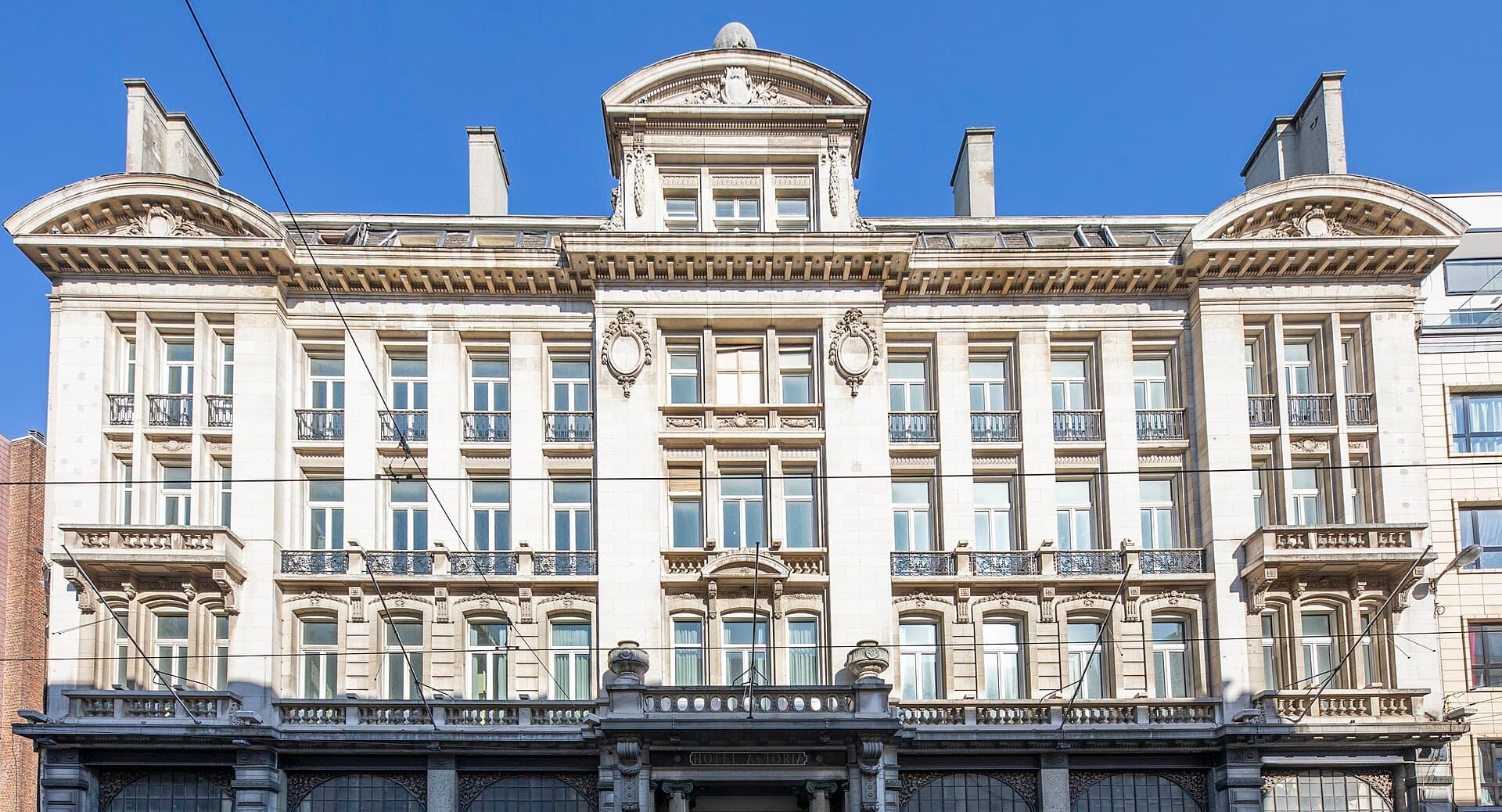

On Rue Royale, between the royal quarter and the Botanical Garden of Brussels, the Beaux-Arts palace hotel that was the Hotel Astoria has come back as Corinthia Grand Hotel Astoria. Closed in 2007 and reopened in 2024 after one of the longest hotel restorations in Europe, it has returned the city's grandest historic hotel to service.
History
The Hotel Astoria opened in 1910, the year of the Brussels World Exhibition, when the city built hotels to receive the visitors drawn to the fair. The architect was Henri Van Dievoet, whose design took the Beaux-Arts language of Paris and set it on the hill of Rue Royale, close to the royal palace and parliament. Through the twentieth century the Astoria was the address for official visitors to Brussels, and its Pullman Bar, fitted out as a railway dining carriage, became one of the city's best-known rooms.
The hotel closed in 2007 for a renovation that stalled, and the building stood empty for years. Corinthia Hotels, the Maltese group, acquired the project and carried out a full restoration and enlargement, keeping the listed historic core and adding new wings behind it. The hotel reopened in 2024 as Corinthia Grand Hotel Astoria, the group's first property in Belgium.
Architecture and design
Van Dievoet's facade is a composition of stone, balconies and a mansard roof in the Belgian Beaux-Arts manner. The protected interiors include the Palm Court under its glazed roof, the grand staircase and the Pullman Bar, which was dismantled, restored and reinstalled. The new construction behind the historic building houses the larger rooms, the spa and the event floor, so that the original salons could be kept as they were. The works took far longer than planned, and the scaffolding on Rue Royale became a fixture of the street for more than a decade before the hotel reopened.
Rooms and suites
The hotel has seven signature suites alongside its rooms, several of them in the historic building with ceilings and windows of 1910 proportions. Rooms in the new wings are larger and quieter, facing inner courtyards rather than the street.
Dining
The hotel runs two restaurants and the Pullman Bar. The Palm Court serves breakfast, afternoon tea and lighter meals under the glass roof, and a fine-dining restaurant occupies one of the historic salons.
Wellness
A spa on the lower floors offers treatment rooms, thermal facilities and a fitness centre, built new as part of the restoration.
Weddings and events
The hotel has meeting and reception rooms on a dedicated floor, and the Palm Court and historic salons lend themselves to receptions, dinners and weddings in the centre of Brussels. Its position near the European quarter and the Belgian institutions makes it a natural venue for diplomatic and corporate events.
Location
The hotel stands at Rue Royale 103, on the ridge that runs from the royal palace to the Botanical Garden, with the Parc de Bruxelles and the Grand-Place a few minutes away on foot. The Botanical Garden, now a cultural centre, lies at the foot of the street, and the Botanique and Rogier metro stations are close by. Walking to Brussels Central Station takes about 15 minutes; Brussels Airport at Zaventem is roughly 20 minutes off by car, or by train from Brussels Nord. Among luxury hotels in Brussels, it is the one with the longest pedigree and the newest interior.
At a glance
What sets it apart
- 01Opened in 1910 as the Hotel Astoria for the Brussels World Exhibition
- 02Beaux-Arts design by Henri Van Dievoet, interiors protected
- 03Pullman Bar fitted out as a railway dining carriage, restored and reinstalled
- 04Closed in 2007, reopened in 2024 under Corinthia Hotels
- 05Palm Court under a glazed roof
Chronology
Dates that matter
1910
The Hotel Astoria opens on Rue Royale during the Brussels World Exhibition.
1935
Brussels hosts a second World Exhibition; the Astoria is among the city's leading hotels.
2007
The hotel closes for a renovation that stalls.
2024
The hotel reopens as Corinthia Grand Hotel Astoria.