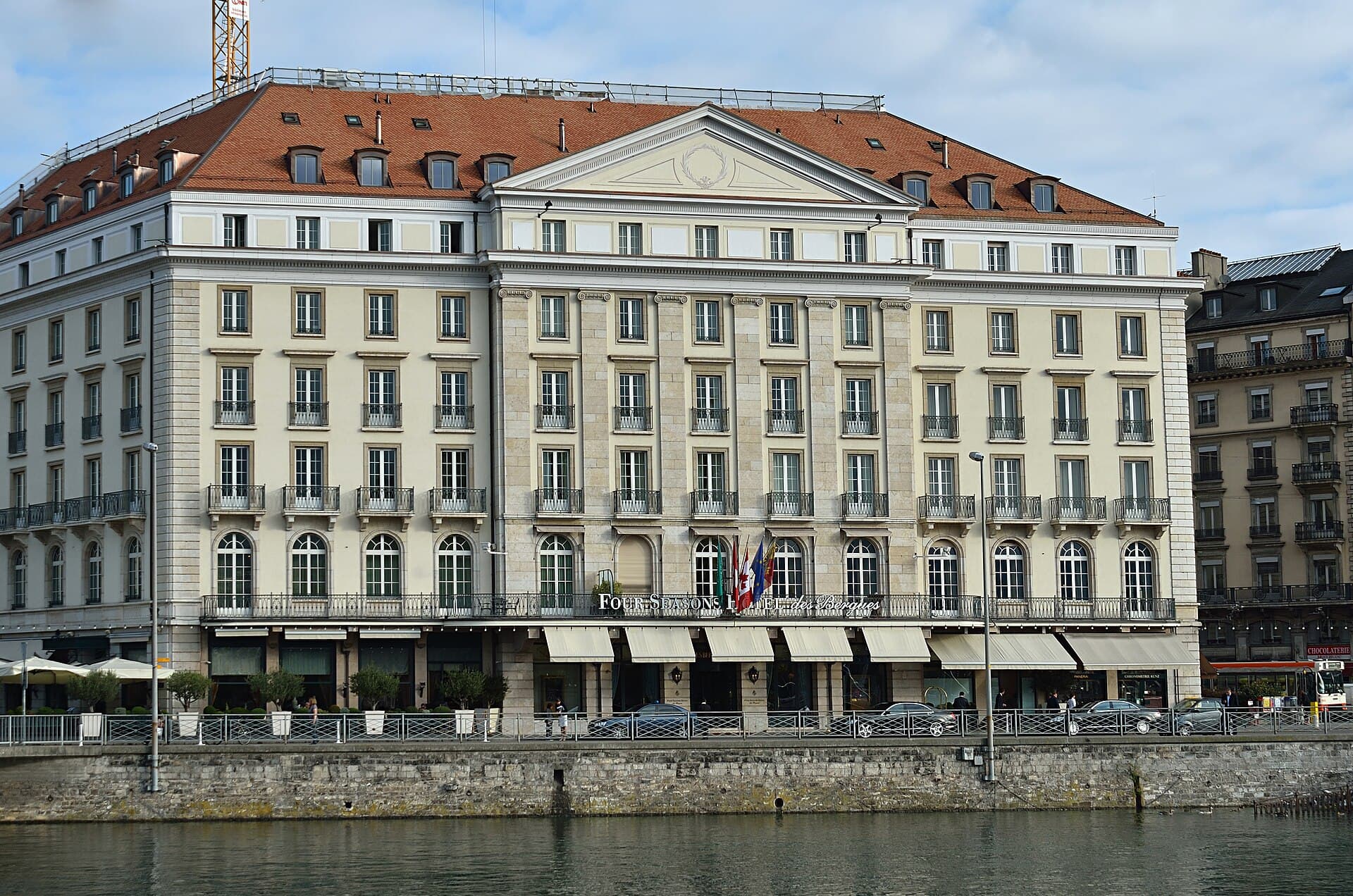
Just below the point where the Rhône leaves Lake Geneva, beside the Pont des Bergues, a neoclassical façade has faced the water since 1834. The Four Seasons Hotel des Bergues Geneva was the city's first purpose-built grand hotel, and from its upper floors the Jet d'Eau rises across the harbour.
History
The hotel was the idea of Guillaume Fatio, a Genevan businessman who wanted lodgings to match the city's growing traffic of foreign visitors. The 1830s were a decade of rebuilding on the right bank: the Pont des Bergues opened in 1834, linking the quay to the little Île Rousseau, where James Pradier's bronze of the philosopher was unveiled the following year. Fatio's hotel was planned as part of the same new quarter of quays and terraces facing the lake. It counts among the oldest Swiss hotels still operating in their original building.
For most of the nineteenth and twentieth centuries the Bergues served the diplomats, bankers and royal travellers drawn to Geneva, and the city's role as an international meeting place after the First World War brought a steady flow of delegations. In 2005 the hotel came under Four Seasons management and reopened after a full renovation by the French designer Pierre-Yves Rochon.
Architecture and design
The building is a long, plain-fronted block of the 1830s, its classical discipline typical of Calvin's city, long wary of display. Inside, the 2005 renovation kept the historic salons and their plasterwork and furnished the bedrooms in a restrained French classical manner. The result feels closer to a grand private house than to a palace hotel.
Rooms and suites
Rooms face either the river and lake or the quieter streets behind. The suites on the upper floors have the widest views, taking in the harbour, the Jet d'Eau and, on clear days, the Mont Blanc massif far to the south-east. Bedrooms on the river side look across the Rhône to the Île Rousseau and the old town climbing towards the Cathédrale Saint-Pierre.
Dining
Il Lago, on the ground floor, serves Italian cooking in a room of painted panels facing the quay. On the roof, Izumi pairs Japanese technique with Peruvian flavours, the style known as Nikkei, on a terrace with one of the widest outlooks in the city. Drinks and afternoon tea are served in the Bar des Bergues off the lobby.
Wellness
The spa is set high in the building and includes an indoor pool with views over the city, a rarity in central Geneva, along with treatment rooms and a gym.
Weddings and events
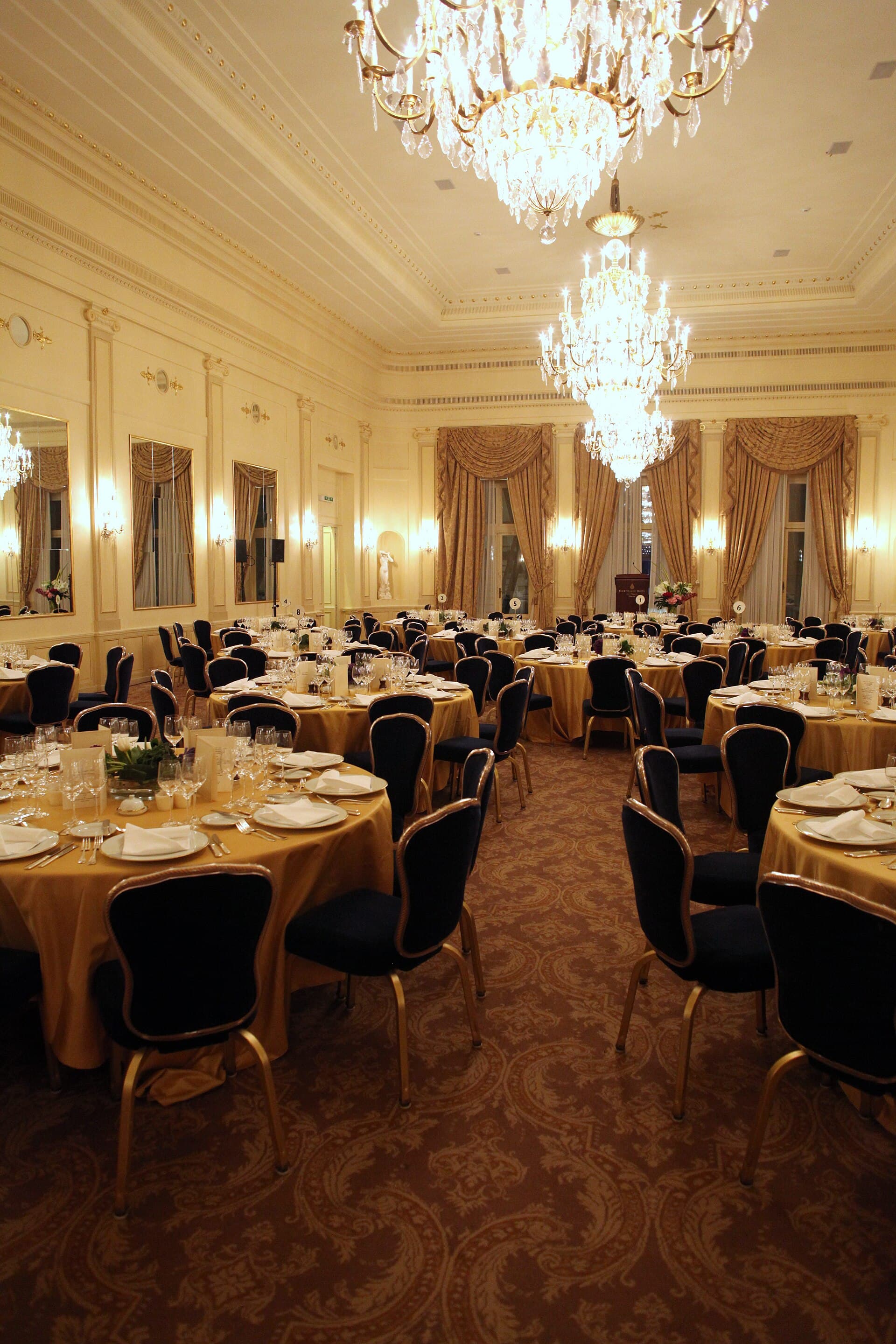
The hotel's historic salons are used for banquets, receptions and board meetings, and several face the river. Weddings are held throughout the year, and the house is a regular venue for the private banks, trading houses and international organisations that give Geneva much of its business traffic.
Location
The Quai des Bergues sits on the right bank, a few steps from the Pont du Mont-Blanc and the boat landings of the Compagnie Générale de Navigation, whose paddle steamers cross the lake. The Rue du Rhône and its jewellers and watchmakers lie just over the bridge, and the cobbled old town rises behind them. Cornavin, the main railway station, is about ten minutes away on foot, and Geneva Airport is roughly fifteen minutes by car, or a few minutes by train to Cornavin. Behind the hotel, the streets of the Pâquis run north towards the Bains des Pâquis, the public lake baths where Genevans swim in summer and eat fondue in winter. Few addresses put a luxury hotel in Geneva so squarely at the centre of things.
At a glance
What sets it apart
- 01Opened in 1834, the oldest grand hotel in Geneva
- 02On the Quai des Bergues beside the Rhône, facing the Jet d'Eau
- 03Managed by Four Seasons since 2005
- 04Rooftop restaurant Izumi serving Nikkei cuisine
- 05Spa with an indoor pool high in the building
Chronology
Dates that matter
1834
Guillaume Fatio's Hotel des Bergues opens beside the new Pont des Bergues.
1835
James Pradier's statue of Rousseau is unveiled on the Île Rousseau, beside the hotel.
1891
The Jet d'Eau is first installed in the harbour opposite the hotel.
2005
Four Seasons takes over management after a renovation by Pierre-Yves Rochon.