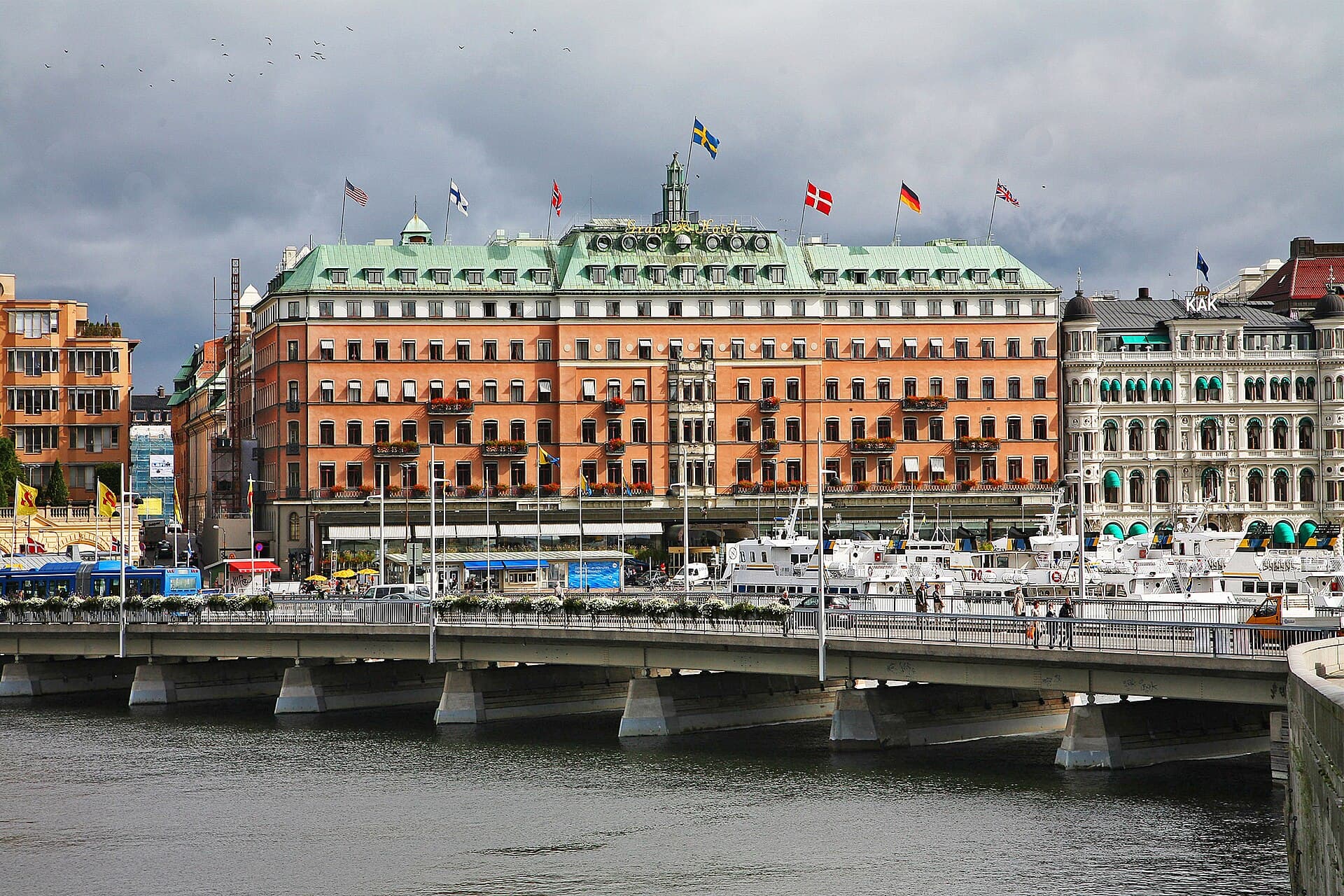

From the quay at Södra Blasieholmshamnen 8, on the Blasieholmen waterfront in Stockholm, Grand Hôtel looks across the water to the Royal Palace and the old town of Gamla Stan. The French restaurateur Régis Cadier opened this luxury hotel in 1874; it hosted the Nobel Banquet in its Hall of Mirrors from 1901 to 1929 and still lodges the Nobel laureates each December. Its rooms, five restaurants and bars, a spa and a set of historic banqueting rooms make it the grand hotel against which the others in Scandinavia are measured.
History
Jean-François Régis Cadier, a Frenchman who had made his name as a restaurateur in Stockholm, opened the hotel in June 1874 in a building designed by the architect Axel Kumlien. It brought to Sweden the standards of the Paris grand hotels, and within a generation it was the address for visiting royalty, diplomats and performers. In 1899 the Hall of Mirrors, modelled on the Galerie des Glaces at Versailles, was inaugurated as the hotel's banqueting room.
From 1901, the first year of the prizes, the Nobel Banquet was held at the Grand Hôtel, and it stayed there until 1929; from 1930 it moved to the newly built City Hall. The laureates have continued to stay at the hotel, and Nobel week in December is still the point of the year when the house is most in the public eye.
The hotel has belonged to the Wallenberg family's investment companies since 1968 and was extended over the twentieth century into the neighbouring Bolinder Palace, built in the 1870s for the industrialist Jean Bolinder, which now houses suites and function rooms.
Architecture and design
Kumlien's building presents a long, pale facade to the quay under a mansard roof, with the Bolinder Palace continuing the line to the east. The Hall of Mirrors, with its chandeliers and mirrored walls, and the Winter Garden, a glass-roofed hall, are the principal historic rooms. The Cadier Bar, named after the founder, looks across the water to the Palace and is the room most visitors see first.
Rooms and suites
The hotel has around 300 rooms and suites, the best of them on the water side with the Palace, Skeppsholmen and the harbour in view. The largest suites are in the Bolinder Palace, with the high ceilings and stucco of the original house.
Dining
Mathias Dahlgren, one of Sweden's best-known chefs, runs his restaurants at the Grand, including Matbaren, which holds a Michelin star. The Veranda, a glassed dining room on the quay, serves the Swedish smörgåsbord for which the hotel is known, and the Cadier Bar serves cocktails and light dishes with a view of the Palace. The hotel counts five restaurants and bars in all.
Wellness
The spa, on the lower floors, includes a swimming pool, saunas, treatment rooms and a fitness room.
Weddings and events
The Hall of Mirrors and the Winter Garden take banquets and wedding receptions of several hundred guests, and a range of smaller rooms in the Bolinder Palace serve meetings, private dinners and small ceremonies. The hotel's Nobel history makes it a frequent choice for gala dinners and awards.
Location
Blasieholmen is a peninsula at the centre of Stockholm, with the Nationalmuseum next to the hotel and the bridge to Skeppsholmen beyond it. Kungsträdgården metro station is a five-minute walk, Stockholm Central and the Arlanda Express fifteen minutes, and the ferries to the archipelago leave from the quay in front. Count on about 40 minutes by car to Stockholm Arlanda airport, or 20 minutes on the Arlanda Express from the central station.
At a glance
What sets it apart
- 01Opened in June 1874 by the French restaurateur Régis Cadier
- 02Host of the Nobel Banquet from 1901 to 1929
- 03Hall of Mirrors of 1899 modelled on the Galerie des Glaces at Versailles
- 04Faces the Royal Palace across the water from Blasieholmen
- 05Owned by the Wallenberg family's companies since 1968
Chronology
Dates that matter
1874
Régis Cadier opens the Grand Hôtel on Blasieholmen.
1899
The Hall of Mirrors is inaugurated.
1901
The first Nobel Banquet is held at the hotel.
1929
The last Nobel Banquet at the Grand Hôtel; the event moves to City Hall.
1968
The Wallenberg family's companies acquire the hotel.