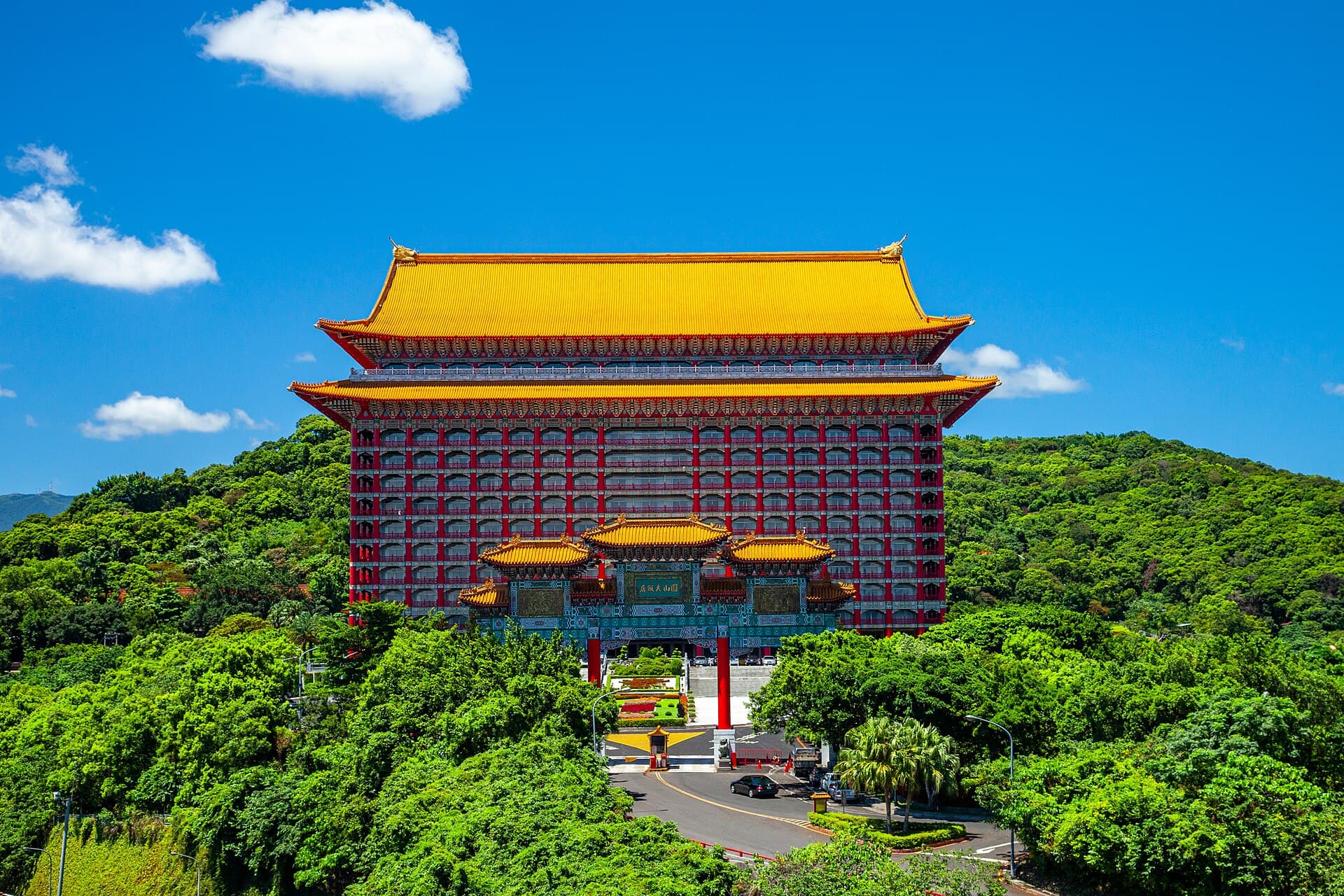

The Grand Hotel, Taipei stands on Yuanshan hill above the Keelung River, on the northern edge of central Taipei, Taiwan. It is one of the most recognisable buildings in the city: a 14-storey block in the form of a Chinese palace, with red columns, a golden roof of glazed tiles and a lobby of palatial proportions. It opened in 1952 and took its present form in 1973. Built to lodge the foreign heads of state and delegations of the Republic of China, it has become, for the people of Taipei, the place for a wedding banquet.
History
The site was that of the Taiwan Grand Shrine, the principal Shinto shrine of the island during Japanese rule, demolished after 1945. After the Nationalist government moved to Taiwan in 1949 it needed somewhere to receive foreign guests, and the hotel opened in 1952 under the patronage of Soong Mei-ling, Madame Chiang Kai-shek, and the Taiwan Hotel and Travel Association. The first building was modest. Through the 1950s and 1960s wings were added, and in 1973 the main palace building was completed to the design of the architect Yang Cho-cheng, making it one of the tallest Chinese-style buildings in the world at the time.
For decades the hotel received presidents, prime ministers and royalty visiting Taipei. In June 1995 a fire during roof repairs destroyed the upper floors and the roof, and the building stood damaged for three years before reopening in 1998 with the roof rebuilt. In 2019 the hotel opened to the public the two emergency slides, each around 180 metres long, built in the basement in the 1970s to evacuate state guests, which had been rumoured for years.
Architecture and design
Yang Cho-cheng's building follows the forms of Chinese palace architecture at a scale no palace reached: fourteen storeys under a hipped roof of golden tiles, with red columns rising through the facade and a grand entrance at the top of a ramp. The lobby is the hotel's set piece, a hall several storeys high with a coffered ceiling carved with plum blossoms, the national flower, and a wide stair rising from it. Dragons appear throughout the decoration, and the hotel invites guests to count them. The upper floors look south over the river to the city and north to the mountains.
Rooms and suites
The hotel has about 500 rooms and suites in the main building and the adjoining wings. Rooms in the main building have balconies with red balustrades facing either the city and the river or the hills. The suites on the upper floors have hosted the state guests the hotel was built for, and their decoration is still in the Chinese style.
Dining
The Golden Dragon restaurant serves Cantonese cuisine and dim sum, and Yuan Yuan serves Taiwanese and Chinese dishes; both are long-standing. The hotel's bakery is known across the city, and the Grand Garden terrace restaurant serves Western food with the view. Several banquet halls double as dining rooms for large family occasions.
Weddings and events
The Grand Hotel is the banquet venue Taipei takes for granted, with a series of halls on the main building's lower floors, the largest capable of seating well over a thousand guests at round tables, and function rooms for conferences and government receptions. Weddings here follow the Taiwanese banquet tradition, with the ceremony and reception in the same hall and photographs on the grand stair and the entrance terrace. The hotel also hosts state dinners, industry awards and large corporate meetings.
Location
The hotel stands in Zhongshan District, next to the Yuanshan Park Area, the Taipei Fine Arts Museum and the Taipei Expo Park. Yuanshan station on the Taipei Metro's Tamsui-Xinyi line is at the foot of the hill, and the hotel runs a shuttle to it. By car, Taipei Songshan Airport is about ten minutes away and Taoyuan International Airport about 50. The Shilin Night Market and the National Palace Museum lie a little way north by car. As a luxury hotel in Taipei with the city's most photographed building as its own, it has no equal.
At a glance
What sets it apart
- 01Opened 1952 on the site of the former Taiwan Grand Shrine
- 0214-storey palace-style main building by Yang Cho-cheng, completed 1973
- 03Lobby ceiling carved with plum blossoms, the national flower
- 04Two 1970s emergency slides in the basement, opened to visitors in 2019
- 05Roof destroyed by fire in 1995 and rebuilt by 1998
Chronology
Dates that matter
1952
The hotel opens under the patronage of Madame Chiang Kai-shek.
1973
The 14-storey palace-style main building is completed.
1995
A fire in June destroys the roof and upper floors.
1998
The hotel reopens with its roof rebuilt.
2019
The basement emergency slides are opened to the public.