
In the summer of 1920 the lobby of The Hermitage Hotel in Nashville, Tennessee, was the most watched room in American politics. Thirty-five states had ratified the Nineteenth Amendment; one more was needed, and the Tennessee legislature, meeting two blocks up the hill, would decide it. Suffragists wearing yellow roses and their opponents wearing red took rooms on different floors of the same hotel, and the lobbying went on in the corridors until the vote on 18 August.
History
A group of Nashville businessmen raised the money for a hotel to match the city's ambitions and hired James Edwin Ruthven Carpenter Jr., a Tennessee-born architect practising in New York, who later designed apartment buildings on Fifth and Park Avenues. The hotel took its name from Andrew Jackson's plantation outside the city and opened on 17 September 1910. It was the first hotel in Nashville to give every room its own bathroom.
The suffrage summer made its reputation. Carrie Chapman Catt directed the pro-ratification campaign from a suite here, and Harry Burn, the 24-year-old legislator whose vote broke the tie, did so with a letter from his mother in his pocket. Later guests included Gene Autry, who is said to have brought his horse Champion into the lobby, Al Capone, John F. Kennedy and most of the country-music world; Minnie Pearl and Dinah Shore had their first performances broadcast from the Grill Room in the 1930s and 1940s. The hotel declined with downtown in the 1970s, closed in 1977, reopened in 1981 and was restored at a cost of about 20 million dollars by new owners in 2003. It was designated a National Historic Landmark in January 2020, for its part in the suffrage story.
Architecture and design
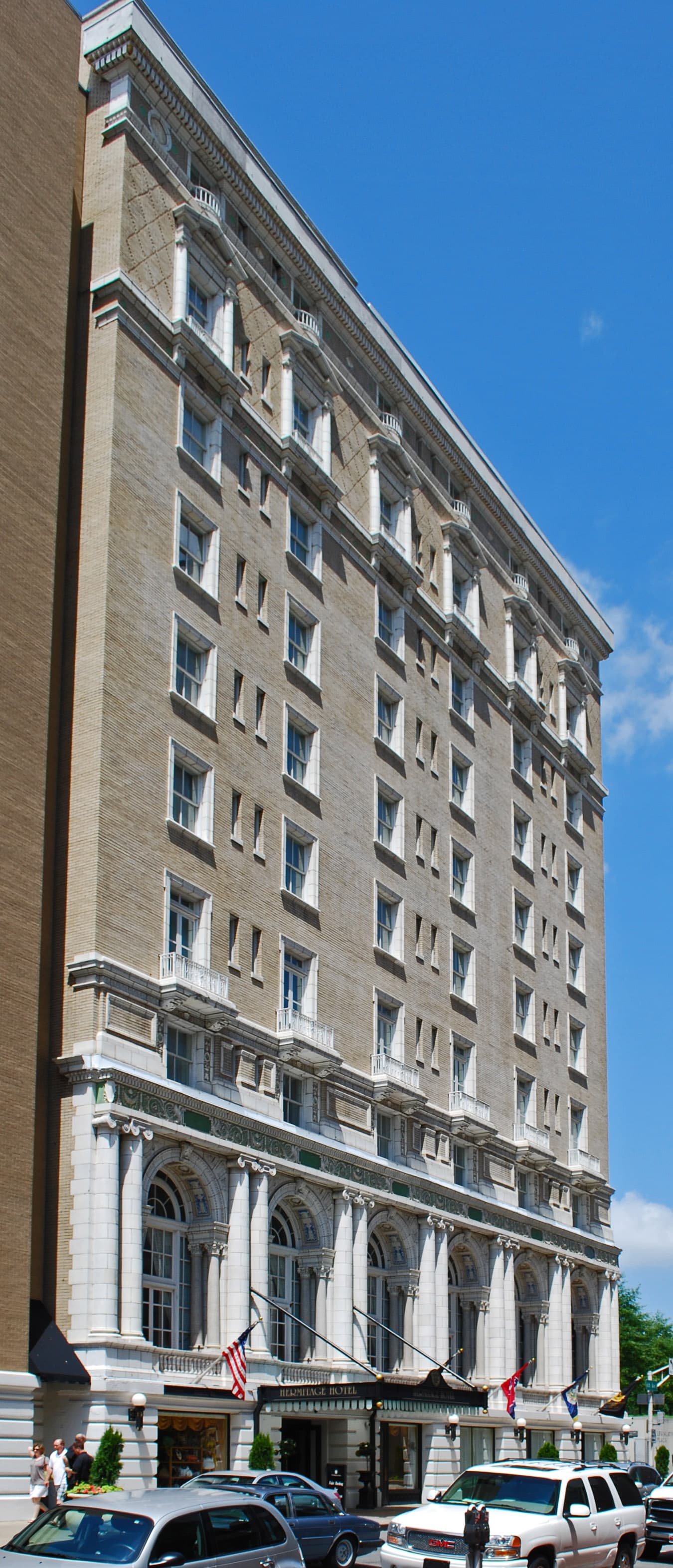
Carpenter's building is a ten-storey Beaux-Arts block of limestone and brick with a rusticated base, arched windows and a projecting cornice. The lobby is the room people come for: a vaulted ceiling of painted plaster and stained glass over a marble floor, Russian walnut panelling in the Oak Bar and a mezzanine behind a balustrade. The men's lavatory off the lobby, refitted in the 1930s in black-and-lime-green Art Deco tile with a shoeshine chair, has won awards as the best restroom in America and is shown to anyone who asks.
Rooms and suites
The hotel has 122 rooms and suites on the upper floors, among the largest standard rooms in Nashville because the original plan gave each a sitting area and a full bath. Suites on the corners look towards the Capitol and the Cumberland River. The decoration follows the Beaux-Arts palette of the public rooms, with moulded ceilings and tall windows.
Dining
Drusie and Darr, opened in 2022 under Jean-Georges Vongerichten and named for two of the hotel's early managers, is the main restaurant, in the former Capitol Grille space. The Pink Hermit is the all-day café off the lobby. The Oak Bar, panelled and low-lit, is where the legislature drinks.
Weddings and events
The Grand Ballroom on the mezzanine, with its own balcony and coffered ceiling, is the principal wedding and banquet room, and the Veranda and the smaller rooms on the mezzanine take ceremonies, dinners and meetings. The lobby is used for receptions. The hotel has hosted weddings since it opened and inaugural balls for Tennessee governors. Capacities depend on the room and the layout.
Location
The Hermitage Hotel stands at the corner of Sixth Avenue North and Union Street, across from the Legislative Plaza and two blocks south of the Capitol. The Ryman Auditorium, Printer's Alley and Lower Broadway are within ten minutes on foot. Nashville International Airport is about nine miles east, 15 to 25 minutes by car. There is no passenger rail station in Nashville. As the oldest luxury hotel in Nashville still in operation, it belongs to the city's political history as much as to its music.
At a glance
What sets it apart
- 01Opened 17 September 1910, architect J. E. R. Carpenter, Beaux-Arts
- 02Headquarters of both sides in the August 1920 suffrage ratification fight
- 03National Historic Landmark since 2020
- 04Lobby with painted vaulted ceiling and stained-glass skylight; Oak Bar in Russian walnut
- 05122 rooms; Art Deco men's lavatory of the 1930s
Chronology
Dates that matter
1910
The Hermitage Hotel opens on 17 September, the first in Nashville with a bathroom in every room.
1920
Suffragists and their opponents lobby from the hotel; Tennessee ratifies the Nineteenth Amendment on 18 August.
1977
The hotel closes as downtown Nashville declines.
2003
A restoration of about 20 million dollars returns the hotel to its original plan.
2020
Designated a National Historic Landmark for its role in the suffrage story.
2022
Drusie and Darr opens under Jean-Georges Vongerichten.