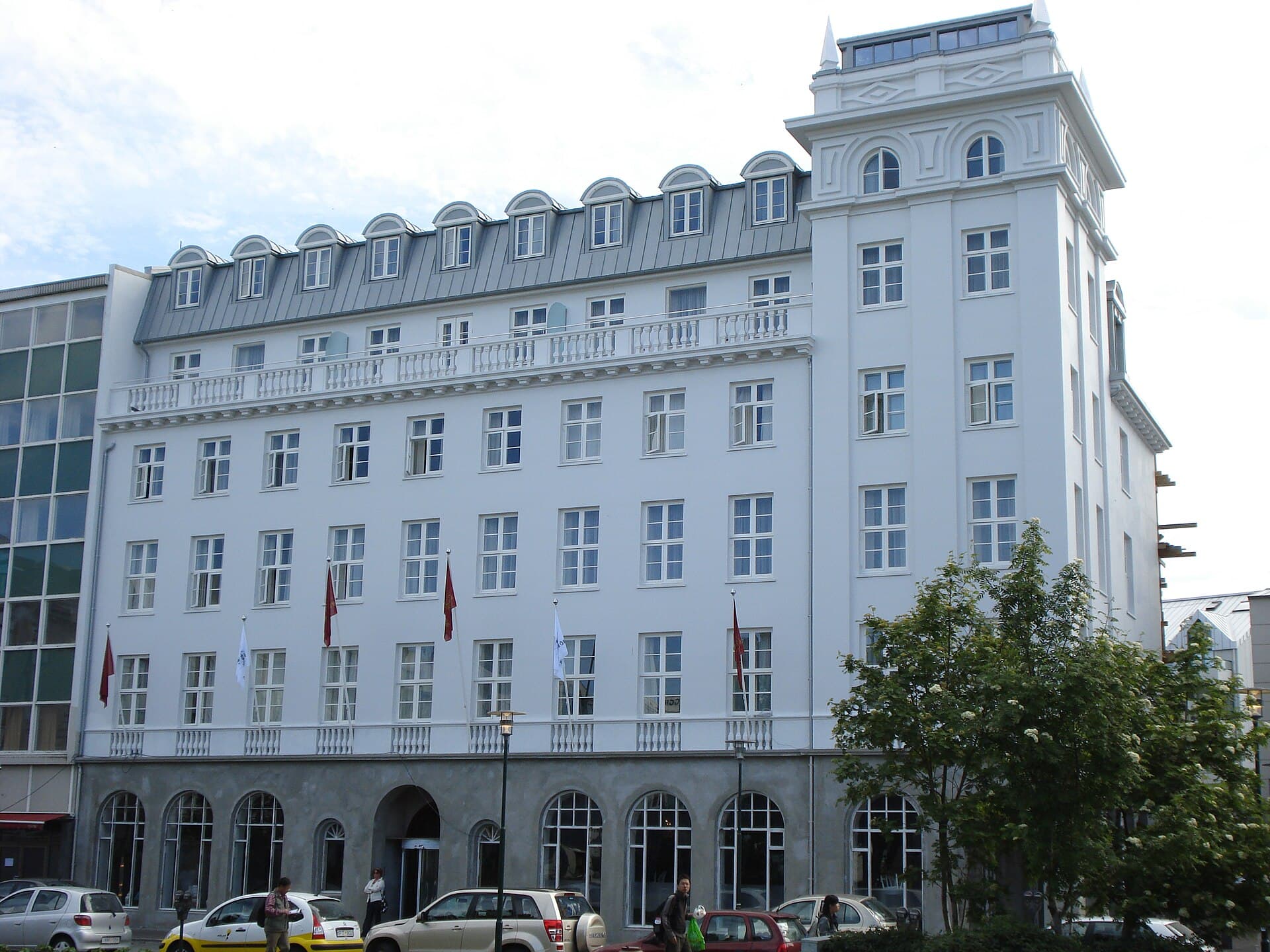

The money that built Hotel Borg was earned in American circus tents. Jóhannes Jósefsson, born in Akureyri in 1883, was Iceland's champion of glíma, the national wrestling, competed for Denmark at the 1908 London Olympics, and spent the next two decades performing feats of strength in the United States, for a time with Barnum & Bailey. He came home to Reykjavík in 1927 with capital and a plan: the capital of a country about to celebrate a thousand years of its parliament had no hotel fit to receive the foreign guests. Hotel Borg opened on 18 January 1930 on Austurvöllur, the square in front of the Althing, and the millennium festival that June filled it.
History
Jósefsson hired Guðjón Samúelsson, the State Architect, who was at the same time designing the main building of the University of Iceland and would later draw Hallgrímskirkja. The hotel was the largest private building in the city, with hot and cold water in every room, a lift and a ballroom, and it set the standard for a country whose previous hotels had been guesthouses. For thirty years Jósefsson ran it himself, with his wife Karólína, and the Borg was where the republic's early state dinners and parliamentary receptions were held.
Marlene Dietrich stayed in 1944, when she came to perform for the Allied troops stationed in Iceland. The ballroom was Reykjavík's dance floor through the 1950s and 1960s, the stage for the country's first rock bands as well as its waltzes. Later owners altered the interiors, and it took a restoration in the 1990s to bring back the Art Deco detail that Samúelsson had specified. Keahotels, the Icelandic group, has run the hotel since; an extension into the neighbouring building on Pósthússtræti in 2007 raised the room count to 99 and added the Tower Suite at the top.
Architecture and design
Samúelsson's building is a white rendered block of five storeys with a rounded corner towards the square, stepped parapets and the flat geometry of the Art Deco of the late 1920s, rare in Iceland. The ground floor has tall arched windows onto Austurvöllur. Inside, the restoration recovered the black-and-white marble, the mirrored panels, the chrome and the geometric joinery of the original scheme, and the rooms follow the same vocabulary in dark wood, cream and brass.
Rooms and suites
The hotel has 99 rooms and suites. Rooms on the square side look across Austurvöllur to the parliament house of 1881 and the cathedral beside it; those in the 2007 wing are larger and quieter. The Tower Suite on the top floor has its own terrace and views over the roofs to Faxaflói bay and Mount Esja beyond.
Dining
The hotel's restaurant and bar occupy the ground floor on the square, serving Icelandic fish and lamb and a long breakfast. The bar was the first in Reykjavík to be run on continental lines when the hotel opened, in a country that kept beer illegal until 1989.
Wellness
The Borg Spa in the basement is small: a sauna, a steam room, a hot tub and a gym, with treatment rooms. There is no swimming pool; Reykjavík's geothermal pools are a short bus ride away.
Weddings and events
The Golden Room, Gyllti salurinn, is the hotel's ballroom and the most storied function room in Iceland, where state banquets and the city's dances were held from 1930. It is used for weddings, receptions and conference dinners, and a set of meeting rooms serves boards and seminars. The parliament across the square and the cathedral next to it are the backdrop for photographs.
Location
Austurvöllur is the centre of old Reykjavík. The Althing house is across the lawn, Dómkirkjan beside it, and the harbour and Harpa concert hall are a few minutes to the north. Keflavík airport is about 50 kilometres away, roughly 45 minutes by the airport coach, which stops at the BSÍ terminal a short taxi ride from the hotel. For a luxury hotel in Reykjavík with the city's history on its doorstep, the Borg is the original.
At a glance
What sets it apart
- 01Opened 18 January 1930, built by wrestler Jóhannes Jósefsson
- 02Art Deco design by State Architect Guðjón Samúelsson
- 03Faces the Althing parliament house across Austurvöllur square
- 04Golden Room ballroom, in use since 1930
- 0599 rooms after the 2007 extension, with the Tower Suite on top
Chronology
Dates that matter
1908
Jóhannes Jósefsson wrestles at the London Olympics before his circus career in America.
1927
Jósefsson returns to Reykjavík and commissions Guðjón Samúelsson.
1930
Hotel Borg opens on 18 January; the Althing millennium festival follows in June.
1944
Marlene Dietrich stays while performing for Allied troops in Iceland.
2007
An extension into the adjoining building brings the hotel to 99 rooms and adds the Tower Suite.