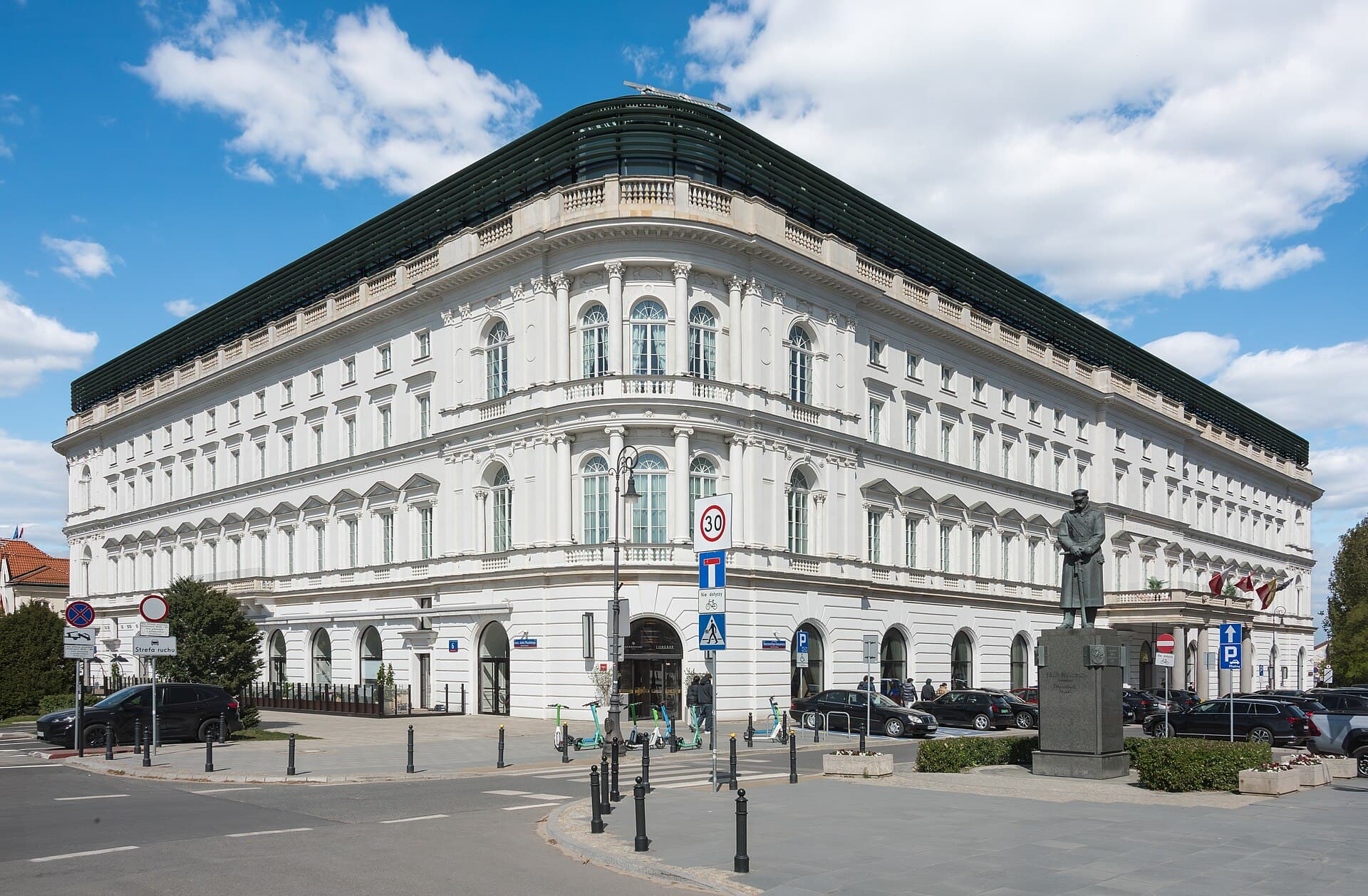
Krakowskie Przedmieście is the street Warsaw rebuilt first after 1945, and the Hotel Bristol was one of the few buildings on it that did not need rebuilding. It stands at numbers 42 and 44, beside the Presidential Palace, a long neo-Renaissance block with a rounded corner tower that has faced the Royal Route since 1901. Among the investors who paid for it was Ignacy Jan Paderewski, then the most famous pianist in the world and later the first prime minister of an independent Poland.
History
The hotel opened in November 1901 after a design competition and a long building programme. It was the most modern hotel in Russian-ruled Warsaw, with electric light, lifts and a telephone exchange, and it became the address for visiting artists and politicians through the interwar years. The German occupation requisitioned the building, which is why it stood when the rest of the street burned in the 1944 uprising. After the war the state hotel company Orbis ran it until 1981, when the building was closed and left to decline. A restoration under new ownership returned it to use in 1993, and it has operated since as one of the Luxury Collection hotels of Marriott. Pablo Picasso stayed in 1948 while attending the Congress of Intellectuals in Wrocław, one entry in a guest book that runs through most of the twentieth century.
Architecture and design
The exterior follows the neo-Renaissance design of Władysław Marconi, in pale stone with a corner rotunda. The interiors had a different hand: the Art Nouveau café and public rooms were fitted out a few years after opening and were among the first of their kind in Warsaw. The 1993 restoration returned the ground floor to its historic appearance, so the Column Bar, the Café Bristol and the ballroom read as period rooms rather than reproductions. Bedrooms upstairs were rebuilt behind the original walls.
Rooms and suites
There are 206 rooms and suites. The best look onto Krakowskie Przedmieście and the Presidential Palace gardens; others face the quieter courtyard side. High ceilings and tall windows come from the 1901 plan. The suites on the upper floors carry the names of guests and figures from the hotel's history, and the Paderewski connection is marked throughout the house.
Dining
Café Bristol on the corner is the Viennese-style café that Varsovians use as much as hotel guests do, with pastries and a view of the street. The Column Bar, with its marble columns and long counter, is the hotel bar. Marconi, the main restaurant, is named after the architect and serves Polish and European cooking under the restored ceilings of the former dining room.
Wellness
A small spa and fitness area occupies the top of the building, with an indoor pool, a sauna and a few treatment rooms. It is a convenience rather than a destination; the city, five minutes on foot in any direction, is the reason to come.
Weddings and events
The Sala Malinowa, the Raspberry Room, is the historic ballroom and the room Warsaw associates with the Bristol. It is used for weddings, galas and receptions, with further salons on the same floor for dinners and meetings. The hotel hosts both weddings and conferences and the historic ground floor is the draw for either.
Location
The Bristol sits on the Royal Route in the centre of Warsaw, between the Old Town to the north and the Nowy Świat shops to the south. The University of Warsaw is across the street and the Presidential Palace next door. This is the best-placed luxury hotel in Warsaw for walking: the Old Town square is ten minutes away. Chopin Airport is about 25 minutes by car, and Warszawa Centralna station is a short taxi ride.
At a glance
What sets it apart
- 01Opened 1901 on Krakowskie Przedmieście, financed in part by Ignacy Paderewski
- 02Neo-Renaissance facade by Władysław Marconi with a corner rotunda
- 03Survived the 1944 destruction of Warsaw; closed 1981, reopened 1993
- 04Sala Malinowa, the historic ballroom, for weddings and galas
- 05Café Bristol and the Column Bar on the ground floor
Chronology
Dates that matter
1901
The Hotel Bristol opens in November on Krakowskie Przedmieście, with Paderewski among its investors.
1944
Requisitioned by the occupiers, the building survives the Warsaw Uprising while the street around it burns.
1948
Pablo Picasso stays at the Bristol during his visit to Poland.
1981
The hotel closes and the building stands empty for more than a decade.
1993
Reopening after a full restoration of the historic ground floor and new bedrooms.