Via Bocca di Leone is a narrow street between Via Condotti and Via Frattina, in the grid of lanes below the Spanish Steps where Rome's tailors and jewellers have traded for two centuries. At number 14 stands the Hotel d'Inghilterra, Rome, a house that has taken paying guests since 1845 and whose name, the Hotel of England, records the nationality of the travellers who first filled it.
History
The building is older than the hotel. In the 16th century it served as the guest quarters of the Torlonia family, whose palace stands on the same street; visitors to the princes were lodged here rather than in the main house. When the Grand Tour turned Rome into a fixed stop for English and American travellers, the building became an inn and took its present name in 1845.
The guest book of the following century reads like a syllabus. Henry James stayed here, as did Mark Twain. Ernest Hemingway was a guest, and so was the composer Franz Liszt. For a long time the house was the address of choice for writers and musicians who wanted to be within reach of the Caffè Greco on Via Condotti and the Keats-Shelley House on the piazza. In the 21st century it passed to Starhotels, the Florentine group, which placed it in its Collezione of historic properties and refurbished it floor by floor.
Architecture and design
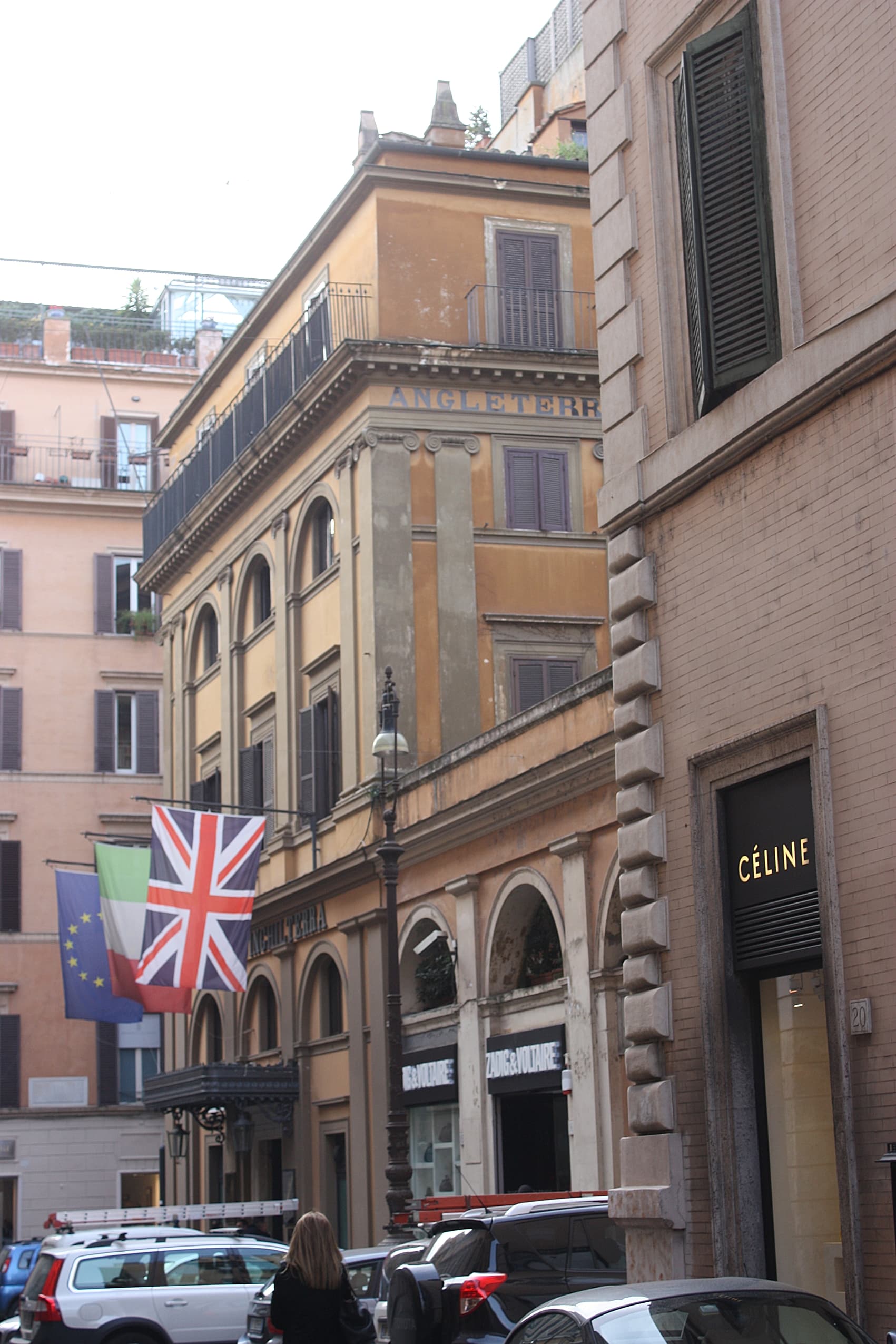
From the street the hotel is discreet: an ochre facade, shuttered windows, a small canopy over the door. Inside, the plan is that of a Roman palazzo rather than a purpose-built hotel, with a sequence of small salons on the ground floor, a staircase, and corridors that turn with the building. The decoration follows the house's age, with marble floors, antique furniture, prints and painted panels, renewed in successive refurbishments without stripping the character of the rooms.
The best vantage is the roof. The terrace looks over the tiled roofs, domes and bell towers of the historic centre, with the dome of Saint Peter's in the distance.
Rooms and suites
Rooms vary in size and shape, as they do in any converted palazzo. Many look onto the lanes of the fashion district; upper-floor rooms and the suites take in the rooftops. Eight suites sit at the top of the range, several with private terraces. Furnishings mix antiques with contemporary comfort, and the bathrooms are in marble.
Dining
The Café Romano is the hotel's restaurant, with tables inside and out on Via Borgognona, serving Italian and Roman cooking through the day. The lounge bar on the ground floor is a quiet place for an aperitivo before dinner. In fine weather the rooftop bar opens for cocktails with the centre spread out below.
Wellness
A single spa suite offers treatments by appointment, and there is a small fitness room. Guests who want more usually walk: the Pincio and the Villa Borghese gardens are ten minutes away on foot.
Weddings and events
The hotel is a small house and its event capacity is limited. Meetings are held in its salons, which suit boards, private dinners and small receptions rather than large gatherings.
Location
Few hotels in Rome are better placed for a visitor on foot. The Spanish Steps and the Keats-Shelley House are two minutes away, Via Condotti one street over, and Via Margutta, with its painters' studios, just beyond the piazza. The Trevi Fountain is a ten-minute walk, the Pantheon fifteen. Spagna metro station on line A is at the top of Via Condotti; Termini station is three stops away. Fiumicino airport is about 30 kilometres to the south-west, Ciampino about 15. For a luxury hotel in Rome, the d'Inghilterra is unusually quiet at night, the lane being closed to most traffic.
At a glance
What sets it apart
- 01Hotel since 1845 in the 16th-century guest quarters of the Torlonia family
- 02Via Bocca di Leone, two minutes from the Spanish Steps and Via Condotti
- 03Guests have included Henry James, Mark Twain, Hemingway and Liszt
- 04Café Romano restaurant with tables on Via Borgognona
- 05Rooftop bar over the roofs of the historic centre
Chronology
Dates that matter
1845
The former Torlonia guest house opens as a hotel named for its English clientele.
1900
By the turn of the century the house is an address for visiting writers and musicians.
2011
Starhotels adds the hotel to its Collezione of historic properties.