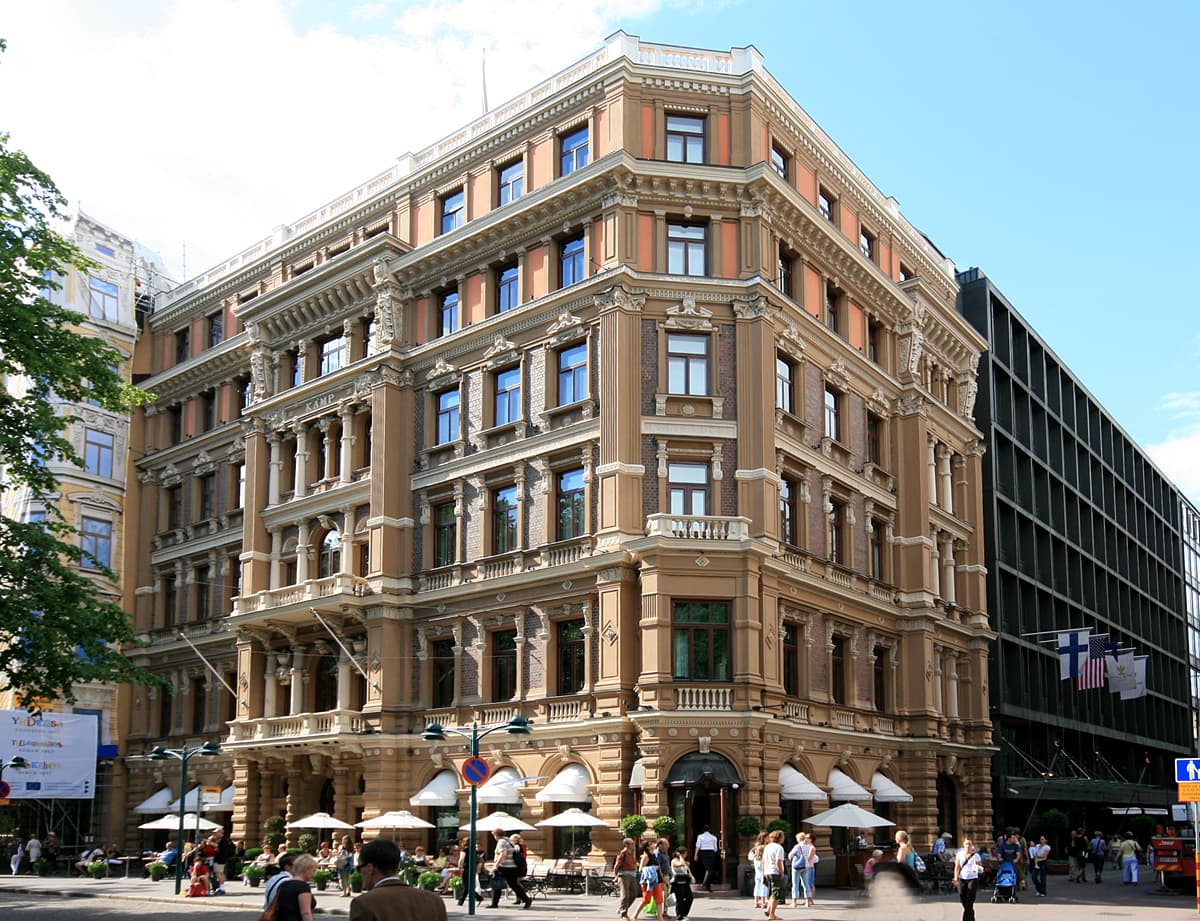

Finnish composers, painters and politicians have gathered since 1887 at Hotel Kämp, the grand hotel of Helsinki, a five-storey house on Pohjoisesplanadi facing the Esplanadi park. No luxury hotel in Helsinki carries the same weight, and it is a stage for the city's cultural life as much as a place to sleep.
History
Carl Kämp, a restaurateur, commissioned the building from the architect Theodor Höijer and opened it in 1887. Within a few years the hotel had become the meeting place of the Symposion circle: Jean Sibelius, the conductor Robert Kajanus, the composer Oskar Merikanto and the painter Akseli Gallen-Kallela, whose 1894 painting Symposion records their long evenings together. Through the first half of the twentieth century the Kämp was where Helsinki received visiting royalty, diplomats and correspondents, and during the Winter War of 1939 foreign journalists filed their reports from its rooms.
The building deteriorated after the Second World War and was demolished in 1965. The bank Kansallis-Osake-Pankki rebuilt a near-replica on the site for its own offices, and the facade of today's hotel dates from that reconstruction rather than from 1887. The house returned to its original purpose in 1999, when it reopened as Hotel Kämp after a restoration that recreated the principal historic rooms. Since then it has again been the hotel where heads of state and performers stay when they visit Helsinki.
Architecture and design
Höijer designed the house in a Renaissance Revival manner, with a rusticated ground floor, tall arched windows and a corner tower turned towards the Esplanadi. Inside, the public rooms follow the proportions of the original, and the Mirror Room, the Peilisali, is still the heart of the house: gilded mouldings, chandeliers and a run of tall mirrors along one wall. The interior is protected under the city plan. The guest floors are quieter in tone, with dark wood, textiles in muted colours and a classic layout rather than a contemporary one.
Rooms and suites
The hotel has about 179 rooms and suites. The most sought-after face the Esplanadi park; the others look onto the inner courtyard and are the quieter choice. Suites on the upper floors are the largest, several with views across the park towards the harbour.
Dining
Brasserie Kämp on the ground floor serves a French-leaning menu and has long been a Helsinki address for lunch. Kämp Bar, opening onto the Esplanadi, is the established place in the city for an aperitif. A Japanese restaurant, Yume, completes the three dining venues.
Wellness
Kämp Spa occupies the top floor of the hotel, with Finnish saunas, treatment rooms and a gym, and is open to outside guests as well as residents.
Weddings and events
The Mirror Room is the main venue for weddings, galas and receptions, and the hotel's meeting rooms serve seminars and board meetings. The hotel states a capacity of up to 500 guests across its event spaces. Its position in the centre of Helsinki, a short walk from the Market Square and the Senate Square, makes it practical for city weddings and corporate dinners that continue late.
Location
The hotel stands at Pohjoisesplanadi 29, on the north side of the Esplanadi park, between the Market Square and the Stockmann department store. Helsinki Central Station is some ten minutes on foot, and Helsinki-Vantaa Airport roughly half an hour by train or car. For a luxury hotel in Helsinki, no address is more central.
At a glance
What sets it apart
- 01Opened in 1887 on Pohjoisesplanadi, facing the Esplanadi park
- 02Meeting place of the Symposion circle around Jean Sibelius in the 1890s
- 03Original building demolished in 1965, near-replica rebuilt, hotel reopened in 1999
- 04The Mirror Room, the Peilisali, is the main ballroom
- 05Kämp Spa with Finnish saunas on the top floor
Chronology
Dates that matter
1887
Carl Kämp opens the hotel in a building by Theodor Höijer.
1894
Akseli Gallen-Kallela paints Symposion, portraying the circle that met at the Kämp.
1965
The original building is demolished; a near-replica is built for Kansallis-Osake-Pankki.
1999
The house reopens as Hotel Kämp after a restoration of the historic rooms.