
The first Palmer House opened on 26 September 1871. Thirteen days later the Great Chicago Fire burned it down, together with most of the business district. Potter Palmer, the merchant who had made State Street the city's main shopping street, began again almost at once, and the Palmer House name has stood on State Street ever since. The present building, at 17 East Monroe Street in the Loop, is the third, completed in 1925.
History
Palmer built the original hotel as a wedding present for Bertha Honoré, whom he had married in 1870. Its successor opened in 1875 and was advertised as fireproof, a selling point in a city still clearing rubble. Bertha Palmer became the leading hostess of Gilded Age Chicago, and in 1893 she chaired the Board of Lady Managers of the World's Columbian Exposition. For the fair she asked the hotel's pastry kitchen for a cake small enough to pack in a box lunch. The answer, a dense chocolate square with walnuts and an apricot glaze, is generally credited as the first brownie, and the hotel still bakes it to that recipe.
In the 1920s the second hotel was replaced in stages by a 25-storey building by Holabird & Roche, the Chicago practice behind many of the Loop's early office towers. Conrad Hilton bought the Palmer House in 1945, and it has carried the Hilton name ever since. In the post-war decades its supper club, the Empire Room, booked headliners such as Frank Sinatra, Judy Garland and Ella Fitzgerald, and an evening there was a fixture of a smart Chicago night out.
Architecture and design
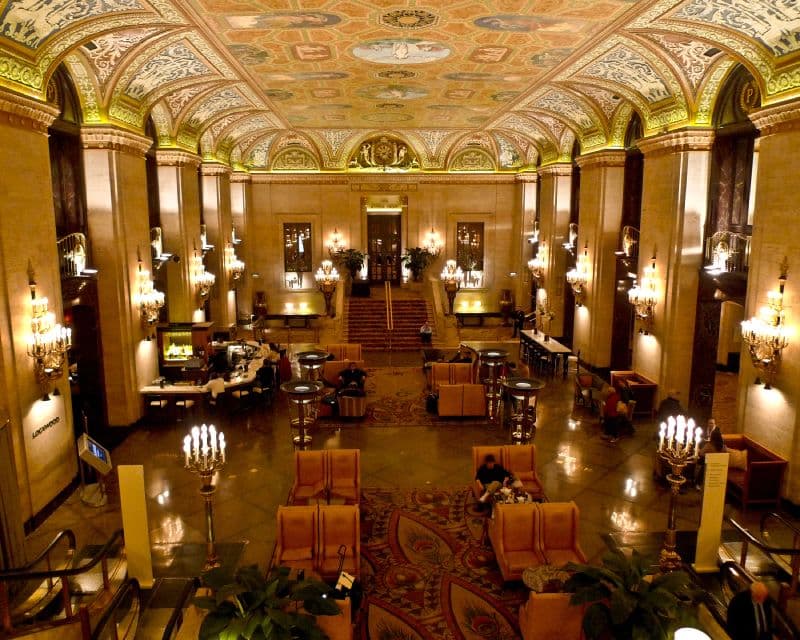
The lobby sits one floor above the street, and it is the reason most visitors climb the stairs. It is a long, double-height hall under a ceiling of painted panels by the French artist Louis Pierre Rigal, scenes from Greek mythology set in gilded frames, cleaned and restored at the end of the twentieth century. Hotel guests, conference delegates and passers-by share the room with little distinction, which has always been part of its appeal. At the Monroe Street entrance stand bronze doors decorated with peacocks, attributed to Louis Comfort Tiffany. The function floors carry the same 1920s vocabulary of gilt, mirrors and painted ceilings.
Rooms and suites
With more than 1,600 rooms, the Palmer House is among the largest hotels in Chicago. Bedrooms run between compact doubles and suites on the upper floors, and the scale explains its long career as a convention hotel as much as a place for weekend visitors.
Dining
Lockwood, the restaurant and bar beside the lobby, serves the original brownie alongside its regular menus. Drinks are also served under the Rigal ceiling itself, which turns the lobby into a bar in the early evening.
Weddings and events
The function rooms read like a record of a century of Chicago entertaining. The Grand Ballroom, the State Ballroom, the Red Lacquer Room and the Empire Room host weddings, gala dinners and conferences, and the number of bedrooms allows a large meeting to keep its delegates under one roof.
Location
The hotel is in the heart of the Loop, a block from the State Street department stores. The Art Institute of Chicago and Millennium Park lie a short walk east along Monroe Street, and Orchestra Hall, home of the Chicago Symphony Orchestra, is on Michigan Avenue nearby. The theatre district is a few blocks north. The Monroe stations on the CTA Red and Blue Lines are on the doorstep, and both O'Hare and Midway airports can be reached by train. Among the luxury hotels in Chicago, it is the one whose story begins before the Great Fire.
At a glance
What sets it apart
- 01First hotel opened in 1871 and burned in the Great Chicago Fire 13 days later
- 02Present 25-storey building by Holabird & Roche, completed in 1925
- 03Lobby ceiling painted by Louis Pierre Rigal
- 04Brownie created in its pastry kitchen for the 1893 World's Fair
- 05Owned by Conrad Hilton from 1945
Chronology
Dates that matter
1871
The first Palmer House opens on 26 September and is destroyed by the Great Chicago Fire in October.
1875
The second Palmer House opens, advertised as fireproof.
1893
Bertha Palmer's request for a box-lunch cake for the World's Columbian Exposition produces the brownie.
1925
The present 25-storey building by Holabird & Roche is completed.
1945
Conrad Hilton buys the Palmer House.