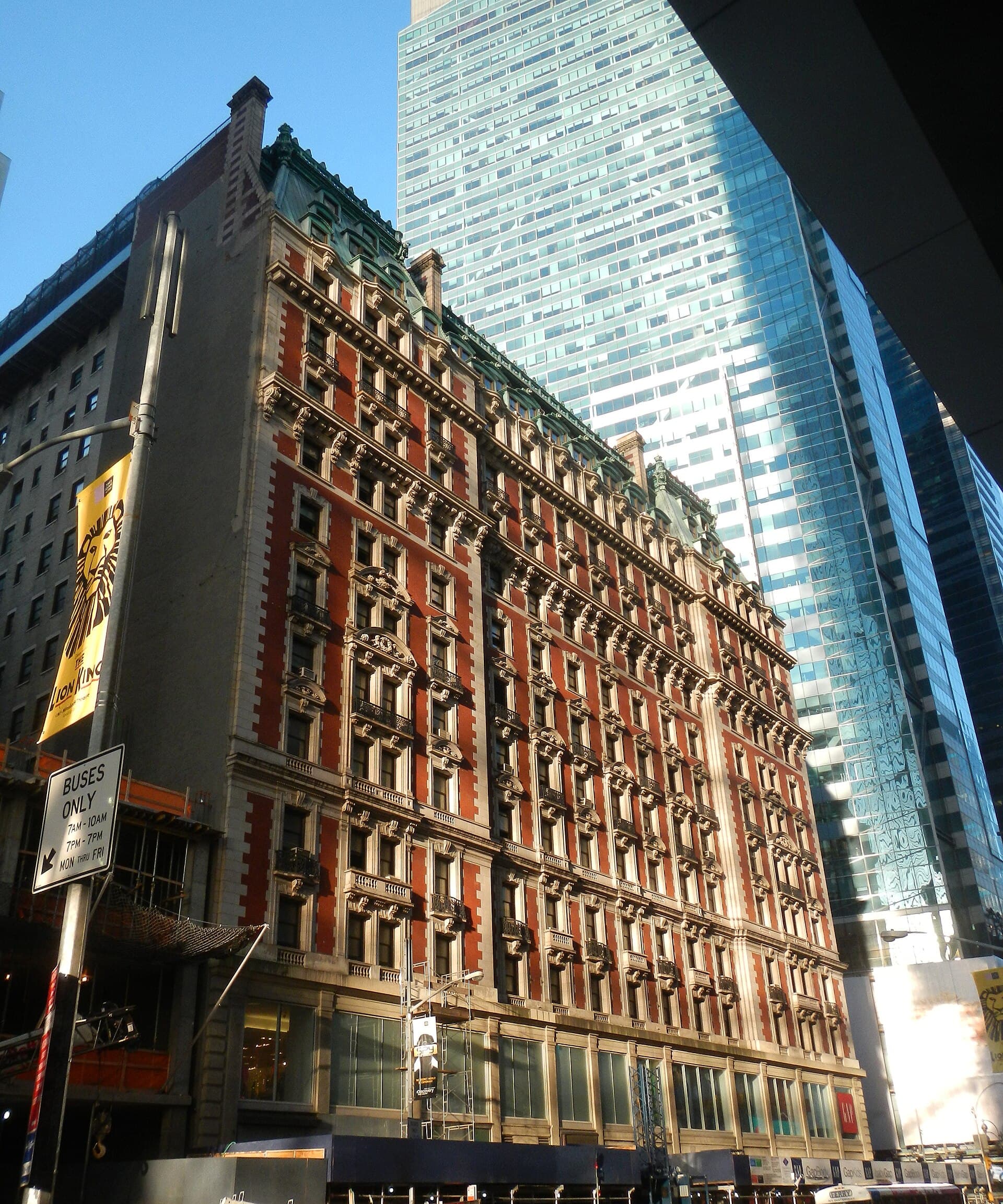
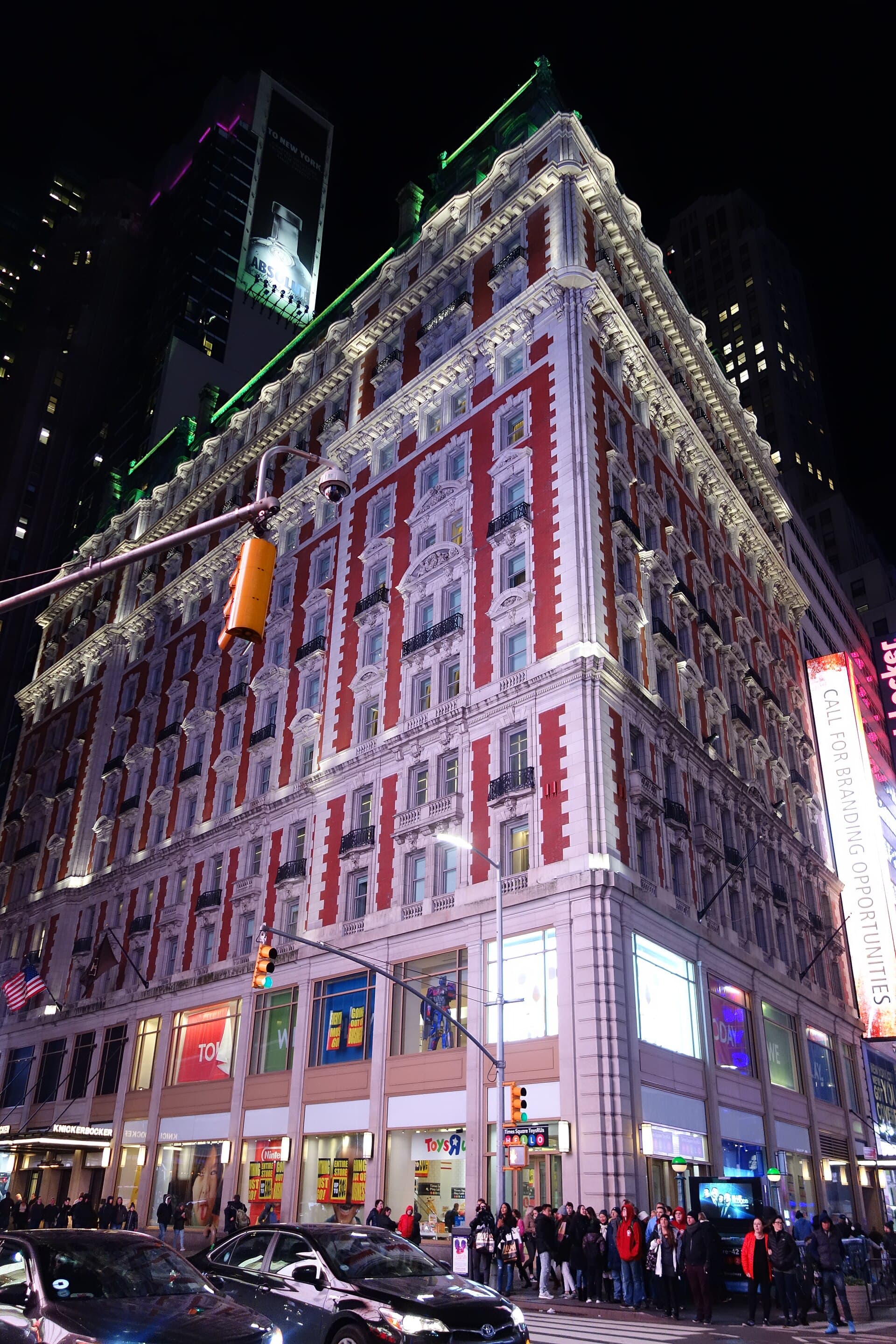
Six Times Square is the postal address, but the building answers to an older one: the south-east corner of 42nd Street and Broadway, where John Jacob Astor IV opened The Knickerbocker in New York City on 23 October 1906. The red brick and terracotta pile with its mansard roof went up when Times Square had only just taken its name, and the subway below still has a sealed door marked Knickerbocker on the platform of the 42nd Street shuttle, through which hotel guests once walked straight to their trains.
History
Astor spent lavishly. Marvin and Davis drew the plans, with Bruce Price brought in to shape the Beaux-Arts facade. Maxfield Parrish painted his Old King Cole mural for the Knickerbocker bar in 1906; it hangs now in the King Cole Bar of the St. Regis, another Astor house. Enrico Caruso lived in the hotel for years during his seasons at the Metropolitan Opera, and the story that the dry martini was first mixed here for John D. Rockefeller is repeated far more often than it is proven. Astor himself died on the Titanic in April 1912.
Prohibition finished the hotel's first life. It closed in 1920 and was converted into offices, trading for decades as the Knickerbocker Building, housing garment showrooms and, for a period, the editorial offices of Newsweek. The city designated the exterior a landmark in 1988. A restoration lasting two years returned it to hotel use, and The Knickerbocker reopened in February 2015 with 330 rooms, a member of The Leading Hotels of the World.
Architecture and design
The exterior is Astor's: brick and limestone, terracotta ornament and a mansard roof of the kind Paris was building at the time, on a scale that still holds its corner against the electronic billboards. Inside, little of 1906 survived the office decades, so the 2015 interiors were made new, in a quieter register than the facade. Ceilings reach 12 feet in many rooms, a legacy of the original floor heights, and the public rooms use dark timber, pale stone and tall windows onto Broadway and 42nd Street. The result is a luxury hotel in Midtown Manhattan that reads as modern once you are past the door.
Rooms and suites
The 330 rooms and suites look onto Times Square, 42nd Street or the quieter inner side of the block. High ceilings and tall windows give even the smaller rooms a sense of volume unusual in Midtown. Furniture is low and dark, and the glazing is serious, because the building sits at the busiest intersection in the city.
Dining
The roof is the draw. St. Cloud, the rooftop bar and terrace, looks across 42nd Street at One Times Square, which makes it one of the few places in the city where you can watch the New Year's Eve ball drop with a drink in hand; those tickets are the most contested of the year. Charlie Palmer opened the ground-floor restaurant with the hotel in 2015, and a cafe at street level serves the morning trade.
Weddings and events
St. Cloud takes private parties and receptions, in the open in summer and under heaters and canopies in winter, and the hotel has indoor function rooms for meetings and dinners. New Year's Eve on the roof is sold as a ticketed event rather than a private hire. Corporate bookings dominate the weekday calendar, given the address.
Location
The hotel stands on Times Square, with the 42nd Street subway station, the Theater District and Bryant Park at the door. Grand Central Terminal is a ten-minute walk east along 42nd Street, Penn Station a similar distance south-west. LaGuardia is the closest airport, about 30 minutes by car outside the rush; JFK and Newark are both about an hour.
At a glance
What sets it apart
- 01Opened by John Jacob Astor IV on 23 October 1906
- 02Beaux-Arts facade by Marvin and Davis with Bruce Price, city landmark since 1988
- 03Closed 1920 to 2015, reopened with 330 rooms
- 04St. Cloud rooftop bar faces One Times Square and the New Year's Eve ball
- 05Sealed Knickerbocker door on the Times Square shuttle platform
Chronology
Dates that matter
1906
The Knickerbocker opens on 23 October, built by John Jacob Astor IV at 42nd Street and Broadway.
1912
Astor dies in the sinking of the Titanic.
1920
Prohibition closes the hotel; the building is converted to offices.
1988
New York City designates the exterior a landmark.
2015
The Knickerbocker reopens as a hotel in February with 330 rooms.