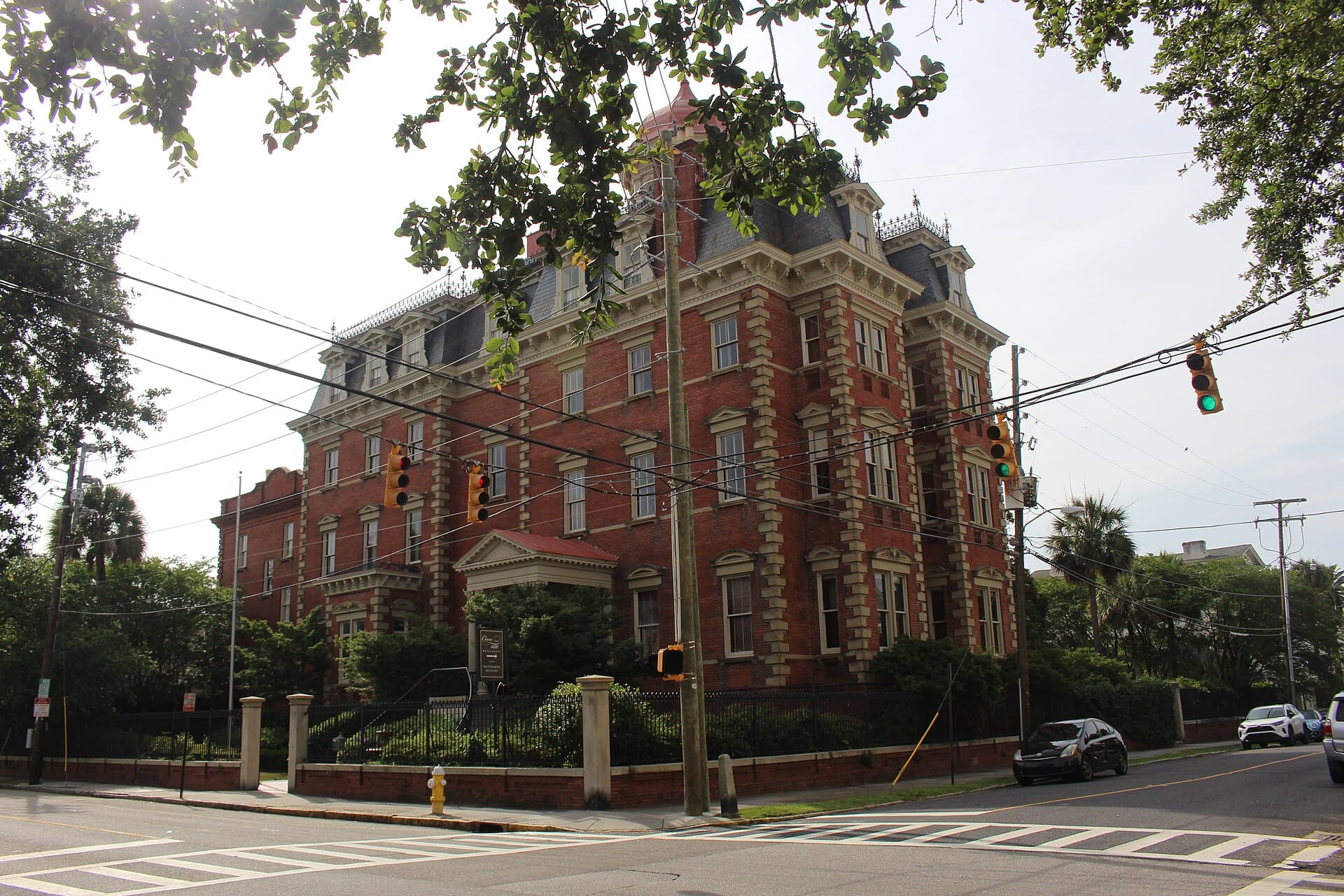

Wentworth Street in Charleston's Harleston Village has houses of every decade of the nineteenth century, and the largest of them is a mansard-roofed pile of brick and brownstone set back behind iron railings at number 149. Francis Silas Rodgers, who had made a fortune in cotton and phosphate after the Civil War, built it in 1886 as a house for his family of thirteen children. Wentworth Mansion in Charleston, South Carolina, is that house, run since 1998 as an inn of 21 rooms.
History
Rodgers began the house in 1885 and finished it in 1886, the year of the earthquake that damaged much of Charleston; the mansion survived it. He spared nothing: carved mahogany and oak, Italian marble fireplaces, plaster ceilings and windows of Louis Comfort Tiffany's stained glass. After the family's time the house became the offices of an insurance company, which kept the interiors intact under decades of filing cabinets. In 1996 the Charleston hotelier Richard Widman bought the building and spent two years restoring it; it opened as an inn in 1998 and belongs to his Charming Inns group, with the John Rutledge House and two other Charleston properties.
Architecture and design
The house is one of the few Second Empire mansions in Charleston, a style more common in the North, with a slate mansard roof, dormers and the cupola that rises above it. The ground floor keeps its sequence of parlours with pocket doors and the carved staircase; the Tiffany glass is in the windows of the stair and the main rooms. Furnishing is in period style, with four-poster beds and antiques, and the restoration added bathrooms and whirlpool baths without altering the plan of the main rooms.
Rooms and suites
There are 21 rooms and suites on the three floors of the mansion, each different, most with working gas fireplaces and some with the original carved mantels. The largest suites are on the first floor, the former family rooms with the highest ceilings. Guests have the run of the house, including the cupola, reached by a stair from the top floor, with a view over the rooftops to the harbour and the spires of the city's churches.
Dining
Circa 1886, in the former carriage house at the back of the garden, is one of the restaurants most often cited in Charleston, serving Lowcountry cooking in a fine-dining register in a small room of brick and timber. Breakfast is served to residents in the sun porch, and the inn offers wine in the afternoon and port in the evening in the parlours.
Wellness
The spa occupies the former carriage house alongside the restaurant, with a few treatment rooms. There is no pool.
Weddings and events
The mansion takes small weddings, usually with the ceremony in the garden or the parlours and the dinner at Circa 1886, for parties that fit a house of 21 rooms. Elopements and anniversary dinners are its usual trade; it is not a conference hotel, though the parlours can host a small board meeting.
Location
Harleston Village lies on the western side of the Charleston peninsula, a quiet residential district of the historic city. King Street and its shops are a few blocks east, the College of Charleston two blocks north, and the Battery and White Point Garden about 15 minutes on foot to the south. Charleston International Airport is about 20 kilometres north-west. Among the luxury hotels in Charleston, Wentworth Mansion is the one that is a single house, with the scale and quiet that implies.
At a glance
What sets it apart
- 01Second Empire mansion built in 1886 for cotton merchant Francis Silas Rodgers
- 02Hand-carved mahogany and oak, Italian marble fireplaces, Tiffany stained glass
- 03Rooftop cupola open to guests with a view over the peninsula
- 0421 rooms and suites, an inn since 1998 under Charming Inns
- 05Circa 1886 restaurant and spa in the former carriage house
Chronology
Dates that matter
1886
Francis Silas Rodgers completes his mansion on Wentworth Street; it survives the Charleston earthquake.
1996
Richard Widman buys the house and begins a two-year restoration.
1998
Wentworth Mansion opens as an inn of 21 rooms.