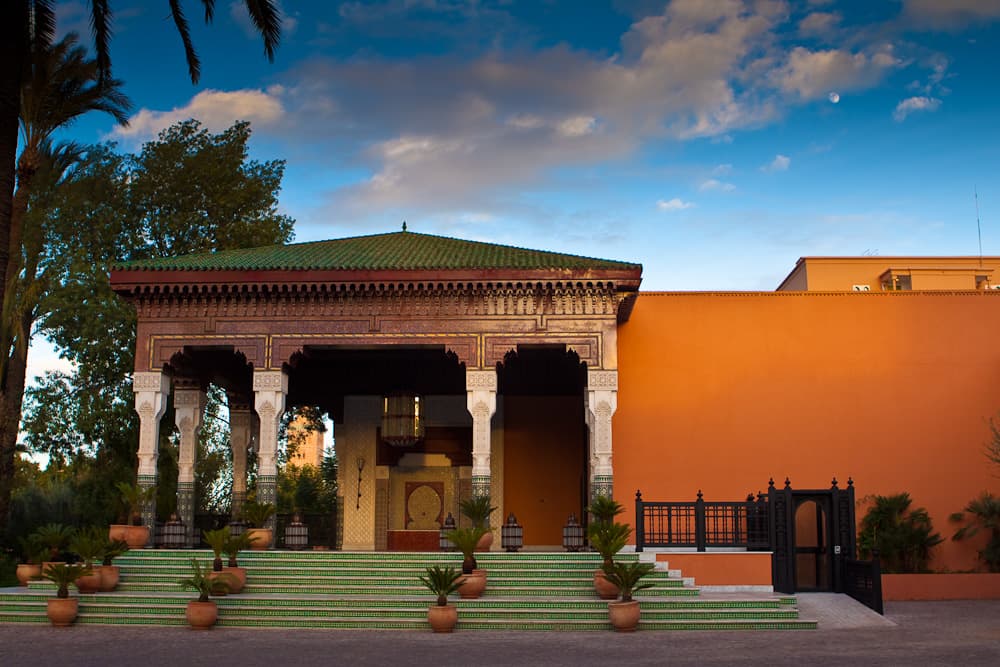
The Route de Ouarzazate leaves Marrakech towards the Atlas past golf courses and olive groves, and after twelve kilometres a pink wall with a green-tiled gate marks Amanjena. Ed Tuttle designed it for Aman in 2000 as the group's first resort in Africa, on flat land south-east of the city with the High Atlas rising to the south.
History
Aman had built in Asia and the Pacific through the 1990s and chose Morocco for its first step onto another continent. The name means "peaceful paradise". Tuttle, who had designed Amanpuri and Amanjiwo, took the Moorish palace and the Berber kasbah as his models and completed the resort in 2000. The site has hosted film crews and visiting celebrities since, and in 2016 a part of the resort was renewed with new interiors.
Architecture and design
The plan is organised around the bassin, a square pool of water, 30 metres across, of the kind that fed the gardens of the Menara and the Agdal in the medieval city. Water channels run from it to the pavilions. The buildings are of pise, the rammed earth of Marrakech, in a rose colour, with roofs of green glazed tile, cedar ceilings, carved plaster and zellige tilework in the bathrooms and courtyards. Columns and arches follow the Moorish pattern; the colonnade around the bassin is the central image of the resort. Palms, olives and cypresses give shade, and the pavilions have walled gardens.
Rooms and suites
There are 32 pavilions and 6 maisons, with a two-bedroom Al-Hamra Maison as the largest house. Each pavilion has a domed ceiling of cedar, a fireplace, a bathroom in marble and zellige, and a private courtyard garden with a fountain or a plunge pool; the maisons add a private swimming pool and a butler. A pavilion is the size of a small house, and the maisons were built for families and for guests who stay for weeks.
Dining
The Restaurant serves Moroccan cooking, with tagines, couscous and the dishes of the Marrakech kitchen, and a second menu of Mediterranean dishes. In summer, meals move to the terrace by the bassin and to the pool. A Japanese menu has been served in the evening in recent years. The bar in the main pavilion has a fireplace for the winter evenings, when the Atlas keeps the city cold after dark.
Wellness
The Aman Spa has two hammams in the Moroccan tradition, treatment rooms and a gym. The main pool is heated and lies beyond the bassin among olive trees; the maisons have their own. Two tennis courts, a putting green and the neighbouring golf courses complete the sports, and the resort arranges rides and drives into the Atlas foothills.
Weddings and events
Amanjena hosts weddings around the bassin and in the gardens, with Moroccan musicians and lanterns at dusk, and the whole resort can be taken over, which is what most large weddings do. The hotel does not publish fixed capacities; the colonnade around the bassin holds the largest dinners. Company groups use the private dining spaces and the maisons.
Location
The resort stands on the Route de Ouarzazate about twelve kilometres from the medina, between the golf courses of the Royal Golf and the Amelkis. The drive to the Jemaa el-Fna square and the souks takes around 20 minutes, and Marrakech Menara International Airport about 25 minutes. The Palmeraie is on the other side of the city, about half an hour away. Among the luxury hotels of Marrakech, this is one of the few built with the mountains as the view, and on clear winter days the snow of the Atlas shows above the olive groves.
At a glance
What sets it apart
- 01First Aman resort in Africa, opened 2000
- 02Central bassin of water with colonnade, designed by Ed Tuttle
- 0332 pavilions and 6 maisons in rose pise with green-tiled roofs
- 04Two Moroccan hammams in the spa
- 05Medina about 20 minutes away on the Route de Ouarzazate
Chronology
Dates that matter
2000
Amanjena opens on the Ouarzazate road outside Marrakech, Aman's first resort in Africa.
2016
Part of the resort reopens with renewed interiors.