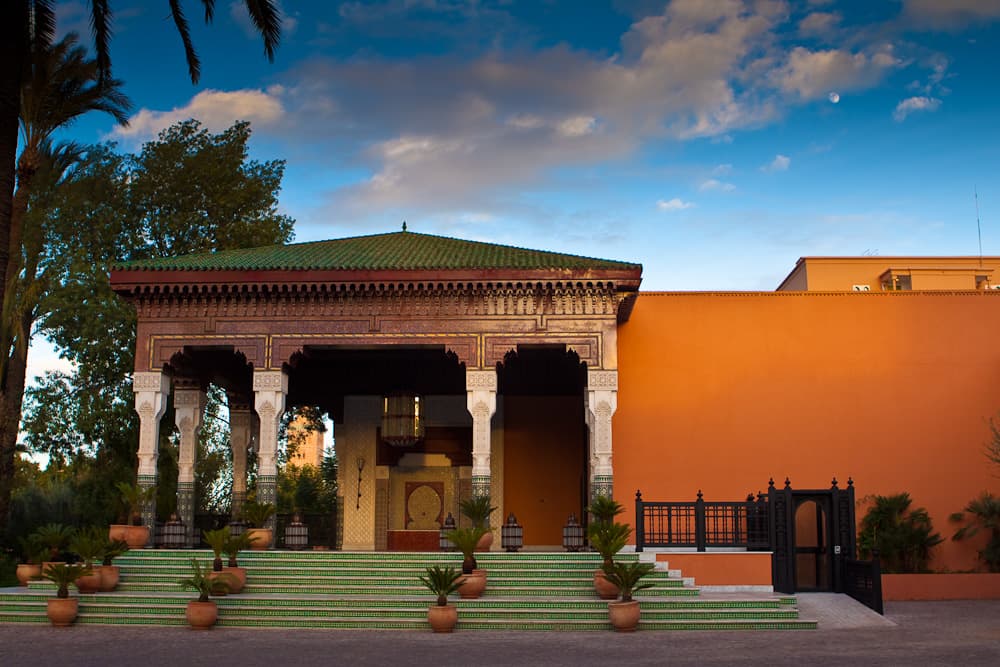
A gate in the ochre ramparts near Bab Jdid opens onto a lane of carved cedar doors, each one the entrance to a private house. Royal Mansour Marrakech was built as a town within the town: 53 riads of three storeys inside a walled compound of three and a half hectares, next to the old medina and a few hundred metres from the minaret of the Koutoubia. It opened in 2010 on the orders of King Mohammed VI, who wanted a showcase of Moroccan craft, and was built by the royal holding company.
History
The project was announced in the mid-2000s and took about three years to build. Some 1,500 craftsmen from across Morocco worked on the zellige mosaic, the carved plaster, the painted cedar ceilings and the brass, most of it done on site in workshops set up for the purpose. The name recalls the Mansour of the Saadian dynasty, the sultan who built the Badi palace a short distance away. Since opening the hotel has added gardens and restaurants, and in 2023 it reopened its spa and public rooms after a refresh.
Architecture and design
The plan is that of a medina: narrow lanes, small squares with fountains, orange trees, and behind each door a riad arranged around a courtyard open to the sky. There are no corridors. A network of tunnels under the compound carries staff, laundry and room service between the kitchens and the riads, so that guests never see a trolley in the lanes. The gardens, planted around a central pool, were laid out by the Spanish landscape designer Luis Vallejo. The spa is a three-storey atrium of white wrought-iron lattice, the single most photographed room in the hotel.
Rooms and suites
Each of the 53 riads is a house: a salon and courtyard on the ground floor, one to four bedrooms above and a roof terrace with a plunge pool and a view of the Atlas on clear days. The smallest riads have one bedroom; the largest, the Grand Riad, has four and its own hammam and pool. Every riad has a butler reached by a bell.
Dining
La Grande Table Marocaine serves Moroccan cooking in a dining room of carved plaster and silk. La Grande Table Française opened with Yannick Alléno as consulting chef. Sesamo, the Italian restaurant, opened in 2019 with the Alajmo family of Padua, whose Le Calandre holds three Michelin stars. Le Jardin serves lunch under the trees by the pool, and the tea salon and bar occupy the public rooms off the lobby. Cooking classes are held in a dedicated kitchen.
Wellness
The spa occupies 2,500 square metres under the white lattice atrium, with two hammams, treatment rooms, a hydrotherapy pool, a hairdresser and a fitness room. The main pool in the garden is heated; each riad also has its own rooftop plunge pool.
Weddings and events
The hotel hosts weddings in the gardens and in the Moroccan restaurant, and larger celebrations on the lawns around the pool, with the riads taken by the families. Meeting rooms are few and small, in keeping with a hotel of 53 keys; incentive groups usually take the whole compound. Moroccan wedding traditions, with the amariya procession and the negafa, are catered for.
Location
Royal Mansour stands on the rue Abou Abbas El Sebti, inside the walls near Bab Jdid, between the Koutoubia mosque and the Mamounia gardens. The Jemaa el-Fna square is ten minutes on foot. Marrakech Menara Airport is about 15 minutes by car. Of the luxury hotels in Marrakech it is the only one built from scratch as a walled medina, and the only one owned by the king.
At a glance
What sets it apart
- 0153 three-storey riads, each with courtyard, roof terrace and plunge pool
- 02Built by about 1,500 Moroccan craftsmen between 2007 and 2010
- 03Underground tunnels for staff and service beneath the lanes
- 04Spa under a three-storey white wrought-iron lattice atrium
- 05Gardens by Luis Vallejo around a heated central pool
Chronology
Dates that matter
2010
Royal Mansour opens with 53 riads on the orders of King Mohammed VI.
2019
Sesamo, the Italian restaurant with the Alajmo family, opens.
2023
The hotel reopens its spa and public rooms after a renovation.