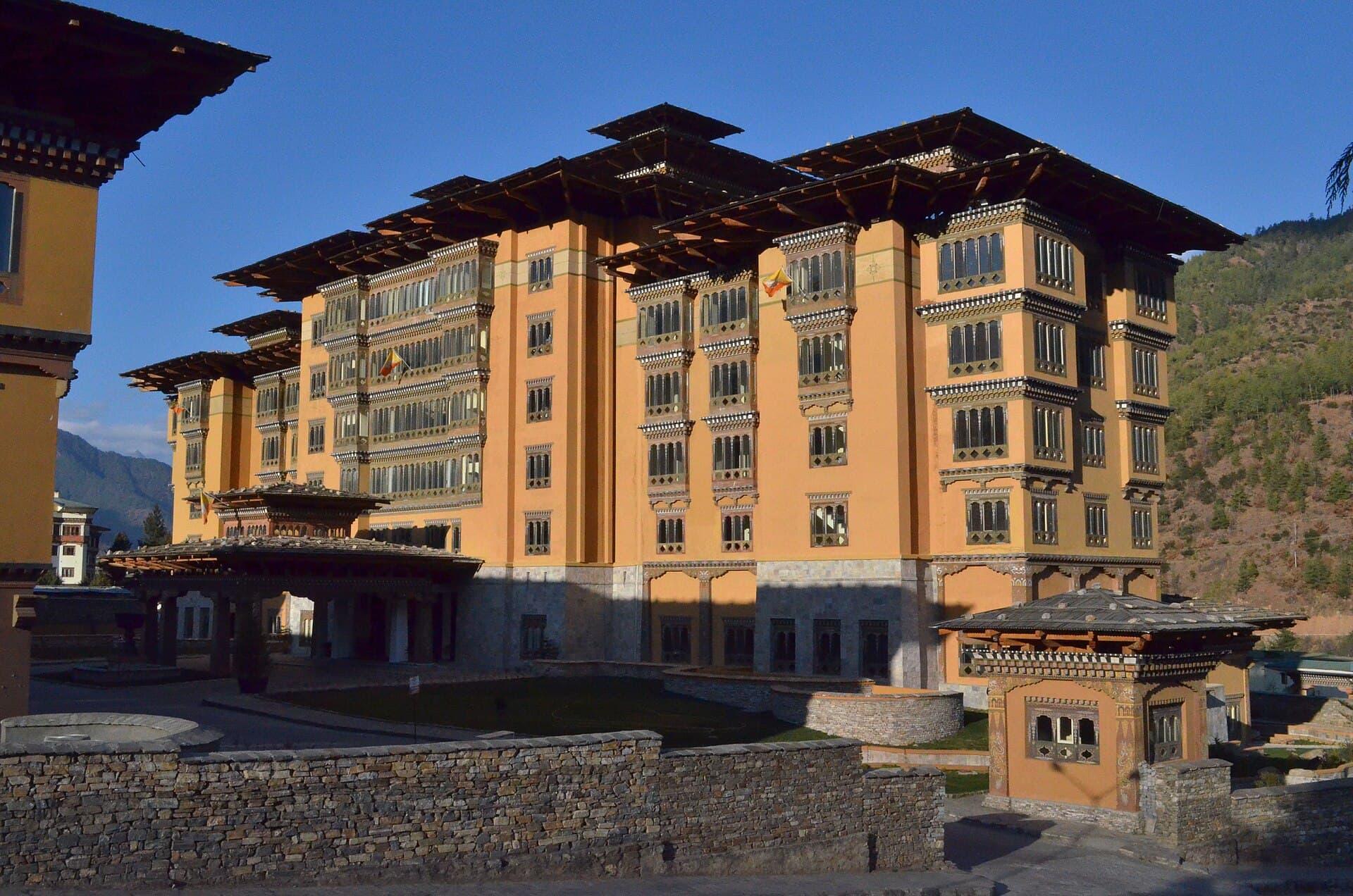
Blue pines surround the suites of Amankora Paro, at the upper end of Bhutan's Paro valley, and the road from the lodge passes the ruined walls of Drukgyel Dzong, the fortress that once guarded the route north. Paro is the first of five Amankora lodges strung across western and central Bhutan, and for most guests it is also the first night in the kingdom. Aman conceived them as a single journey rather than a single hotel: guests travel between valleys by road, and each lodge repeats the same architecture, the same rituals and the same quiet.
History
Bhutan admitted its first tourists only in 1974, and for decades it kept numbers low by charging every visitor a daily tariff. International hotel groups arrived slowly. Amankora opened in 2004, among the first, and its lodges at Paro, Thimphu, Punakha, Gangtey and Bumthang were planned as stages on a circuit. The name joins aman, the Sanskrit word for peace, to kora, the Tibetan term for a circular pilgrimage, and the itinerary follows the idea: a slow loop through the dzongs, monasteries and passes of the western and central valleys.
Architecture and design
All five lodges were designed by the Australian architect Kerry Hill, whose practice also designed Aman Tokyo. Hill took the thick rammed-earth walls of Bhutanese farmhouses and dzongs and set them in long, low compounds of courtyards and timber-framed windows, with the mountains as the only ornament. Inside, the suites are panelled in pale wood, with a bukhari, the wood-burning stove found in Bhutanese homes, and a large bathroom with a deep terrazzo tub. The restraint is deliberate: nothing competes with the views or the temples.
Rooms and suites
The Paro lodge has 24 suites, the largest number on the circuit, arranged in buildings among the pines. Every suite follows the same plan, a bedroom and living area in one long room warmed by the stove, with a dressing area and the bathroom beyond. Elsewhere the lodges are smaller; Punakha and Gangtey each have only eight suites, which makes a full circuit feel like a series of private houses.
Dining
Each lodge has a dining room and a living room with a fire. Menus pair Bhutanese dishes, among them ema datshi, the national stew of chillies and cheese, with Asian and Western cooking, and much of the produce comes from local farms. Picnics are a feature of the Amankora journey: lunch laid out beside a river, below a monastery or on a pass, with staff driving ahead to set the table.
Wellness
The spa at Paro offers massage and the traditional Bhutanese hot stone bath, in which river stones heated in a fire are dropped into a wooden tub of water infused with herbs. Yoga, meditation and guided walks fill the hours between visits to dzongs and temples. The altitude, around 2,200 metres in Paro, rewards a slow first day.
Location
The lodge lies at the upper end of the valley, near Drukgyel Dzong, whose restoration began in 2016, and close to the start of the trail to Taktsang, the Tiger's Nest monastery, which clings to a cliff about 900 metres above the valley floor. On clear days Jomolhari, the 7,326-metre peak on the northern frontier, can be seen from this end of the valley. Paro International Airport, the country's only international airport, is about half an hour away by road, which makes Amankora Paro the obvious luxury hotel in Paro for a first or last night. Beyond it, the circuit continues to Thimphu, the capital, then east over the Dochu La to the rice terraces of Punakha, the Phobjikha valley at Gangtey, where black-necked cranes spend the winter, and Bumthang, where the lodge stands beside the Wangdicholing Palace.
At a glance
What sets it apart
- 01First of five Amankora lodges across Bhutan
- 02Rammed-earth architecture by Kerry Hill
- 03Suites heated by bukhari wood-burning stoves
- 04Near Drukgyel Dzong and the trail to Taktsang
- 05Traditional hot stone bath at the Paro spa
Chronology
Dates that matter
1649
Drukgyel Dzong is built to guard the upper Paro valley.
1951
Fire guts Drukgyel Dzong, leaving the ruins that stand near the lodge.
1974
Bhutan admits its first tourists.
1983
Druk Air begins flights into Paro, the country's only international airport.
2004
Amankora opens, with its lodges designed by Kerry Hill.
2016
Restoration of Drukgyel Dzong begins.