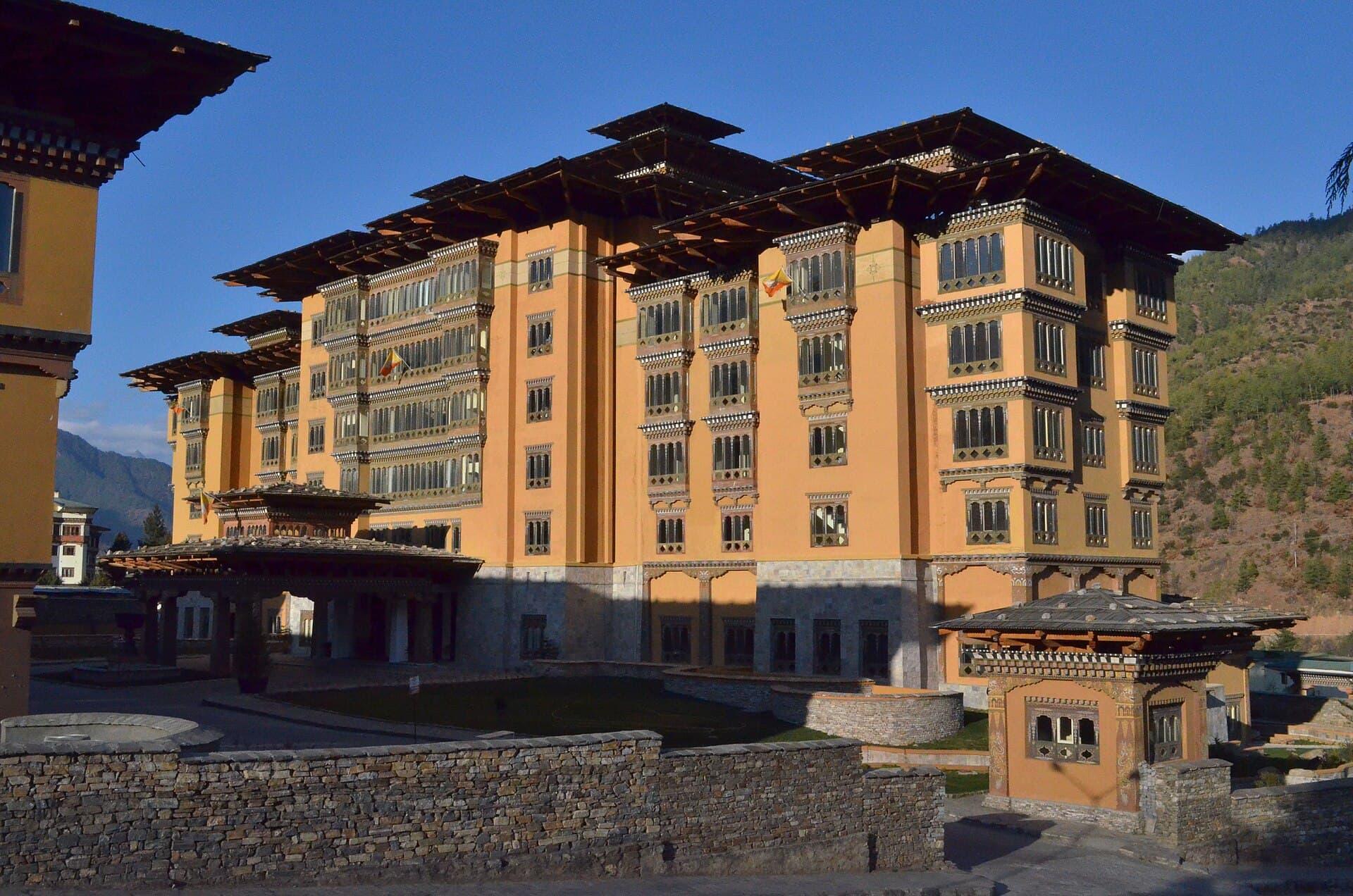
Thimphu spreads along the valley of the Wang Chhu at well over 2,000 metres, and the Thimphu lodge of Six Senses Bhutan looks down on it from a forested hillside above the city. This is one of five lodges the group opened across the kingdom from 2018. Together, Thimphu, Paro, Punakha, Gangtey and Bumthang count 82 suites and villas, and most guests travel between several of them, each set in a different landscape of the country.
History
Bhutan opened to tourism in 1974 and has always limited visitor numbers by charging a daily fee, so international hotel groups have arrived slowly and in small numbers. Six Senses, the wellness-led brand founded by Sonu and Eva Shivdasani in the 1990s, spent years planning its Bhutan circuit before the first lodges received guests in 2018; the others followed in 2019. That same year InterContinental Hotels Group bought Six Senses, and the Bhutan lodges now sit within the IHG portfolio while keeping the brand's own approach to food, design and wellbeing.
Architecture and design
The lodges were designed by Habita Architects of Bangkok, and each was shaped around its site rather than repeated from a template. Stone, timber and earth tones recur, with low roofs, terraces and wide windows that turn the mountains into the main feature of every room. Interiors stay muted and uncluttered, closer to a retreat than a palace. The result is architecture that defers to the landscape, a choice that suits a country where new buildings must follow traditional forms.
Rooms and suites
Across the circuit, accommodation runs to 82 keys, divided between suites and larger villas. The suites are spacious and heated against cold Himalayan nights, with deep baths and wide views. The villas add more space and, at several lodges, private outdoor areas. The lodges in the centre of the country are the smallest, while Thimphu and Paro are larger and better suited to families and small groups travelling together.
Dining
Each lodge has its own restaurant. Menus combine Bhutanese cooking, with its chillies, cheese and red rice, with Indian, Asian and Western dishes, and a share of the produce comes from farms in the surrounding valleys. The Six Senses approach shows on the plate: lighter cooking, little processed food and a preference for what grows nearby. Ema datshi, the national stew of chillies and cheese, is on hand for anyone who wants to try it.
Wellness
Wellness is the reason many guests choose Six Senses. Each lodge has a spa, and programmes combine massage, meditation, yoga and the Bhutanese hot stone bath, in which heated river stones are dropped into a wooden tub. Sessions can be planned across the whole circuit, so a stay builds over a week or more rather than starting again at each lodge. Altitude matters here: Thimphu and Paro both lie well above 2,000 metres, and the first days are best taken slowly.
Location
Thimphu is often described as the only national capital without traffic lights; a police officer directs cars at the main junction. Its sights sit close together: Tashichho Dzong, which houses the throne room, government offices and the central monastic body; the National Memorial Chorten, built in 1974; the weekend market by the river; and, on a hill to the south, the gilded bronze Buddha Dordenma. Paro International Airport, the country's only international gateway, is about an hour away by road, and many itineraries begin with a night in Paro before driving to the capital. Beyond Thimphu, the road climbs east over the Dochu La pass towards Punakha and its dzong, then continues to Gangtey, in the Phobjikha valley, where black-necked cranes winter, and on to Bumthang in the centre of the country. For travellers choosing a luxury hotel in Thimphu, the lodge's appeal lies as much in the circuit it opens as in the city below.
At a glance
What sets it apart
- 01Five lodges across Bhutan, 82 suites and villas in total
- 02Thimphu lodge on a forested hillside above the capital
- 03Lodges designed by Habita Architects of Bangkok
- 04Spa and wellness programmes at each lodge
- 05About an hour by road from Paro International Airport
Chronology
Dates that matter
1974
Bhutan opens to tourism, and the National Memorial Chorten is built in Thimphu.
2015
The gilded bronze Buddha Dordenma is completed on a hill above Thimphu.
2018
Six Senses opens its first lodges in Bhutan.
2019
InterContinental Hotels Group acquires Six Senses; the Bhutan circuit is completed.