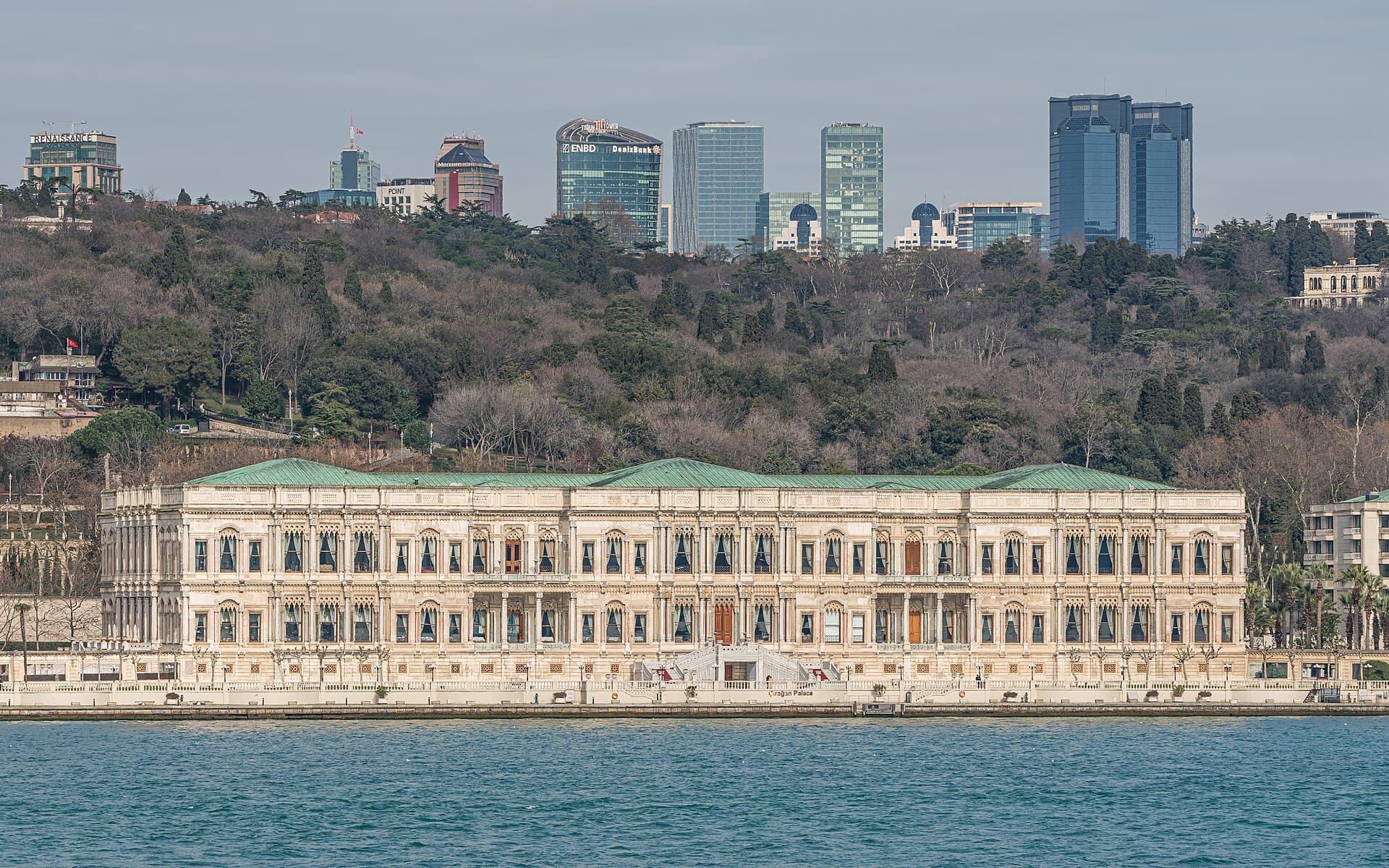

Çırağan Caddesi follows the European shore of the Bosphorus between Beşiktaş and Ortaköy, and for most of its length a wall hides the water. At one point the wall opens on a gate, and beyond it a long marble palace turns its front to Asia across the strait. This is the Çırağan Palace, built for Sultan Abdülaziz in the 1860s, and since 1991 the historic core of Çırağan Palace Kempinski Istanbul, the hotel that grew up around its restored shell.
History
The Ottoman court had kept wooden pavilions on this shore since the seventeenth century, and the name recalls the torch-lit festivals, çırağan in Turkish, once held on it. Abdülaziz replaced them with a stone palace, built between 1863 and 1867 by the Balyan family, the Armenian dynasty of architects who also gave the city the Dolmabahçe Palace. Its life as a residence was short. Abdülaziz was deposed in 1876, and later that year the palace became the place of confinement of his nephew, the deposed Sultan Murad V, who lived there until his death in 1904. In 1909 the Ottoman parliament moved in. In January 1910 a fire left only the outer walls standing.
For most of the next eight decades the shell stood empty on the shore, and part of its grounds served as a football ground used by the Beşiktaş club. In the late 1980s the Japanese contractor Kumagai Gumi restored the palace and built a new hotel wing beside it. The hotel opened in 1991 with Kempinski as operator, the role it has held ever since.
Architecture and design
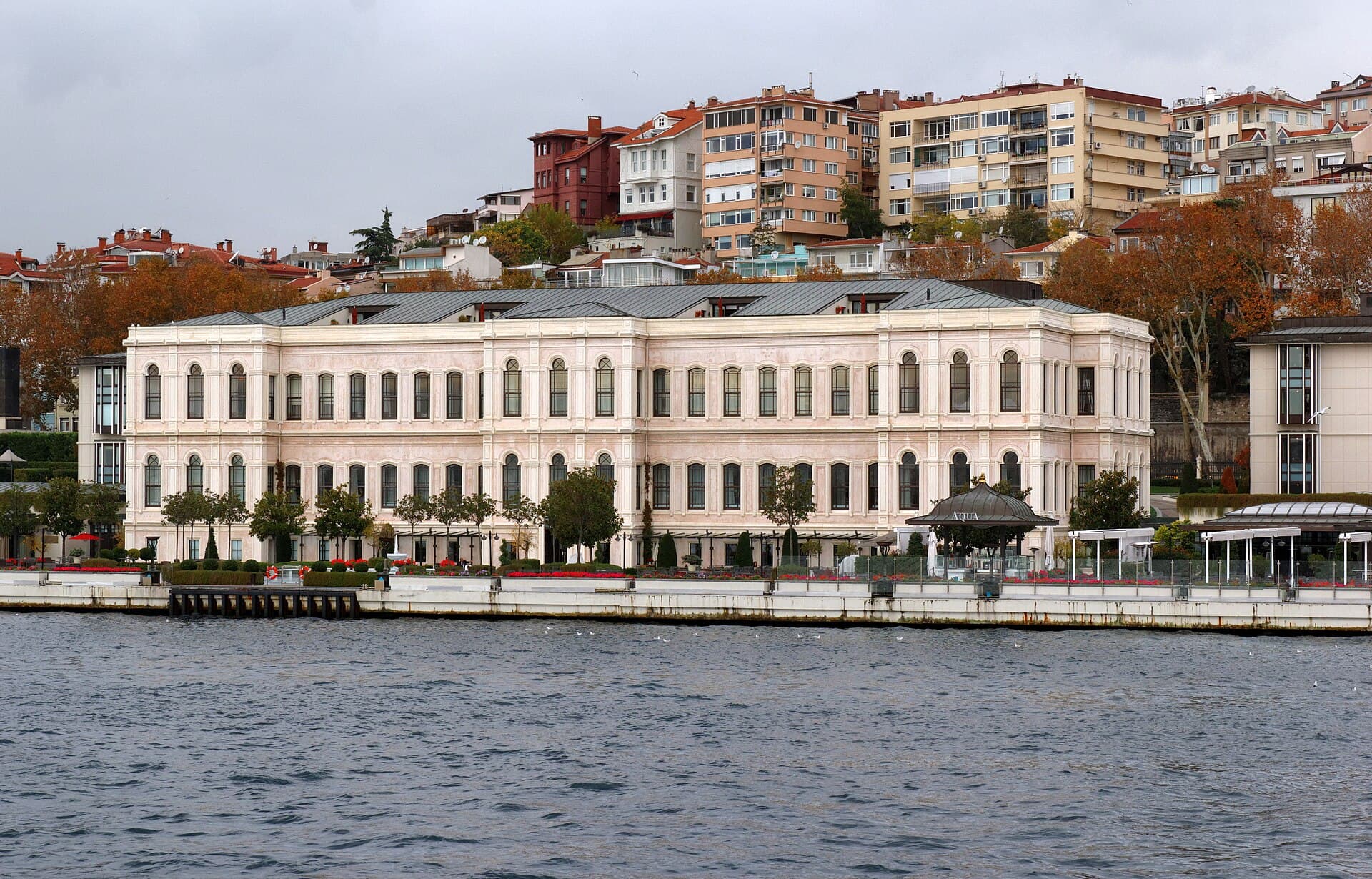
The palace is a long two-storey block faced in marble, its windows framed with the mixture of Ottoman, Moorish and European ornament that marks the Balyan buildings of the period. Almost nothing inside survived the fire, so the interiors were rebuilt rather than restored, and they now hold the palace suites, the main restaurant and the halls used for receptions. The 1991 wing stands beside it, a modern block in a quieter idiom. Between the two run gardens and terraces, with the pool set on the quay itself.
Rooms and suites
The hotel has more than 300 rooms and suites, most in the modern wing, with views of the Bosphorus or of the gardens and the wooded slopes of Yıldız Park. A small group of suites occupies the palace itself. The largest of them, the Sultan Suite, is often cited among the largest hotel suites in Europe, and its windows look straight onto the shipping lanes of the strait.
Dining
Tuğra, the restaurant inside the palace, serves Ottoman cooking based on the recipes of the imperial kitchens, in high rooms with windows on the water. Breakfast and lunch move onto the terraces in warm weather. The Gazebo Lounge, between the palace and the garden, serves afternoon tea and drinks, with tankers and ferries passing a few dozen metres away.
Wellness
The outdoor pool is an infinity pool on the edge of the quay, heated through the year, so swimmers look across the water to the Asian shore almost at sea level. The spa adds a traditional Turkish hammam, treatment rooms and a fitness room.
Weddings and events
The palace halls and the gardens on the water have long been a choice for Istanbul weddings. Large receptions use the hotel's ballroom and the palace terraces; smaller dinners take the palace salons, and the same rooms serve for conferences and corporate events through the year. Capacities vary with the room and the layout and are not listed here.
Location
The hotel stands on Çırağan Caddesi in Beşiktaş, with Yıldız Park climbing the hill behind it. The Ortaköy Mosque and the Bosphorus Bridge are within walking distance north along the shore, and Dolmabahçe Palace is about two kilometres south. For a luxury hotel in Istanbul it is placed for the water rather than the monuments: Sultanahmet is roughly 25 minutes by car. Istanbul Airport is about 45 minutes away in light traffic, and Sabiha Gökçen, on the Asian side, about an hour.
At a glance
What sets it apart
- 01Palace built 1863 to 1867 for Sultan Abdülaziz by the Balyan architects
- 02Gutted by fire in 1910, restored and opened as a hotel in 1991
- 03Heated infinity pool on the quay of the Bosphorus
- 04Tuğra restaurant serving Ottoman cooking inside the palace
- 05Palace suites, among them the Sultan Suite
Chronology
Dates that matter
1863
Construction of the stone palace for Sultan Abdülaziz begins on the Bosphorus shore.
1876
The deposed Sultan Murad V is confined in the palace, where he lives until his death in 1904.
1909
The Ottoman parliament moves into the palace.
1910
A fire in January leaves only the outer walls standing.
1991
After restoration and the building of a new wing, the hotel opens under Kempinski.