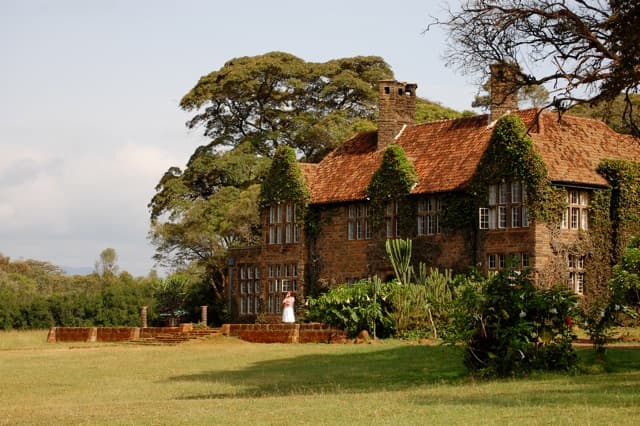
Denys Finch Hatton died at Voi on 14 May 1931, when the Gipsy Moth he was flying came down just after take-off. His name now belongs to Finch Hattons Luxury Tented Camp, inside Tsavo West National Park in southern Kenya, where tents on timber decks surround a string of pools fed by underground springs. Hippos lie in the water through the day, crocodiles take the sun on the banks, and on clear mornings the snows of Kilimanjaro show in the distance.
History
Finch Hatton was a younger son of the Earl of Winchilsea, educated at Eton and Oxford, who came out to British East Africa before the First World War. In the 1920s he led hunting safaris, including trips for the Prince of Wales, and he took up flying to scout game from the air. Karen Blixen wrote about him in Out of Africa, published in 1937, and Robert Redford played him in Sydney Pollack's film of 1985. He is buried in the Ngong Hills above Nairobi.
Tsavo had its own fame long before the camp. In 1898 two maneless lions killed workers building the Uganda Railway bridge over the Tsavo River until the engineer John Henry Patterson shot them. His book The Man-Eaters of Tsavo followed in 1907, and the lions are now in the Field Museum in Chicago. Tsavo was gazetted as a national park in 1948 and divided for management into Tsavo East and Tsavo West, which together form one of the largest protected areas in Kenya.
Architecture and design
The camp is planned around the water. A central building holding the dining room, bar and lounge looks over the main pool, and the tents line the banks on either side, linked by raised walkways so that animals can move beneath them. Each tent is a canvas room under a fixed roof on a timber platform, which gives the sound of a camp with the solidity of a lodge. The decoration looks back to the safaris of Finch Hatton's day, with dark wood, brass, leather and canvas.
Rooms and suites
There are fewer than twenty tents, suites among them, each with its own bathroom and a veranda over the pools. The water is the point of the place. After dark the hippos leave it to graze on the banks, and their grunts carry through the canvas along with the frogs and, some nights, a lion calling further off. The camp is unfenced, so staff walk guests back to their tents after dinner.
Dining
Dinner has long been the formal part of the day here, served with linen, silver and crystal in the main dining room, a habit that suits the name over the door. Breakfast and lunch move out onto the decks above the water, where the hippos are rarely more than a few metres away.
Location
Tsavo West is volcanic country, hillier and greener than the flat red plains of Tsavo East on the other side of the Mombasa highway. Its best-known sight is Mzima Springs, where water that has filtered through the lava of the Chyulu Hills rises into clear pools. A submerged viewing chamber lets visitors watch hippos and fish from below, and a pipeline carries part of the flow to Mombasa. The Shetani lava flow, a black sheet of rock whose name means devil in Swahili, lies in the north-west of the park, and the Ngulia Rhino Sanctuary keeps black rhino behind fences. Elephant, lion, leopard, buffalo and lesser kudu are all seen on drives.
Most guests at this luxury camp in Tsavo West arrive by air, on light aircraft from Nairobi Wilson Airport to the camp's own airstrip. By road the usual way in is the Mtito Andei gate on the Mombasa highway, and the Madaraka Express railway stops at Mtito Andei station, on the line between Nairobi and the coast.
At a glance
What sets it apart
- 01Named after Denys Finch Hatton, who died in a plane crash at Voi in 1931
- 02Tents on raised decks around natural spring-fed pools with resident hippos
- 03Inside Tsavo West National Park, gazetted in 1948
- 04Kilimanjaro visible on clear mornings
- 05Mzima Springs and the Ngulia Rhino Sanctuary within the park
Chronology
Dates that matter
1898
Two lions kill railway workers at the Tsavo River bridge until John Henry Patterson shoots them.
1931
Denys Finch Hatton dies when his Gipsy Moth crashes at Voi.
1937
Karen Blixen publishes Out of Africa, with Finch Hatton at the heart of the story.
1948
Tsavo is gazetted as a national park and divided into Tsavo East and Tsavo West.
1985
Sydney Pollack's film Out of Africa casts Robert Redford as Finch Hatton.