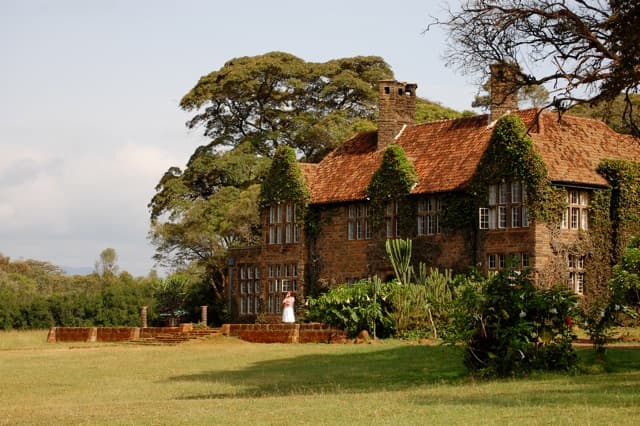
In the early morning, in the Langata suburb of Nairobi, a herd of endangered Nubian giraffe wanders the grounds of a house built in 1932 and puts its heads through the windows at breakfast. Giraffe Manor, the twelve-room hotel in that house, is owned by The Safari Collection, a Kenyan family company, and the manor's conservation work through the adjoining Giraffe Centre is the reason the giraffes are there at all.
History
The house was built in 1932 by Sir David Duncan, a Scottish businessman, in the style of a Scottish hunting lodge, on land that was then open forest on the edge of the Ngong hills. It changed hands several times before 1974, when Jock Leslie-Melville, a Kenyan of Scottish descent, and his American wife Betty bought it. That year they brought a young Rothschild's giraffe named Daisy to the garden. Her subspecies, now classified as Nubian giraffe, had been reduced to a small population on a ranch in western Kenya that was being broken up, and the Leslie-Melvilles decided to breed from rescued calves at the manor.
Daisy was followed by Marlon and others, and the couple founded the African Fund for Endangered Wildlife, which opened the Giraffe Centre next door as an education site. Betty wrote the story in Raising Daisy Rothschild, published in 1977. After Jock's death in 1984 the family began taking paying guests to fund the work, and in 2009 Tanya and Mikey Carr-Hartley, the founders of The Safari Collection, bought the manor and gave it its present form.
Architecture and design
The manor is a two-storey house of stone and timber under a steep roof, with mullioned windows, a terrace and a lawn running down to the forest. Inside it is furnished as a 1930s country house, with fireplaces, antiques and portraits rather than safari decoration. The Garden Manor wing, added in the same style, took the room count to twelve. The point of the design is the ground-floor windows and the terrace, which are at the height of a giraffe's head.
Rooms and suites
The twelve rooms are divided between the Main Manor and the Garden Manor and named after giraffes of the herd. Two of the rooms are suites. The Karen Blixen Suite and the Finch Hatton Suite are the largest, named after the neighbours whose farm at Karen gave the district its name. No other luxury hotel in Nairobi sells out as far ahead.
Dining
Meals are included and taken in the dining room or on the terrace. Breakfast is the event of the day: the giraffes come to the windows and the terrace in the early morning to be fed pellets by the guests, then wander back into the forest. Dinner is a set menu served at individual tables, with guests sharing the drawing room afterwards.
Wellness
The Retreat, a spa pavilion in the garden with treatment rooms and a heated pool, was added in 2019.
Weddings and events
Giraffe Manor is not a conference hotel and does not take meetings. It can be booked in its entirety for a wedding or a family gathering of up to about 24 guests sleeping in the house, with ceremonies on the lawn and the giraffes as uninvited witnesses, and small receptions of up to about 50. Bookings of this kind are made a year or more ahead.
Location
The manor lies in Langata, a leafy suburb about 20 kilometres south-west of central Nairobi, beside the Giraffe Centre and close to the Karen Blixen Museum and the Sheldrick Wildlife Trust's elephant orphanage. By road it is about 30 kilometres to Jomo Kenyatta International Airport and about ten to Wilson Airport, the base for light aircraft to the safari camps. The Safari Collection runs transfers for guests continuing to its camps in the Masai Mara, Laikipia and Samburu.
At a glance
What sets it apart
- 01Built in 1932 by Sir David Duncan as a Scottish-style hunting lodge
- 02Home to a breeding herd of endangered Nubian giraffe since 1974
- 03Giraffes feed from the breakfast-room windows and the terrace
- 04Twelve rooms, named after giraffes of the herd
- 05Owned by The Safari Collection since 2009; next to the Giraffe Centre
Chronology
Dates that matter
1932
Sir David Duncan builds the manor in the Langata forest.
1974
Jock and Betty Leslie-Melville buy the house and bring Daisy, the first giraffe.
1977
Betty Leslie-Melville publishes Raising Daisy Rothschild.
1984
Jock Leslie-Melville dies; the family begins taking paying guests.
2009
The Safari Collection buys the manor.
2019
The Retreat spa and pool open in the garden.