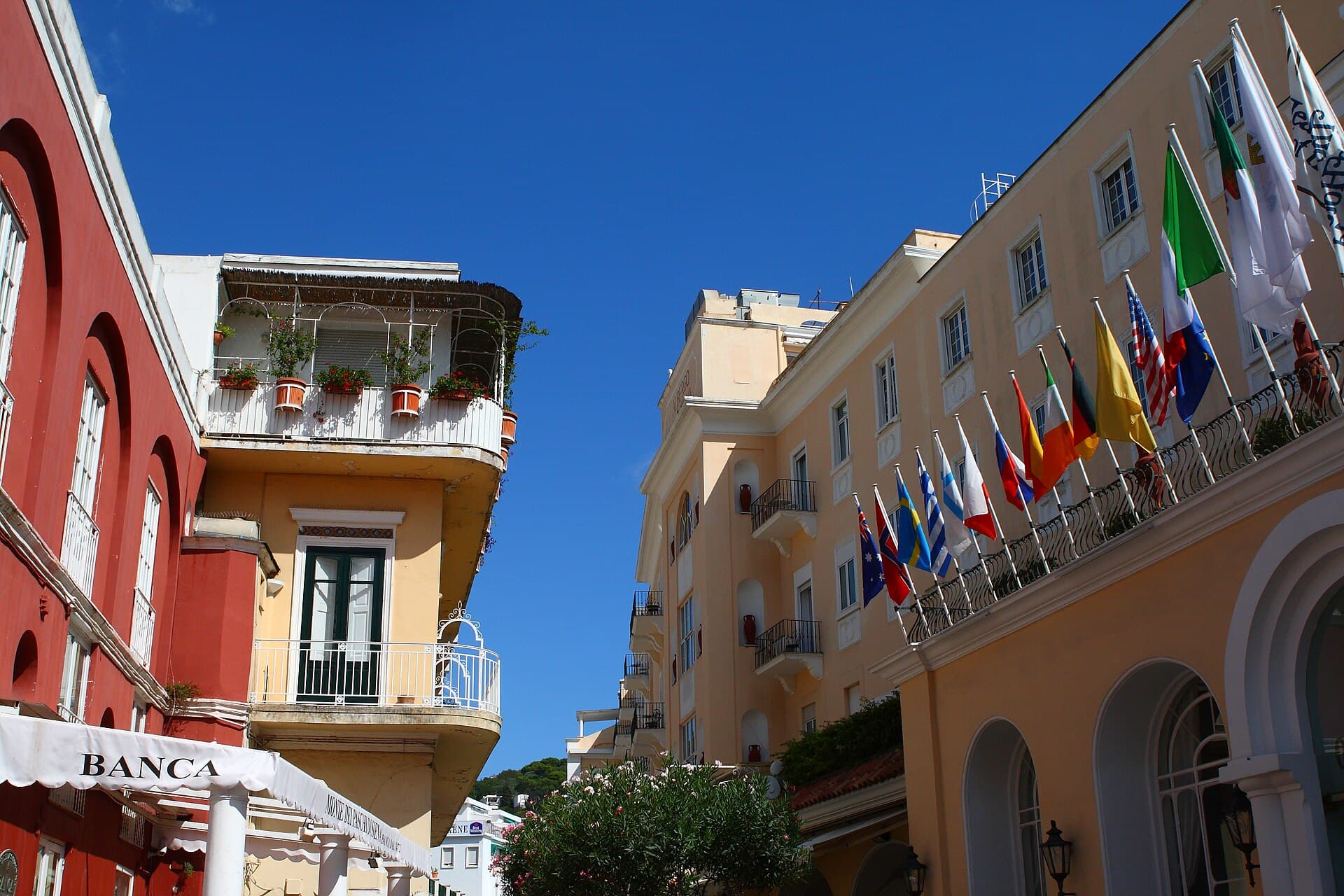
Via Camerelle, the street of Capri's boutiques, starts at a white facade with a long terrace of cane chairs, and everybody who walks down from the Piazzetta passes it. The Grand Hotel Quisisana has stood at this corner of Capri since the 1840s, and its terrace is where the island goes to be seen in the evening.
History
George Sidney Clark, a doctor from Scotland, arrived on Capri in the 1840s and built a sanatorium for English patients in 1845. He named it Quisisana, from the Italian qui si sana, here one heals. The air of Capri was prescribed for chest complaints, and the building faced south towards the sea for that reason. By 1861 the patients had given way to paying guests and the sanatorium became a hotel.
The Quisisana grew with the island's fame through the Belle Époque. Friedrich Alfred Krupp, the German industrialist, stayed for long periods at the turn of the century. Oscar Wilde was asked to leave in 1897 when other guests objected to his presence, an episode he recorded in a letter. The Morgano family, Capri hoteliers for generations, has owned and run the hotel since the early twentieth century and still does.
Architecture and design
The hotel is a long neoclassical block, white with yellow shutters, that has been extended several times without losing its line. The public rooms keep the scale of a grand hotel: a marble lobby, the Krupp bar with its wood panelling, and a winter garden. The Teatro Quisisana, a theatre inside the hotel with Art Nouveau detailing, is a rarity in a hotel of this size and still works as a theatre for concerts and congresses.
Rooms and suites
Around 150 rooms and suites occupy the main building and the wings around the garden. Most have tiled floors in the Vietri style and a balcony or terrace; those on the upper floors facing south look over the garden towards the Faraglioni and the Certosa. The hotel is closed from November until the end of March, and the rooms are refreshed each winter.
Dining
Quisi, the restaurant in the former ballroom, is the formal dining room, open in the evening with a terrace onto the garden. La Colombaia serves lunch beside the pool. The Rendez-Vous terrace on Via Camerelle is the bar, and the place on Capri where people meet before dinner. Breakfast is served on the terrace or in the Krupp room.
Wellness
QuisiBeauty, the spa, has a hydro pool, sauna, Turkish bath and treatment rooms, with a gym alongside. The outdoor pool in the garden is the largest on the island. There are two tennis courts within the grounds, which is unusual for a property in the middle of Capri town.
Weddings and events
The Quisisana hosts weddings in the garden, on the terraces and in the ballroom, and congresses in the theatre and a set of meeting rooms. The hotel counts five event spaces, of which the theatre is the largest and seats a conference audience in rows. Civil ceremonies on Capri take place at the town hall on the Piazzetta, a few hundred metres uphill from the hotel.
Location
The hotel stands at Via Camerelle 2, in the centre of Capri town, between the Piazzetta and the Gardens of Augustus. Capri has no cars in the centre, so arrival is by hydrofoil or ferry from Naples or Sorrento to Marina Grande, then by funicular or taxi up to the town and on foot or by hotel porter from the Piazzetta. The nearest airport is Naples Capodichino, about an hour and a half away in total. As a luxury hotel in Capri town it has no rival on the same scale: everything else of its class on the island is smaller or further out.
At a glance
What sets it apart
- 01Founded in 1845 as a sanatorium by the Scottish doctor George Sidney Clark
- 02Owned and run by the Morgano family of Capri
- 03Teatro Quisisana, a theatre inside the hotel with Art Nouveau detailing
- 04Largest outdoor pool on Capri, in the hotel garden
- 05Terrace on Via Camerelle, the island's evening meeting point
Chronology
Dates that matter
1845
George Sidney Clark opens the Quisisana as a sanatorium facing the sea.
1861
The sanatorium becomes a hotel.
1897
Oscar Wilde is asked to leave the hotel after guests object to his presence.