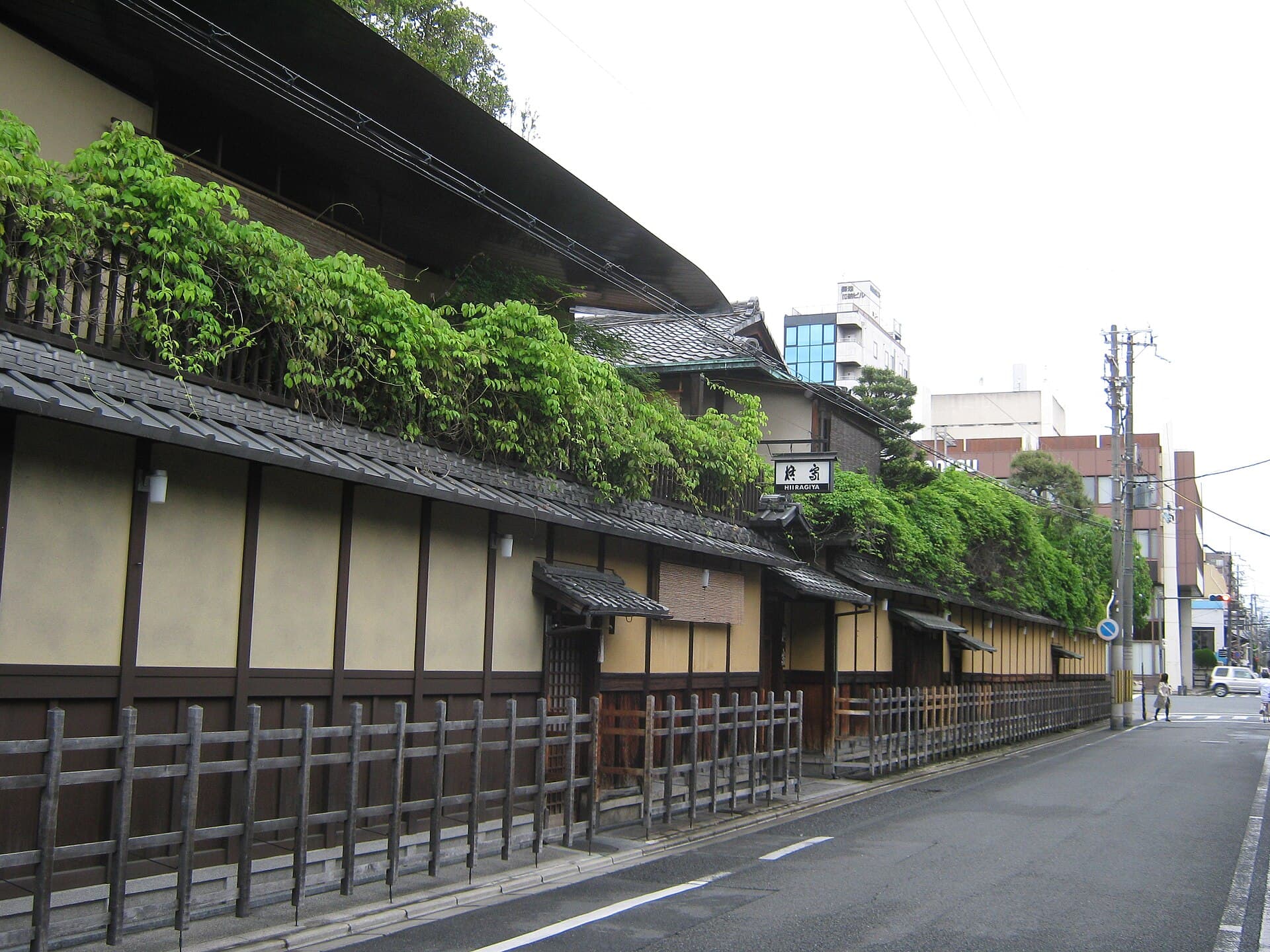
Fuyacho-dori is a narrow north-south street in central Kyoto, and just above its crossing with Aneyakoji, two of the city's most celebrated inns face each other across the roadway. One of them is Hiiragiya, behind a low gate, a stone path and a lantern. The inn has received guests since 1818, and the same family has owned and run it ever since.
History
Hiiragiya dates its founding to 1818, in the late Edo period, when Kyoto was still the seat of the emperor and the capital of courtly taste. The Nishimura family came from Wakasa, on the Japan Sea coast north of the city, and the house began as a merchant's business before it turned to lodging travellers. The name comes from the hiiragi, the holly-leaved osmanthus, a plant that Japanese households have long set by their doors to keep misfortune away, and its spiked leaf serves as the inn's emblem.
After the emperor moved to Tokyo at the start of the Meiji era, Kyoto lost its political role but kept its place as the country's cultural capital, and the inn received statesmen, scholars, writers and artists. The novelist Yasunari Kawabata, who won the Nobel Prize in Literature in 1968, was a devoted guest. Yukio Mishima stayed, and so did Charlie Chaplin. The inn passed two hundred years in 2018 with the family still in charge.
Architecture and design
The inn is built in wood around small gardens, with corridors, sliding screens and verandas that separate the guest from the street within a few steps of the entrance. An older wing keeps the rooms and craftsmanship of the earlier house, and a newer wing follows the same principles with more modern bathrooms. Baths are made of koyamaki, the Japanese umbrella pine, valued for its scent and its resistance to water. Over the generations the family has also added small inventions of its own to the fittings of the house, so the rooms hold details that guests do not meet in other ryokan.
Rooms and suites
There are fewer than thirty rooms. Each is a tatami room with a tokonoma alcove, a low table and a view of a garden. Futon are laid out in the evening and folded away in the morning, and an attendant looks after each room through the stay. The rooms in the older wing look onto moss, stone lanterns and maples. A stay here works differently from a luxury hotel in Kyoto. Meals, tea and service all come to the guest's own room, and the house is at its best for those who stay in for the evening.
Dining
Dinner is a Kyoto kaiseki meal, served course by course in the room. The menu follows the Kyoto calendar, with bamboo shoots in spring, pike conger in high summer and matsutake in autumn, and the dishes arrive on lacquer and ceramics chosen for the season. Breakfast is Japanese, with rice, grilled fish, pickles and tofu, a speciality of the city since the temple kitchens of the Middle Ages.
Location
The inn is in Nakagyo-ku, the central ward, a few streets from Kyoto City Hall. Tawaraya stands directly across the street, and Sumiya, a third historic ryokan, is close by, which makes this short stretch of Fuyacho one of the densest groups of traditional inns in Japan. Nishiki Market, the Teramachi arcades and the Kyoto Imperial Palace grounds are within walking distance. Kyoto Shiyakusho-mae on the Tozai line is the nearest subway station, and Kyoto Station, for the Shinkansen, is about fifteen minutes by taxi. Kansai International Airport is around 75 minutes away on the Haruka express, and Osaka Itami handles domestic flights.
At a glance
What sets it apart
- 01Family-run ryokan founded in 1818 on Fuyacho-dori, Kyoto
- 02Faces Tawaraya across the street
- 03Baths of koyamaki, the Japanese umbrella pine
- 04Kyoto kaiseki dinner served in the guest's room
- 05Holly osmanthus leaf as the inn's emblem
Chronology
Dates that matter
1818
Hiiragiya is founded in Kyoto in the late Edo period.
1869
The emperor settles in Tokyo, and Kyoto turns from political to cultural capital.
1968
Yasunari Kawabata, a devoted guest of the inn, receives the Nobel Prize in Literature.
2018
The inn marks two hundred years under the same family.