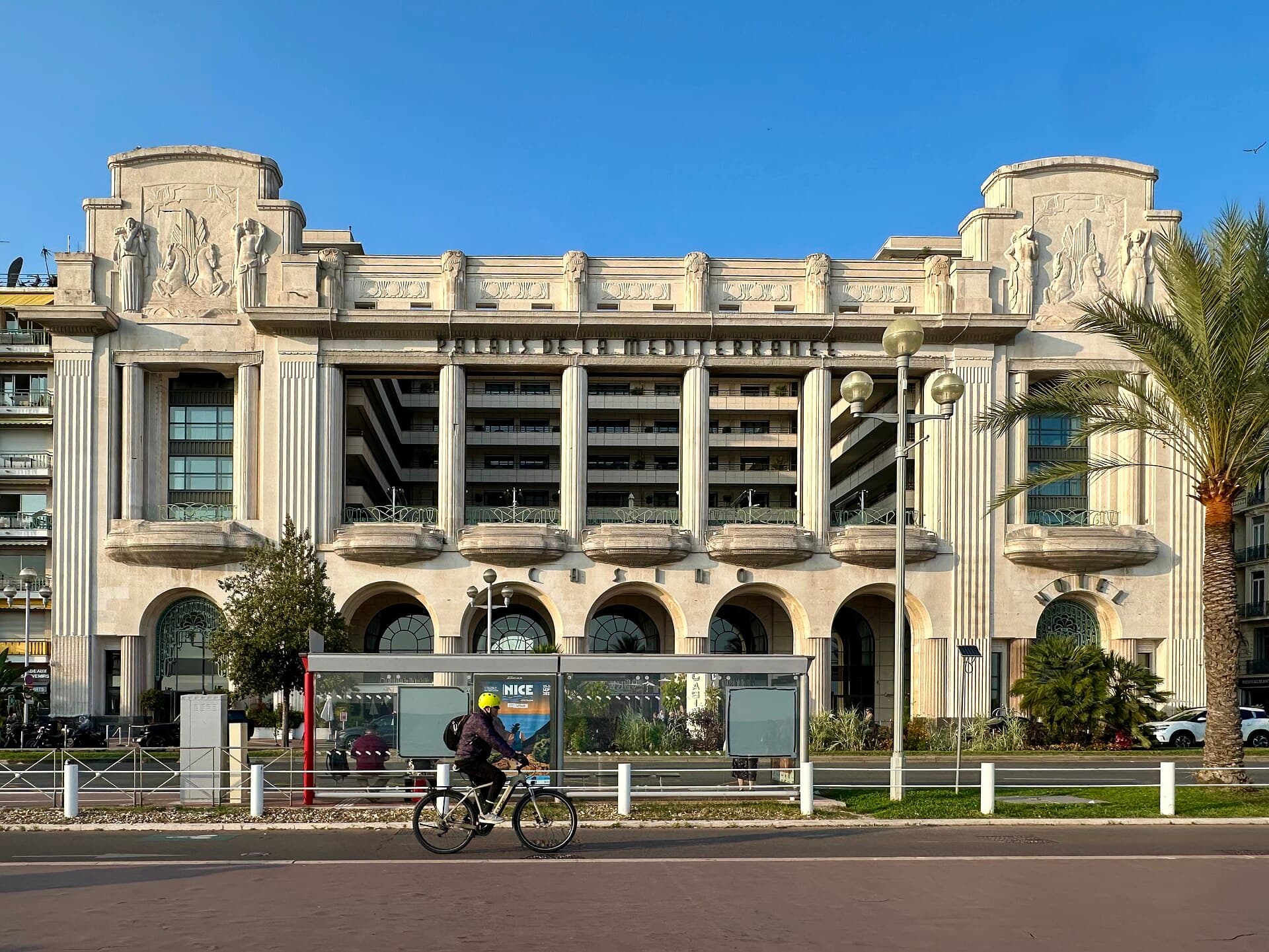
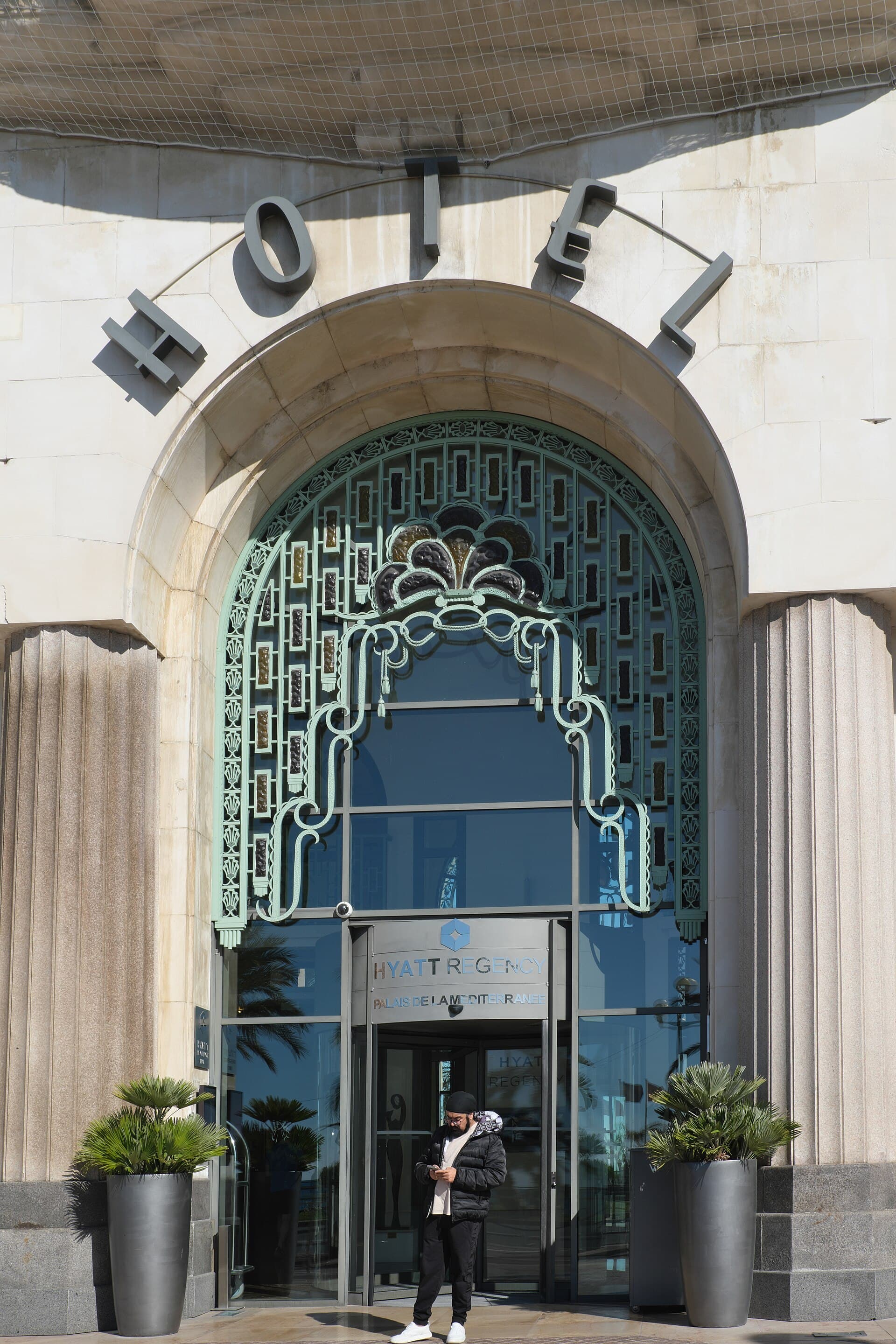
The facade on the Promenade des Anglais is a stage set, and knowingly so. Charles Dalmas and his son Marcel designed it in 1929 for the American heir Frank Jay Gould, who had already built Juan-les-Pins, as the front of the Palais de la Méditerranée, a casino with a theatre and restaurants that was the most lavish on the Riviera. The Hyatt Regency Nice Palais de la Méditerranée stands behind it: a hotel built in 2004 inside a new structure, with the Dalmas facade kept standing on its own through the works.
History
The Palais de la Méditerranée opened in January 1929 and had a short glory. Gould's casino competed with the municipal casino on the Jetée-Promenade, drew the winter colony of the late 1920s and 1930s, then declined after the war. The disappearance in 1977 of Agnès Le Roux, heiress to the casino, and the long legal affair that followed made its name notorious in France. The building closed in 1978 and stood empty; demolition began in 1990, but the two Art Deco facades, on the Promenade and on rue du Congrès, had been listed as historic monuments in 1989 and were preserved while everything behind them came down.
A new building rose behind the facades in the early 2000s, and the Palais de la Méditerranée reopened in January 2004 as a hotel with a casino, run by Concorde Hotels. Hyatt took over management in 2013 and gave it its present name.
Architecture and design
The surviving facade is the finest Art Deco elevation in Nice: a tall white front with a central arch, giant pilasters, a frieze of bas-reliefs showing horses and figures by the sculptor Antoine Sartorio, and a strong vertical rhythm along the Promenade. The 2004 building behind it is a conventional hotel block in plan, organised around a third-floor terrace on the sea side that carries the pool and a sun deck above the traffic of the Promenade. Rooms are contemporary in finish, with the facade's geometry quoted in the public spaces.
Rooms and suites
The hotel has 187 rooms and suites, with sea-view rooms on the Promenade side and city-view rooms at the back. The suites on the upper floors have terraces facing the Baie des Anges.
Dining
Le 3e, the restaurant and bar on the third-floor terrace, serves Mediterranean cooking with the pool and the bay in front of it, inside in winter and on the terrace from spring. The casino on the ground floor has its own restaurant and bar.
Wellness
The pool on the third-floor terrace is heated and partly covered, so it can be used across the seasons, with a fitness room and a small spa with treatment rooms beside it.
Weddings and events
Meeting rooms on the lower floors serve conferences, and the terrace around the pool is used for receptions and wedding cocktails facing the sea. Capacities per room are not in our source material.
Location
Number 13 Promenade des Anglais is at the city end of the seafront, with place Masséna and the old town ten minutes on foot and the beach across the road. Nice-Côte d'Azur airport is 6 kilometres west along the Promenade, around 20 minutes by car or tram; Nice-Ville station is a twenty-minute walk north. For a luxury hotel in Nice it is the one whose history is written on its front.
At a glance
What sets it apart
- 01Art Deco facade of 1929 by Charles and Marcel Dalmas, listed 1989
- 02Built for Frank Jay Gould as a casino; hotel since 2004
- 03187 rooms and suites, 13 Promenade des Anglais
- 04Heated pool on a third-floor terrace facing the Baie des Anges
- 05Casino on the ground floor, Hyatt since 2013
Chronology
Dates that matter
1929
The Palais de la Méditerranée casino opens in January, built for Frank Jay Gould.
1978
The casino closes and the building is abandoned.
1989
The two Art Deco facades are listed as historic monuments.
1990
Demolition begins behind the preserved facades.
2004
The Palais de la Méditerranée reopens in January as a hotel and casino.
2013
Hyatt takes over and renames it Hyatt Regency Nice Palais de la Méditerranée.