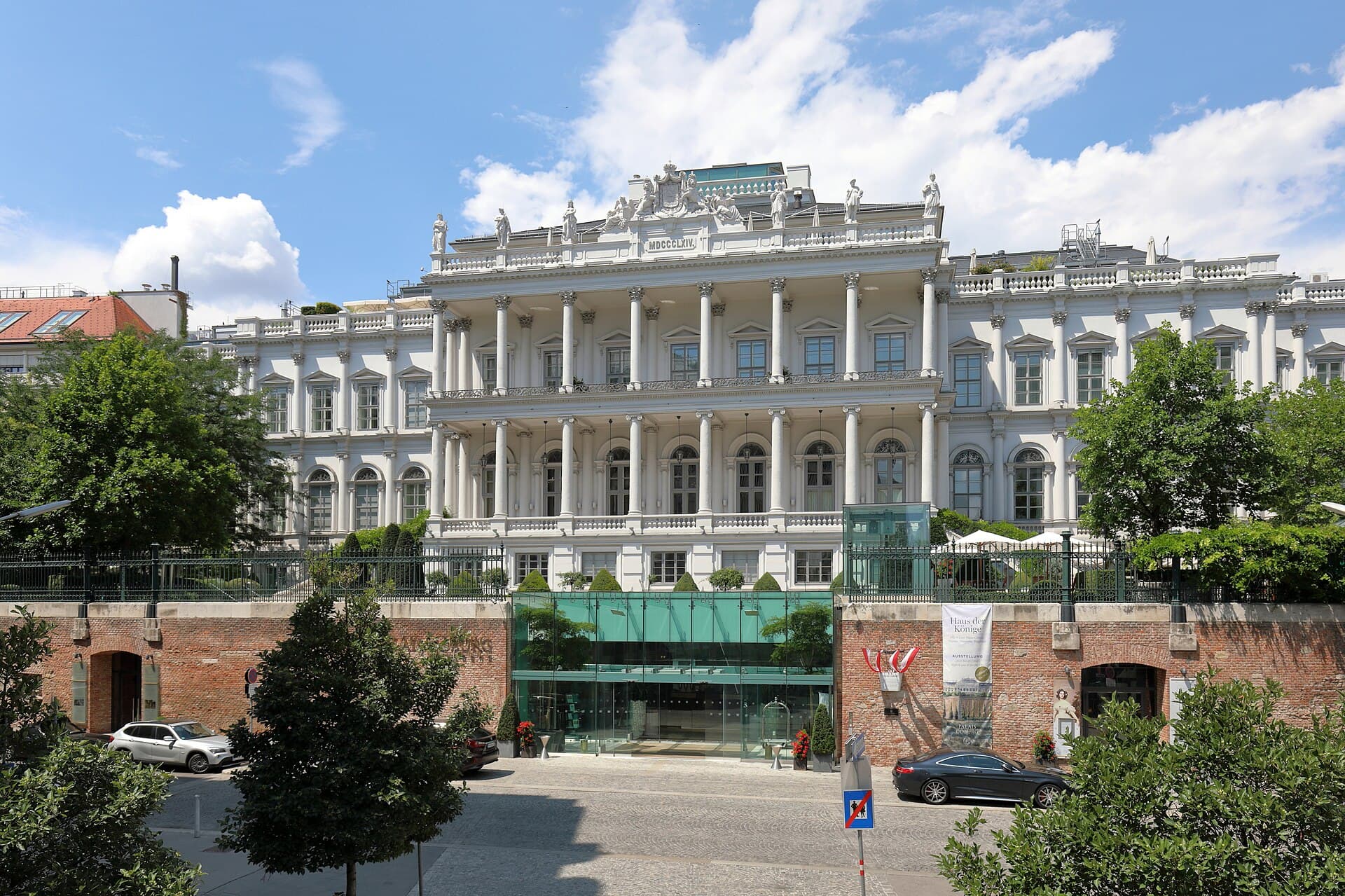

A long row of columns on a raised brick wall looks over the Ringstrasse towards the Stadtpark, and few passers-by realise the wall is a piece of the old city fortifications. The Palais Coburg in Vienna was built on it in the 1840s as a princely residence, and since 2003 it has been a hotel of suites, with the vaulted casemates of the bastion restored beneath it.
History
Prince Ferdinand of Saxe-Coburg and Gotha, a general in Austrian service, commissioned the palace and saw it finished in 1845. His marriage to the Hungarian heiress Maria Antonia Koháry had brought him vast estates, and his branch of the family took the name Saxe-Coburg-Koháry. The site he chose was the Braunbastei, one of the bastions of the ring of walls that still enclosed the inner city.
Few families of the century married so well. Ferdinand's brother Leopold became the first King of the Belgians in 1831. Ferdinand's eldest son, another Ferdinand, married Queen Maria II of Portugal and reigned beside her as king. A grandson, also called Ferdinand, was elected Prince of Bulgaria in 1887 and later took the title of tsar.
In December 1857 Emperor Franz Joseph ordered the city walls demolished to make room for the Ringstrasse. The Coburg bastion was one of the few sections spared, which is why the palace still stands well above the pavement. The family kept the house for more than a century. Around the turn of the millennium it was acquired by a private foundation of the Austrian investor Peter Pühringer, which restored the building over several years and opened it as a hotel in 2003.
Architecture and design
The street front is restrained classicism: a long colonnade lifted on the bastion wall, with little ornament beyond the columns themselves. Viennese humour named the house the Spargelburg, the asparagus castle, after those slender shafts. The restoration brought back the state rooms of the piano nobile, with their parquet floors, stucco ceilings and chandeliers, and it opened up the casemates below. These brick vaults belong to the sixteenth-century fortifications built after the Ottoman siege of 1529, and they had been filled in and forgotten for generations.
Rooms and suites
There are no standard rooms. Every unit is a suite, and the count is small for a building of this bulk, so most are generous in floor area. Some keep the high ceilings and tall windows of the palace floors; others sit higher up with views over the rooftops of the Innere Stadt. The decoration leans on the palace's own period without turning the suites into a museum.
Dining
Wine is the house's obsession. The cellars, partly laid out in the old casemates, hold one of the largest private collections in Austria, with long vertical runs of Bordeaux and Sauternes and bottles reaching back to the eighteenth century. The palace has a gourmet restaurant with tasting menus built to show off that list, and a lighter restaurant, Clementine, set in a glasshouse on the garden side. Tastings are held in the vaults.
Wellness
The spa has an indoor pool, saunas, treatment rooms and a gym, an unusual provision for a palace inside the Ring.
Weddings and events
The state rooms of the piano nobile are let for banquets, balls and receptions, and the casemates serve for dinners and wine events among bare brick vaults. The palace hosts weddings and conferences, and its raised, enclosed position has made it a regular venue for international meetings that need discretion and controlled access.
Location
The address is the Coburgbastei in the first district, between the Ringstrasse and the Seilerstätte. Stubentor on the U3 is the nearest underground station. Wien Mitte, terminus of the City Airport Train from Vienna International Airport, lies just across the Stadtpark, and the Stephansdom, the Musikverein and the State Opera are all reachable on foot. As a luxury hotel in Vienna it is unusual for being central yet set apart, above the traffic on its own stretch of wall.
At a glance
What sets it apart
- 01Completed in 1845 for Prince Ferdinand of Saxe-Coburg and Gotha
- 02Stands on the Braunbastei, a surviving part of the city fortifications
- 03Sixteenth-century casemates restored and used for dinners and tastings
- 04Accommodation entirely in suites
- 05Wine cellars with old Bordeaux and Sauternes vintages
Chronology
Dates that matter
1840
Building begins on the Braunbastei for Prince Ferdinand of Saxe-Coburg and Gotha.
1845
The palace is completed.
1857
Emperor Franz Joseph orders the city walls razed for the Ringstrasse; the Coburg bastion is spared.
2003
The palace opens as a hotel after a restoration financed by the Pühringer foundation.