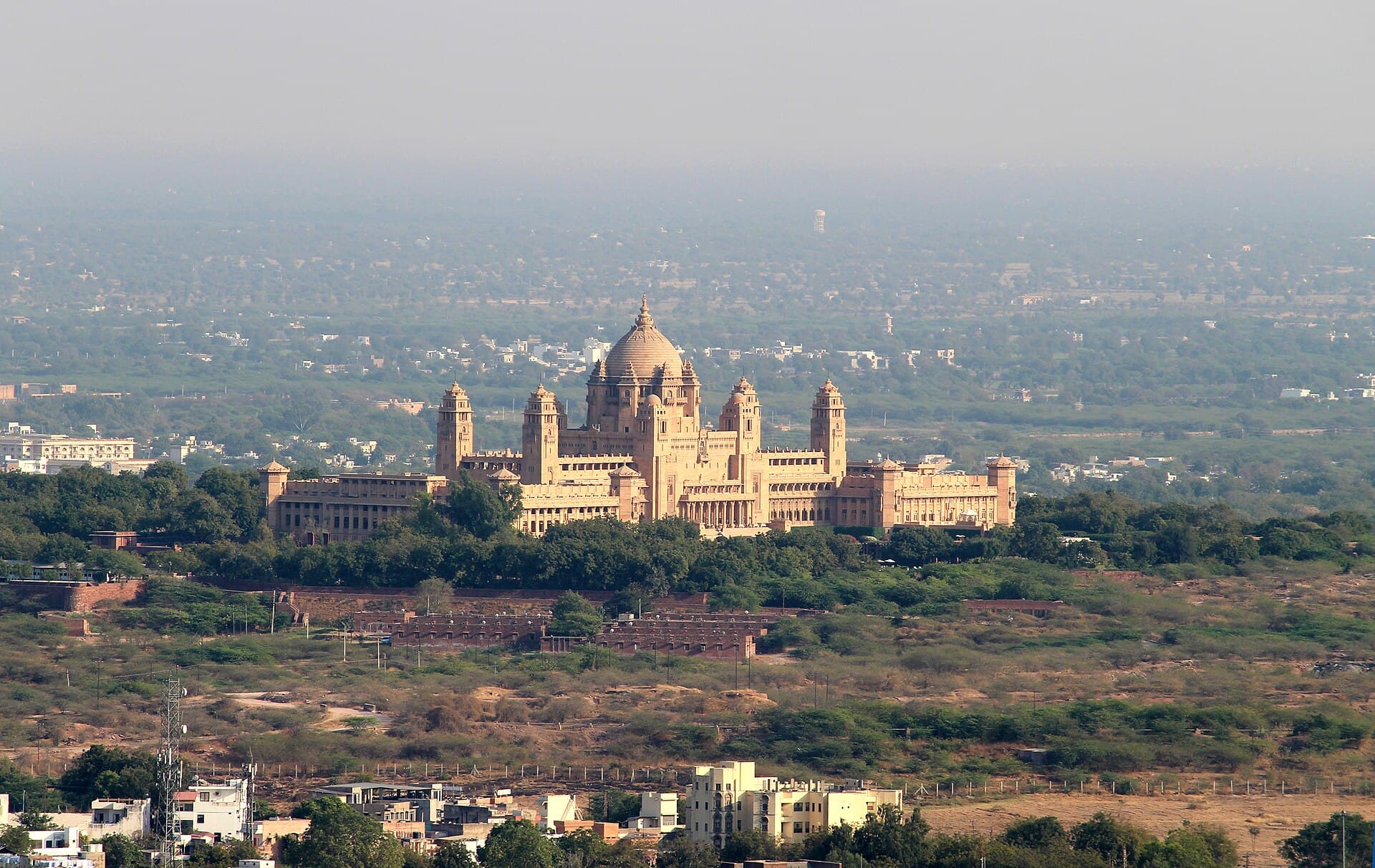

The drive from Jodhpur airport ends at a gate on Chittar Hill, and above it rises a building of golden sandstone with a central dome 105 feet high, more Lutyens' Delhi than Rajput fort. Umaid Bhawan Palace was the last of the great palaces built in India, and it is still three things at once: the home of the Maharaja of Jodhpur, a museum, and a hotel of 64 rooms run by the Taj group.
History
In the late 1920s Marwar suffered a run of failed monsoons, and Maharaja Umaid Singh commissioned a new palace in 1928 as a public work to employ his subjects. Some three thousand people worked on it for 15 years. The architect was Henry Vaughan Lanchester, an Englishman who had worked alongside Lutyens on the plans for New Delhi. The palace was completed in 1943, with 347 rooms, a throne room, a ballroom, a cinema and an indoor pool. Umaid Singh died four years later. His grandson Maharaja Gaj Singh II opened part of the palace as a hotel in 1972, and in 2005 the Taj group took over its management and restored it. The royal family occupies a private wing.
Architecture and design
Lanchester built in the Beaux-Arts manner with Indian motifs, in dune-coloured Chittar sandstone cut on the hill itself and fitted without mortar by an interlocking system. The plan is symmetrical around the great central rotunda, whose dome rises over a double-height hall of marble and balustrades. The interiors are Art Deco, an unusual thing in a Rajput palace: the furniture and fittings ordered from England were lost at sea during the war, so the Polish artist Stefan Norblin, a refugee in India, designed the replacements and painted the murals of the Ramayana in the state rooms. The palace faces 26 acres of garden, with a lawn, a pool and peacocks.
Rooms and suites
The hotel's 64 rooms and suites are in the wings once used by guests of the court, restored with the Art Deco furniture of the period. The Historical Suites have period fittings and garden views; the Royal Suites are larger, with sitting rooms and terraces. The two grandest are the Maharaja Suite and the Maharani Suite, each with its own Norblin murals and private terrace, the Maharani Suite with a bathroom carved from a single block of pink marble.
Dining
Risala is the fine-dining restaurant, with Indian and European dishes in a room of hunting trophies and cavalry regalia named after the Jodhpur Lancers. Pillars is the all-day terrace restaurant in the colonnade facing the lawn. The Trophy Bar serves whiskies and cigars beneath the heads of the Maharaja's hunts, and dinners are set in the gardens and on the Baradari lawn.
Wellness
The Jiva Grande Spa occupies rooms in the palace with Indian treatments, a hammam and a fitness centre. There are two pools: the outdoor one in the gardens and the original indoor pool of 1943, lined with zodiac mosaics, which the hotel kept. Guests may play squash, tennis and croquet, and visit the palace museum.
Weddings and events
Umaid Bhawan is the wedding palace of India in the public mind, the venue of the celebrity weddings that have brought it most of its fame in recent years, and the Taj runs weddings as its main business here. The Baradari lawn and the gardens take receptions of several hundred; the Marwar Hall, the former ballroom, and the throne room are used for dinners and ceremonies, and the palace is let on buyout for the biggest events. Meetings are a secondary line, with a boardroom and the state rooms available for small conferences and incentive groups.
Location
The palace crowns Chittar Hill on the eastern edge of Jodhpur, with Mehrangarh Fort visible across the old city. Jodhpur Airport is about four kilometres away, a ten-minute drive, and Jodhpur Junction railway station is five kilometres. The clock tower and the Sardar Market of the blue city are 15 minutes by car. Of the luxury hotels in Jodhpur, this is the one in which the owner still lives upstairs.
At a glance
What sets it apart
- 01Built 1928 to 1943 as famine relief, designed by Henry Vaughan Lanchester
- 02Central dome 105 feet high in dune-coloured Chittar sandstone
- 03Art Deco interiors and murals by Stefan Norblin
- 0464 hotel rooms out of 347; the Maharaja lives in a private wing
- 05Original 1943 indoor pool with zodiac mosaics
Chronology
Dates that matter
1928
Maharaja Umaid Singh lays the foundation of the palace as a famine-relief project.
1943
The palace is completed with 347 rooms after 15 years of work.
1947
Umaid Singh dies; his son Hanwant Singh succeeds him.
1972
Maharaja Gaj Singh II opens part of the palace as a hotel.
2005
The Taj group takes over management of the hotel and restores it.