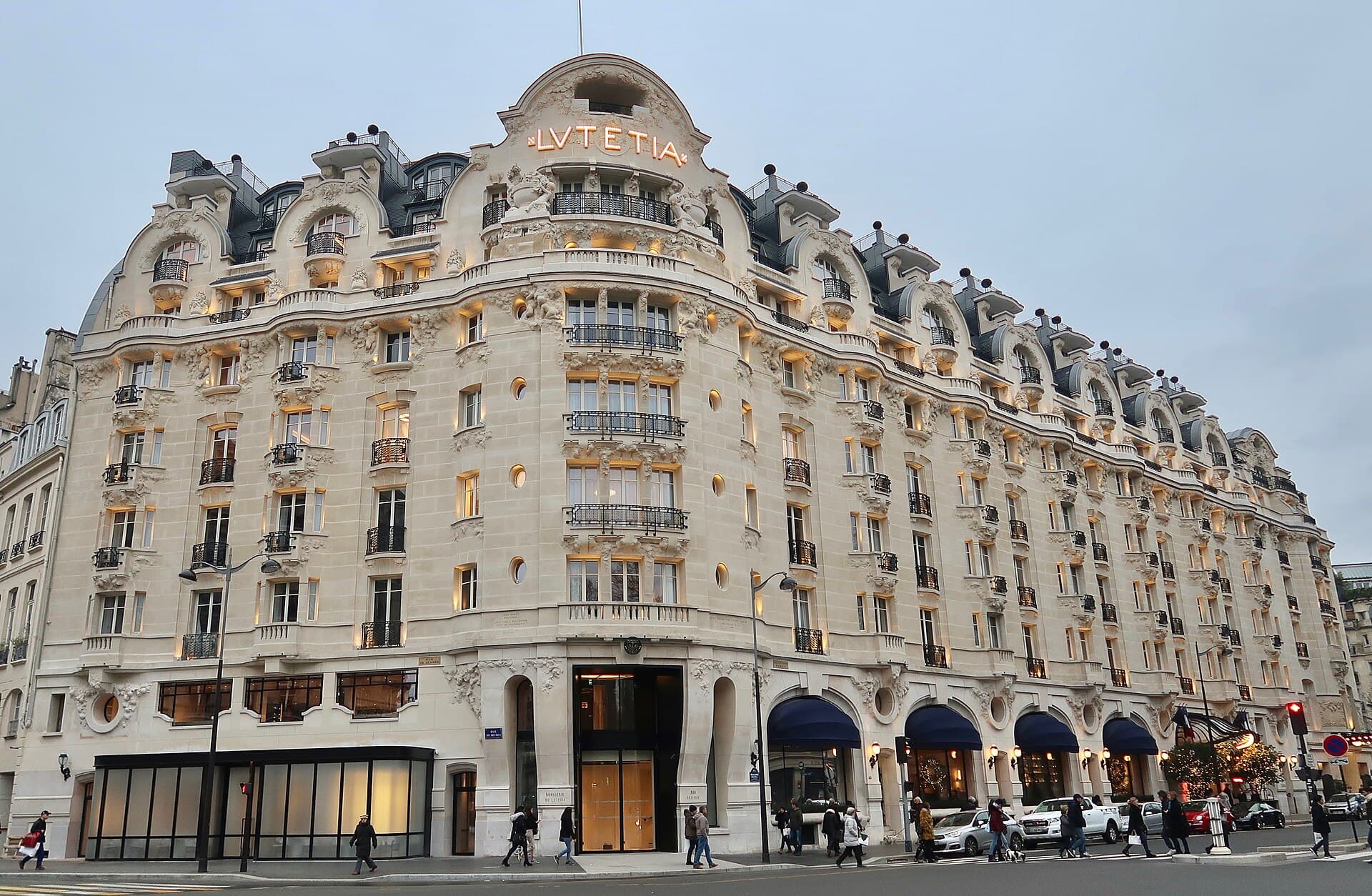

At 45 boulevard Raspail, in Saint-Germain-des-Prés, Hôtel Lutetia is the only grand hotel of this rank on the Left Bank of Paris. The owners of the Bon Marché department store opened the luxury hotel in 1910; it served as the Abwehr headquarters during the occupation and, in 1945, as the reception centre for deportees returning from the camps. A four-year restoration led by Jean-Michel Wilmotte ended with its reopening in 2018, and it is now managed by Mandarin Oriental.
History
The Lutetia was built by the Bon Marché, the department store founded by Aristide and Marguerite Boucicaut, to lodge the provincial and foreign customers who travelled to Paris to shop there. It opened at the end of 1910 and took the Roman name of Paris. In the 1920s and 1930s it became a meeting point for writers and artists: James Joyce worked on Ulysses while living there, and Charles de Gaulle and Yvonne Vendroux spent their wedding night at the hotel in April 1921.
In June 1940 the Abwehr, the German military intelligence service, requisitioned the hotel as its Paris headquarters. From April 1945 the Lutetia was the main reception centre for survivors of the concentration camps returning to France; families gathered in the lobby with photographs, looking for relatives. A plaque on the facade commemorates this period, and a ceremony is held there each year.
The hotel was bought in 2010 by the Alrov group, closed in 2014 and reopened in July 2018 after four years of work that touched every floor of the building.
Architecture and design
The architects Louis-Charles Boileau and Henri Tauzin designed a building at the junction of Art Nouveau and Art Deco, with a facade of sculpted vines and clusters of grapes by Léon Binet and Paul Belmondo, the father of the actor Jean-Paul Belmondo. The facade and roofs are protected as a historic monument.
The restoration led by Jean-Michel Wilmotte uncovered a 1910 fresco by Adrien Karbowsky hidden under layers of paint in the former bar, now Le Saint-Germain, and opened a glass roof above it. The ceiling of Bar Joséphine was painted by the artist Fabrice Hyber. The rest of the interior is pale and restrained, with oak, marble and brass, so that the surviving 1910 details stand out.
Rooms and suites
The hotel has 184 rooms and suites, 47 of them suites, fewer than before the closure, which allowed larger rooms with higher ceilings. The top-floor suites have terraces with views over the rooftops to the Eiffel Tower. Rooms facing the boulevard look on to the trees of the central reservation; those on the courtyard are the quietest.
Dining
Brasserie Lutetia serves seafood and classic French dishes and was opened at the reopening under the direction of the Marseille chef Gérald Passedat. Bar Joséphine is named after Joséphine Baker, a regular guest between the wars. Le Saint-Germain, under the glass roof, serves breakfast, lunch and afternoon tea, and Bar Aristide, named after Aristide Boucicaut, is a small bar for cigars and spirits.
Wellness
The Akasha spa, on the lower level, includes a 17-metre swimming pool, a hammam, a sauna, treatment rooms and a fitness room, a rare combination for a hotel in the sixth arrondissement.
Weddings and events
The Lutetia hosts weddings, receptions, seminars and private dinners in a series of salons on the first floor, with the ground-floor bars and Le Saint-Germain available for cocktails and launches.
Location
The hotel stands at the corner of boulevard Raspail and rue de Sèvres, opposite the Bon Marché and the Square Boucicaut. Sèvres-Babylone station on metro lines 10 and 12 is at the door; the Jardin du Luxembourg is ten minutes on foot and the Musée d'Orsay fifteen. By car, Paris-Orly airport is about 35 minutes away.
At a glance
What sets it apart
- 01Opened in 1910, built by the Bon Marché for its visiting customers
- 02Facade sculptures by Léon Binet and Paul Belmondo
- 03Reception centre for returning deportees from April 1945
- 04Closed 2014 to 2018 for a restoration led by Jean-Michel Wilmotte
- 05184 rooms and suites, 47 of them suites
Chronology
Dates that matter
1910
The Lutetia opens on boulevard Raspail, built by the Bon Marché.
1921
Charles de Gaulle and Yvonne Vendroux spend their wedding night at the hotel.
1940
The Abwehr requisitions the hotel as its Paris headquarters.
1945
The hotel becomes the reception centre for deportees returning from the camps.
2014
The hotel closes for a complete restoration.
2018
The Lutetia reopens in July after four years of work.