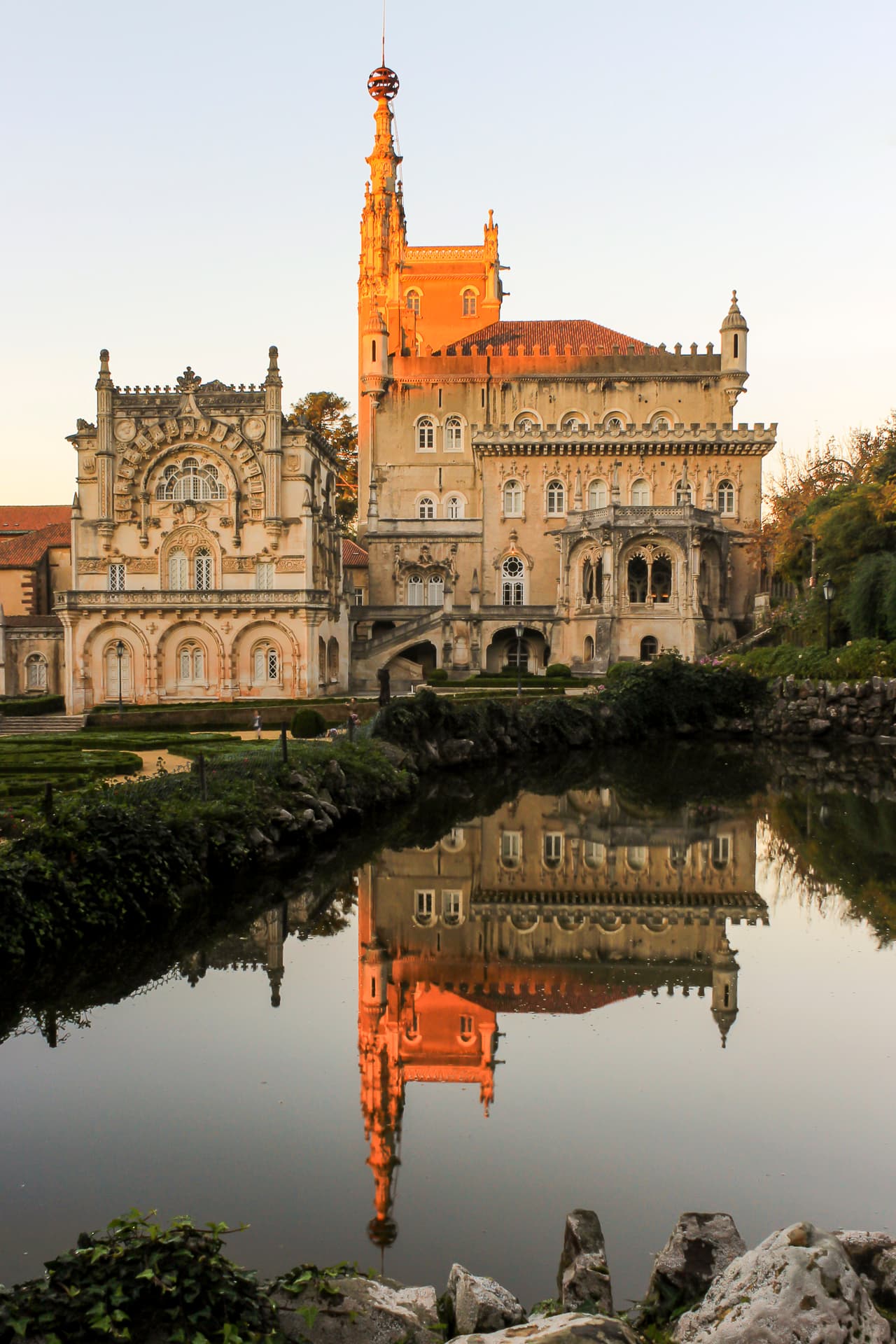
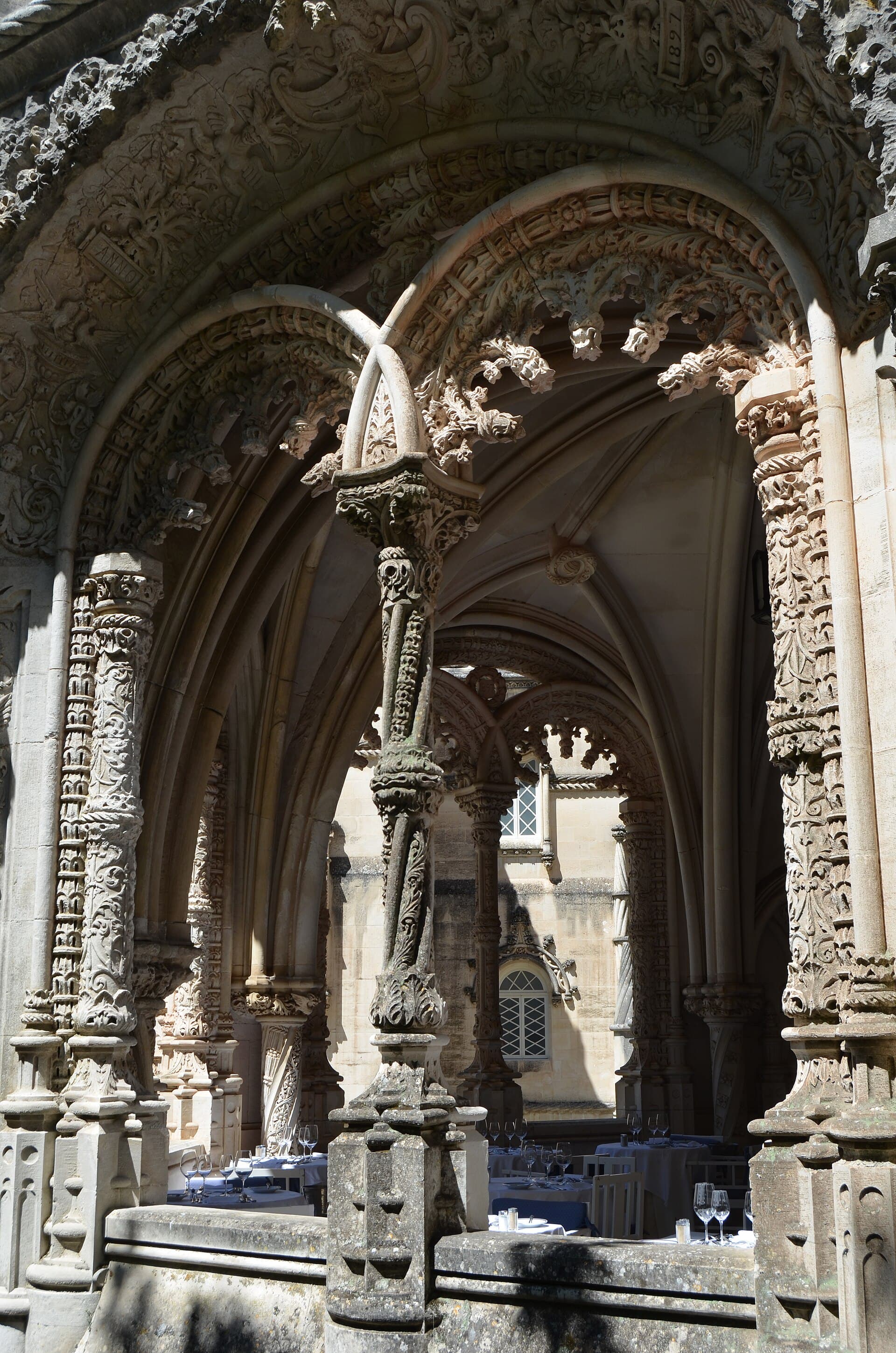
A wall nearly six kilometres long surrounds the forest of Bussaco, planted and tended by Carmelite monks from the 1620s and protected since then by a papal bull that forbade the cutting of its trees. In the middle of it, beside the ruins of the monastery, stands a building of carved limestone, turrets and twisted columns that looks older than it is. The Palace Hotel do Bussaco, in Luso, Portugal, was begun in 1888 and was still unfinished when the monarchy fell.
History
King Luís I approved the project as a royal hunting lodge, and his son Carlos I saw most of it built. The architect was Luigi Manini, an Italian who had come to Lisbon as a set designer for the São Carlos opera house and who also designed the Quinta da Regaleira at Sintra. Work ran from 1888 to 1907 under Manini and then Portuguese architects, with the master craftsmen of the day: stone carvers from Coimbra and the tile painter Jorge Colaço, whose azulejo panels of scenes from Camões's Lusíadas and from the Peninsular War line the loggia and the stair.
Carlos I was assassinated in Lisbon in 1908. His son Manuel II used the palace briefly, and legend attaches his last night in Portugal before exile in 1910 to its rooms. The Republic had no use for a royal lodge in a forest, and in 1917 the building opened as a hotel under Alexandre de Almeida, whose family company, Hotéis Alexandre de Almeida, runs it to this day. The hotel has made and bottled its own Bussaco wines, red and white, from the same year.
Architecture and design
Manini's style is called neo-Manueline: a revival of the ornamented late-Gothic of the age of Vasco da Gama, with armillary spheres, knotted ropes carved in stone, trefoil arches and a tower modelled on the Tower of Belém. The outside is pale Ançã limestone. The arcaded loggia along the garden front and the grand staircase carry Colaço's blue-and-white tile panels; the ceilings of the state rooms are painted and coffered, and the dining room has carved wooden panelling and stained glass. The formal gardens in front, with box parterres and a fountain, run out into the forest paths.
Rooms and suites
Around 60 rooms and suites occupy the upper floors, many with the original furniture and all with views either of the gardens or of the forest canopy. The royal suites on the first floor are the largest, with high ceilings and balconies; rooms on the upper floors are smaller and sit under the turrets.
Dining
The dining room is the palace's original state dining hall, and the kitchen serves Portuguese cooking built on Bairrada produce: suckling pig from the Mealhada road, river fish and game from the forest in season. The Bussaco wines are poured only here, from a cellar that holds vintages back to the 1940s. A bar and a terrace on the loggia take drinks in summer.
Weddings and events
The state rooms, the loggia and the gardens are used for weddings, which the hotel has hosted for decades, and the dining hall seats formal banquets. Meetings and small conferences use the salons on the ground floor. Capacities are confirmed by the hotel for each room and arrangement.
Location
The hotel stands inside the Mata Nacional do Buçaco, above the spa village of Luso in the municipality of Mealhada, about 30 kilometres north of Coimbra and 100 kilometres south of Porto. Wellington's army fought the Battle of Bussaco on the ridge above the forest in September 1810, and the military museum is a short drive. Porto Airport is about an hour and a half by motorway; Coimbra has the nearest main-line railway station. A luxury hotel in Luso is an odd phrase, but the palace has been one since the Republic put the king's lodge to work.
At a glance
What sets it apart
- 01Built 1888 to 1907 as a hunting palace for King Carlos I, design by Luigi Manini
- 02Neo-Manueline carved limestone, tower modelled on the Tower of Belém
- 03Azulejo panels by Jorge Colaço on the loggia and staircase
- 04Own Bussaco wines made by the hotel since 1917
- 05Inside the walled Bussaco forest, planted by Carmelites in the 1620s
Chronology
Dates that matter
1810
Wellington's army defeats Masséna at the Battle of Bussaco on the ridge above the forest.
1888
Work begins on the royal hunting palace to designs by Luigi Manini.
1907
The palace is completed for King Carlos I, a year before his assassination.
1917
The building opens as a hotel under Alexandre de Almeida and begins bottling its own wine.