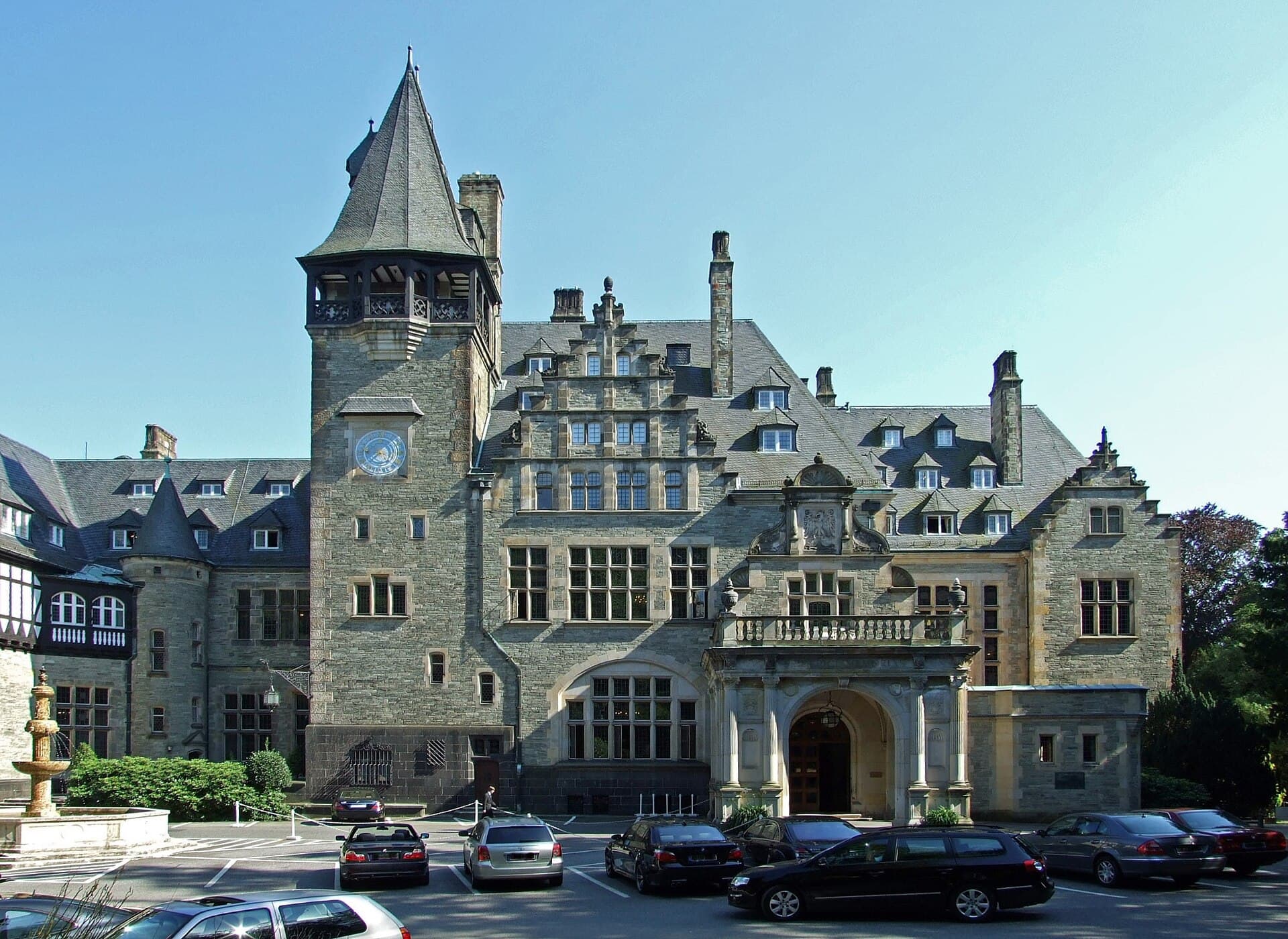
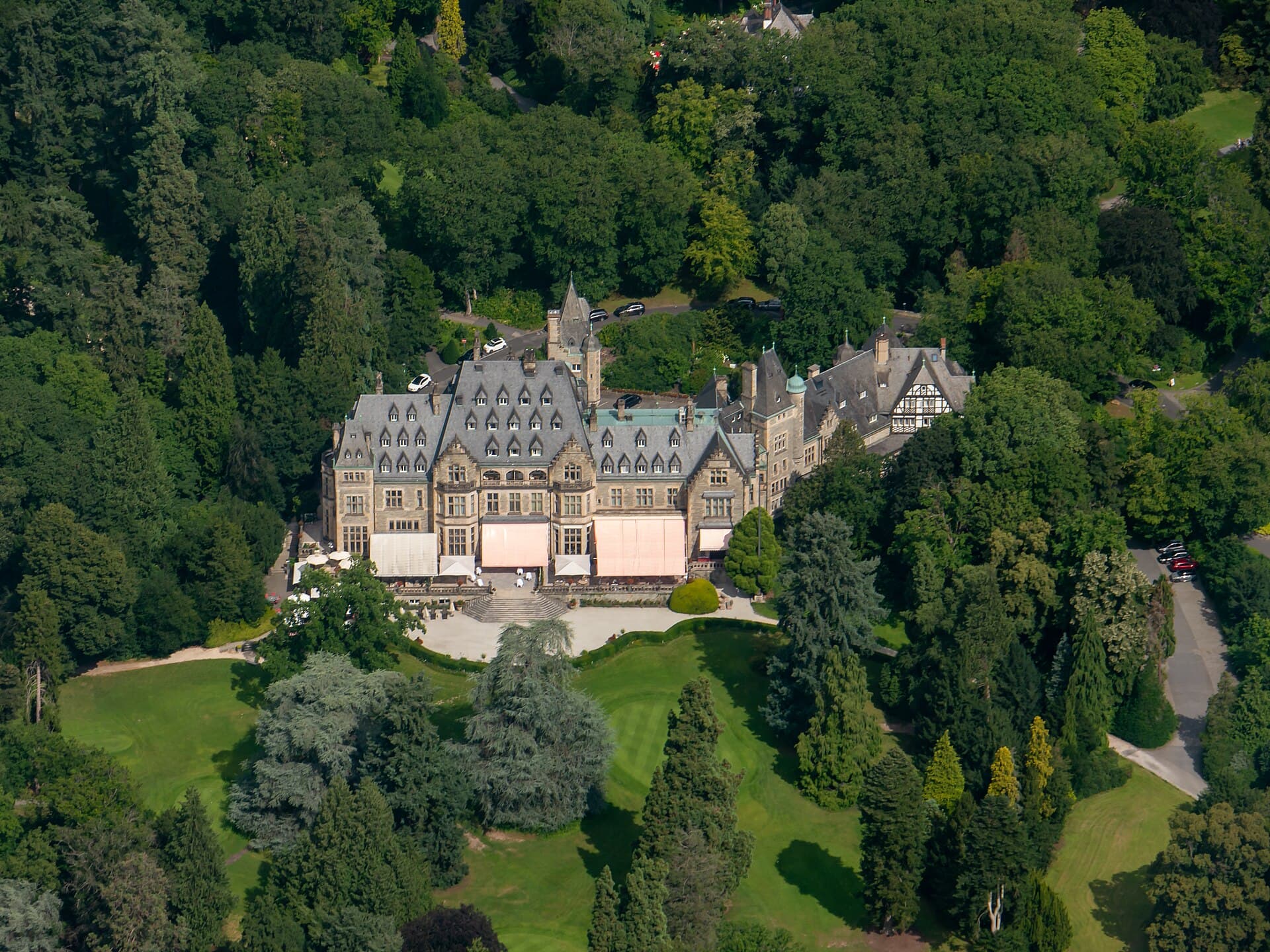
On the wooded slopes above Frankfurt, in Kronberg im Taunus, Empress Frederick, the eldest daughter of Queen Victoria, built the castle that is now Schlosshotel Kronberg as her widow's residence. It is one of the few hotels in Germany where the furniture, paintings and library of an imperial household remain in the rooms where they were placed.
History
Victoria, Princess Royal of Great Britain, married the Prussian crown prince Frederick in 1858. He reigned as German Emperor Frederick III for only 99 days in 1888 before dying of throat cancer. His widow, who took the name Empress Frederick, bought land at Kronberg and had a castle built there between 1889 and 1893, naming it Schloss Friedrichshof in his memory. The architect was Ernst von Ihne, who later designed the Bode Museum and the State Library in Berlin. The empress filled the house with her collections and her library and received her mother's relatives there, including her brother, the future Edward VII. She died at Friedrichshof in August 1901, seven months after Queen Victoria.
The castle passed to her youngest daughter Margarethe, Landgravine of Hesse, and remained a family home until 1945, when the United States Army requisitioned it as an officers' club. In that period the family jewels, hidden in the cellar, were stolen by American officers in a case that ended in courts martial. The House of Hesse recovered the property and in 1954 opened it as a hotel, a use it has kept since. The castle is a protected Kulturdenkmal and is still owned by the Hessian House Foundation.
Architecture and design
Von Ihne designed Friedrichshof in a Tudor Revival manner at the empress's request, recalling the English country houses of her childhood: half-timbered gables, tall chimneys, mullioned windows and a long facade of local sandstone set against the Taunus hills. Inside, the panelled hall, the library with its thousands of volumes, the drawing rooms and the dining room keep the empress's furniture, portraits and porcelain. Rather than a decorated hotel, it reads as a lived-in aristocratic house that happens to take guests.
Rooms and suites
The rooms and suites are spread across the historic floors of the castle and differ in shape and size, as the plan of a private house dictates. Several suites bear the names of members of the imperial and Hessian families and retain original pieces.
Dining
The hotel's restaurant serves a classic cuisine in the former dining rooms, and the terrace facing the park is used in fine weather. Afternoon tea in the library follows the English habit the empress brought from Windsor.
Weddings and events
The castle and its 25-hectare park are a regular setting for weddings, with ceremonies in the grounds and dinners in the historic salons, as well as for board meetings and discreet corporate retreats close to Frankfurt. The park contains a golf course run by the Kronberg golf club.
Location
Schlosshotel Kronberg is at Hainstrasse 25 in Kronberg im Taunus, about 15 kilometres north-west of Frankfurt am Main. The drive from Frankfurt Airport takes roughly 25 minutes, and the S-Bahn from Kronberg station reaches Frankfurt Hauptbahnhof in about half an hour. For a luxury hotel near Frankfurt with a genuine royal history, it stands alone.
At a glance
What sets it apart
- 01Built 1889 to 1893 as Schloss Friedrichshof for Empress Frederick, Victoria's daughter
- 02Tudor Revival design by Ernst von Ihne, architect of Berlin's Bode Museum
- 03Original imperial furniture, portraits and library still in place
- 04Owned by the House of Hesse, a hotel since 1954
- 0525-hectare park with a golf course
Chronology
Dates that matter
1888
Emperor Frederick III dies after a reign of 99 days.
1889
Construction of Schloss Friedrichshof begins at Kronberg.
1893
The castle is completed and Empress Frederick moves in.
1901
Empress Frederick dies at Friedrichshof.
1945
The US Army requisitions the castle as an officers' club; the Hesse jewels are stolen.
1954
The House of Hesse opens the castle as Schlosshotel Kronberg.