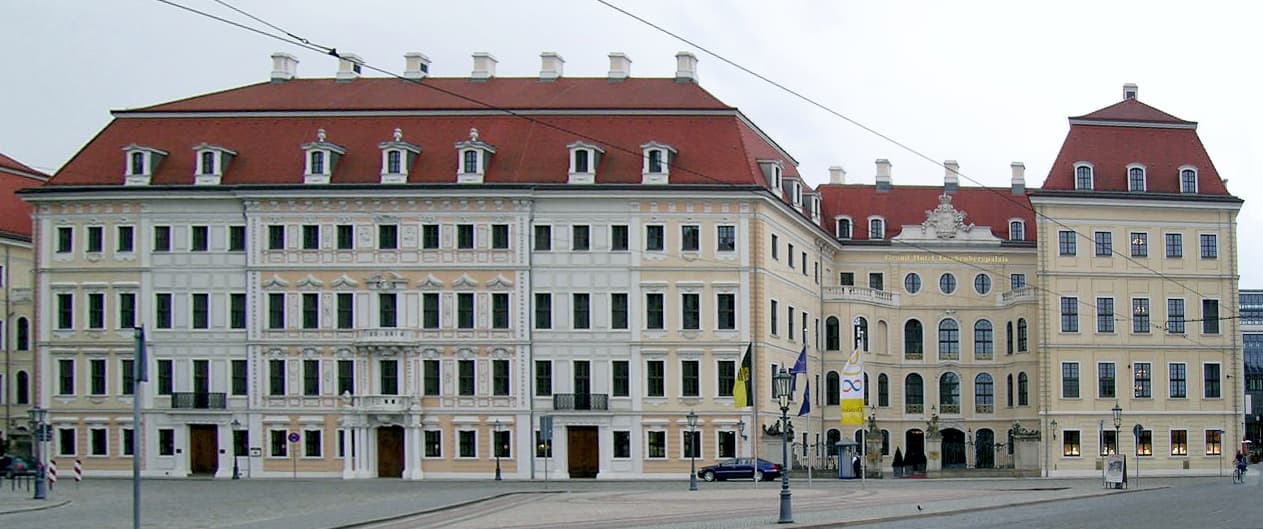
Between the Zwinger and the Residenzschloss in the old town of Dresden, a few steps from the Semperoper, stands the Hotel Taschenbergpalais Kempinski, the city's Baroque palace hotel. No other hotel in the city is housed in a royal building, and its history of destruction and rebuilding mirrors that of Dresden itself.
History
Augustus the Strong, Elector of Saxony and King of Poland, had the palace built between 1705 and 1708 for Anna Constantia von Brockdorff, Countess Cosel, his most famous mistress. His court architect Matthäus Daniel Pöppelmann, who went on to design the Zwinger next door, was responsible for the building. After the countess fell from favour the palace passed to the crown princes of Saxony and was known for two centuries as the Kronprinzenpalais, enlarged several times to connect it to the royal residence.
The Allied bombing of 13 and 14 February 1945 gutted the building. The walls stood as a ruin through the entire period of the German Democratic Republic, the roofless shell a familiar sight beside the Zwinger. After reunification the palace was rebuilt between 1992 and 1995 according to its historic exterior, and it opened as a Kempinski hotel in 1995, one of the first luxury hotels in the reunited east of Germany. For Dresden the reopening was a symbol: the palace returned a decade before the Frauenkirche, consecrated again in 2005, and the two reconstructions are often cited together.
Architecture and design
The exterior is Dresden Baroque restored to Pöppelmann's elevations: sandstone facades, a mansard roof and sculpted window surrounds facing the Taschenberg and the Sophienstrasse. The interior was built new within the historic envelope, with a grand staircase, high-ceilinged public rooms and a glazed inner courtyard. In winter that courtyard is flooded and frozen to form an ice rink, a Dresden tradition since the hotel's early years. The building is a listed monument in Saxony.
Rooms and suites
Rooms and suites are laid out around the courtyard and along the street fronts, with the largest suites on the upper floors facing the Zwinger. Interiors are classic in style, with high ceilings on the principal floors.
Dining
The hotel has four dining venues, including a restaurant serving Saxon and international dishes, a bar and a courtyard terrace used in summer. The Karl May Bar, named after the Saxon adventure novelist, is the house bar.
Wellness
The spa occupies the lower levels with a swimming pool, saunas and treatment rooms, a rarity among hotels in the old town of Dresden.
Weddings and events
The hotel has six event rooms, from a ballroom for gala dinners and weddings to smaller salons for board meetings and seminars. Weddings benefit from the palace setting and the proximity of the Hofkirche and the Frauenkirche for ceremonies. In winter the courtyard ice rink is used for private events.
Location
The palace is at Taschenberg 3 in the old town, between the Zwinger, the Residenzschloss and the Semperoper, with the Frauenkirche and the Brühlsche Terrasse above the Elbe a few minutes away on foot. Dresden Hauptbahnhof takes about 20 minutes on foot, or a short tram ride. Allow roughly 25 minutes by car or S-Bahn for Dresden Airport. For a luxury hotel in Dresden this is the most historic address available.
At a glance
What sets it apart
- 01Built 1705 to 1708 by Pöppelmann for Augustus the Strong and Countess Cosel
- 02Residence of the Saxon crown princes, the Kronprinzenpalais, until 1918
- 03Gutted in the bombing of February 1945, a ruin until 1992
- 04Rebuilt 1992 to 1995 and opened as a Kempinski hotel in 1995
- 05Inner courtyard frozen into an ice rink each winter
Chronology
Dates that matter
1705
Construction begins for Countess Cosel under Pöppelmann.
1708
The palace is completed.
1945
The bombing of 13 and 14 February leaves the palace a ruin.
1992
Reconstruction of the ruin begins.
1995
The Hotel Taschenbergpalais Kempinski opens.